Ch.10 - Gases: Their Properties & Behavior
McMurry - Chemistry 8th Edition
McMurry8th EditionChemistryISBN: 9781292336145당신이 사용하는 게 아니라요?교과서 변경
10장, 문제 26a

Assume that you have a sample of gas in a cylinder with a movable piston, as shown in the following drawing:
Illustration of a gas cylinder with a movable piston, showing gas particles at increased temperature.
Redraw the apparatus to show what the sample will look like after (a) the temperature is increased from 300 K to 450 K at constant pressure

검증된 단계별 안내
1
Identify the initial conditions: The gas is at 300 K and constant pressure.
Recognize that increasing the temperature of the gas from 300 K to 450 K will increase the kinetic energy of the gas particles.
Apply the ideal gas law (PV = nRT) to understand that at constant pressure, the volume of the gas is directly proportional to its temperature (V ∝ T).
Since the temperature increases from 300 K to 450 K, the volume of the gas will also increase proportionally.
Redraw the apparatus with the piston moved upwards to show an increased volume of gas, while keeping the number of gas particles and the pressure constant.

비슷한 문제에 대한 검증된 영상 답변:

이 영상 해법은 위 문제에 도움이 된다고 튜터들이 추천한 것입니다.
영상 길이:
1m

주요 개념

질문에 올바르게 답하기 위해 반드시 이해해야 하는 핵심 개념들은 다음과 같습니다.

Ideal Gas Law

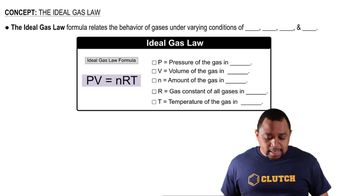
The Ideal Gas Law is a fundamental equation in chemistry that relates the pressure, volume, temperature, and number of moles of a gas. It is expressed as PV = nRT, where P is pressure, V is volume, n is the number of moles, R is the ideal gas constant, and T is temperature in Kelvin. This law helps predict how a gas will behave under different conditions, making it essential for understanding gas behavior in the given scenario.
추천 영상:
가이드 코스
01:15
Ideal Gas Law Formula

Charles's Law

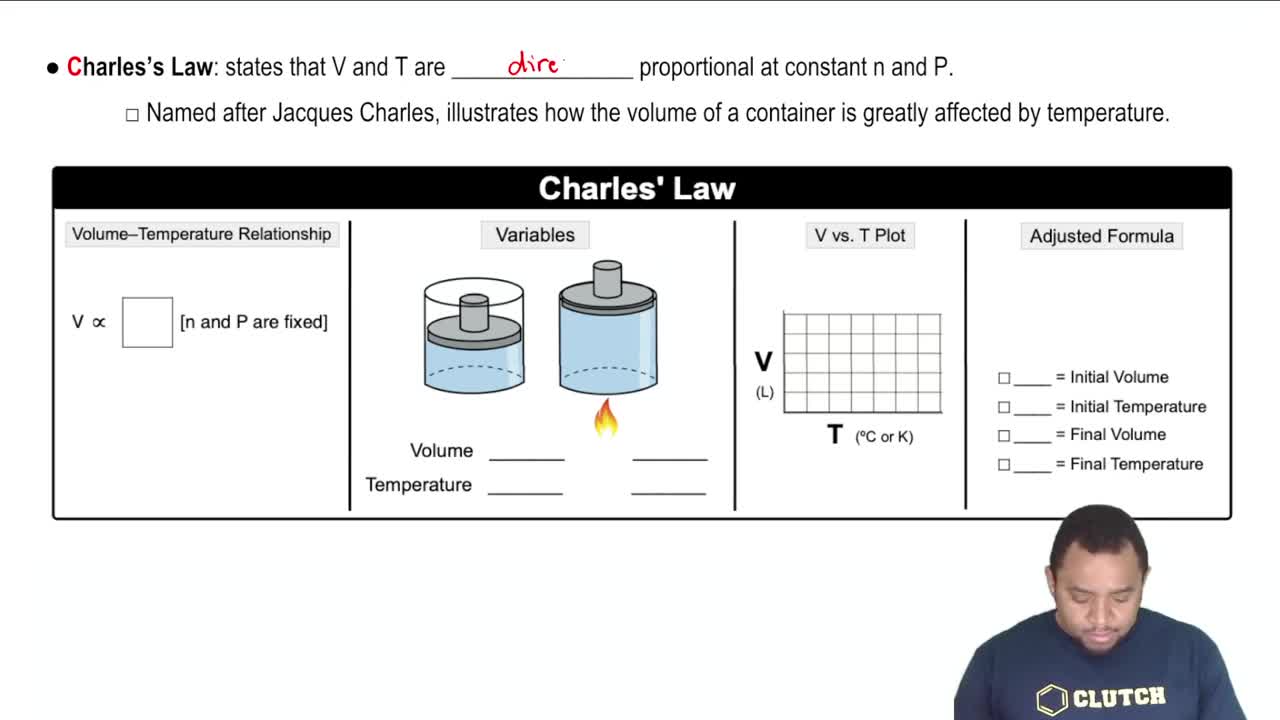
Charles's Law states that the volume of a gas is directly proportional to its temperature when pressure is held constant. Mathematically, it can be expressed as V1/T1 = V2/T2. This principle is crucial for the question, as it allows us to determine how the volume of the gas will change when the temperature is increased from 300 K to 450 K while maintaining constant pressure.
추천 영상:

Kinetic Molecular Theory

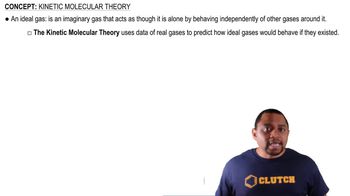
The Kinetic Molecular Theory explains the behavior of gases in terms of the motion of their particles. It posits that gas particles are in constant, random motion and that temperature is a measure of the average kinetic energy of these particles. As the temperature increases, the kinetic energy of the gas particles also increases, leading to greater movement and expansion of the gas, which is relevant for visualizing the changes in the gas sample when heated.
추천 영상:
가이드 코스
01:19
Kinetic Molecular Theory
관련 실천
교과서 질문
An unknown gas is found to diffuse through a porous membrane 2.92 times more slowly than H2. What is the molecular weight of the gas? (a) 17.0 g/mol (b) 5.84 g/mol (c) 8.52 g/mol
803
views

교과서 질문

Assume that you have a sample of gas in a cylinder with a movable piston, as shown in the following drawing:

Redraw the apparatus to show what the sample will look like after (c) the temperature is decreased from 300 K to 200 K and the pressure is decreased from 3 atm to 2 atm.

534
views
교과서 질문
Identify the true statement about deviations from ideal gas behavior. (LO 10.12) (a) The attractive forces between gas particles cause the true volume of the sample to be larger than predicted by the ideal gas law. (b) The attractive forces between gas particles most influence the volume of a sample at low pressure. (c) The volume of the gas particles themselves most influences the volume of the sample at low pressure. (d) The volume of the gas particles themselves causes the true volume of the sample to be larger than predicted by the ideal gas law.
710
views
교과서 질문
A glass tube has one end in a dish of mercury and the other end closed by a stopcock. The distance from the surface of the mercury to the bottom of the stopcock is 850 mm. The apparatus is at 25 °C, and the mercury level in the tube is the same as that in the dish.

(a) Show on drawing (1) what the approximate level of mercury in the tube will be when the temperature of the entire apparatus is lowered from +25 °C to -25 °C.
477
views
교과서 질문
Show the approximate level of the movable piston in drawings (a), (b), and (c) after the indicated changes have been made to the gas.

516
views
교과서 질문

Assume that you have a sample of gas in a cylinder with a movable piston, as shown in the following drawing:

Redraw the apparatus to show what the sample will look like after (b) the pressure is increased from 1 atm to 2 atm at constant temperature

359
views