


Ch.18 - Thermodynamics: Entropy, Free Energy & Equilibrium
McMurry - Chemistry 8th Edition
McMurry8th EditionChemistryISBN: 9781292336145당신이 사용하는 게 아니라요?교과서 변경
18장, 문제 30

An ideal gas is compressed at constant temperature. What are the signs ( + , - , or 0) of ∆H, ∆S, and ∆G for the process? Explain. Illustration showing an ideal gas being compressed at constant temperature.

검증된 단계별 안내
1
Identify that the process involves the compression of an ideal gas at constant temperature.
Recall that for an ideal gas, the internal energy (U) depends only on temperature. Since the temperature is constant, there is no change in internal energy (∆U = 0).
Understand that enthalpy (H) is related to internal energy and pressure-volume work. Since ∆U = 0 and the process is isothermal, ∆H = 0.
Recognize that entropy (S) is a measure of disorder. Compression of a gas decreases its volume, leading to a decrease in entropy (∆S < 0).
Use the Gibbs free energy equation, ∆G = ∆H - T∆S. Since ∆H = 0 and ∆S < 0, ∆G will be positive (∆G > 0) because the term -T∆S will be positive.

비슷한 문제에 대한 검증된 영상 답변:

이 영상 해법은 위 문제에 도움이 된다고 튜터들이 추천한 것입니다.
영상 길이:
1m

주요 개념

질문에 올바르게 답하기 위해 반드시 이해해야 하는 핵심 개념들은 다음과 같습니다.

Enthalpy (∆H)

Enthalpy is a measure of the total heat content of a system. In an isothermal process, such as the compression of an ideal gas at constant temperature, the internal energy remains constant, and any work done on the gas is balanced by heat exchange with the surroundings. For this process, ∆H is 0, indicating no net heat transfer into or out of the system.
추천 영상:
가이드 코스
02:34
Enthalpy of Formation

Entropy (∆S)

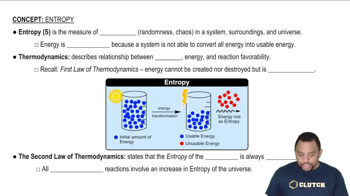
Entropy is a measure of the disorder or randomness in a system. When an ideal gas is compressed, the number of available microstates decreases, leading to a reduction in disorder. Therefore, for this isothermal compression, ∆S is negative, reflecting a decrease in the system's entropy as the gas molecules are forced closer together.
추천 영상:
가이드 코스
02:46
Entropy in Thermodynamics

Gibbs Free Energy (∆G)

Gibbs Free Energy combines enthalpy and entropy to determine the spontaneity of a process. The relationship is given by the equation ∆G = ∆H - T∆S. Since ∆H is 0 and ∆S is negative, ∆G will be positive, indicating that the process is non-spontaneous under constant temperature conditions. This means that work must be done on the system to achieve the compression.
추천 영상:
가이드 코스
01:51
Gibbs Free Energy of Reactions