Ch.18 - Thermodynamics: Entropy, Free Energy & Equilibrium
McMurry - Chemistry 8th Edition
McMurry8th EditionChemistryISBN: 9781292336145당신이 사용하는 게 아니라요?교과서 변경
18장, 문제 32b

Consider the dissociation reaction A2(g) ⇌ 2 A(g). The following pictures represent two possible initial states and the equilibrium state of the system:
(b) What are the signs ( + , - , or 0) of ∆H, ∆S, and ∆G when the system goes from initial state 1 to the equilibrium state? Explain. Is this a spontaneous process?

검증된 단계별 안내
1
Identify the nature of the reaction: The dissociation of A2(g) into 2 A(g) involves breaking bonds, which generally requires energy. Thus, the enthalpy change (∆H) for the reaction is likely positive (+), as energy is absorbed to break the bonds in A2(g).
Consider the entropy change (∆S): The reaction results in the formation of more gas particles (from 1 molecule of A2 to 2 molecules of A). Increasing the number of gas particles increases the randomness or disorder of the system, suggesting that the entropy change (∆S) is positive (+).
Determine the sign of the Gibbs free energy change (∆G) using the relationship ∆G = ∆H - T∆S. Since ∆H is positive and ∆S is also positive, the temperature (T) will play a crucial role. At high temperatures, the T∆S term may outweigh ∆H, leading to a negative (∆G), which indicates a spontaneous process.
Assess the spontaneity of the process: If ∆G is negative, the process is spontaneous. The temperature dependency must be considered to fully determine spontaneity across different temperatures.
Summarize the signs: ∆H is positive (+), ∆S is positive (+), and ∆G could be negative (-) depending on the temperature, indicating that the reaction could be spontaneous under certain conditions.

비슷한 문제에 대한 검증된 영상 답변:

이 영상 해법은 위 문제에 도움이 된다고 튜터들이 추천한 것입니다.
영상 길이:
2m

주요 개념

질문에 올바르게 답하기 위해 반드시 이해해야 하는 핵심 개념들은 다음과 같습니다.

Enthalpy (∆H)

Enthalpy (∆H) is a measure of the total heat content of a system. In a dissociation reaction like A₂(g) ⇌ 2 A(g), if the reaction absorbs heat, it is endothermic, resulting in a positive ∆H. Conversely, if it releases heat, it is exothermic, leading to a negative ∆H. Understanding the sign of ∆H helps determine whether the reaction requires or releases energy.
추천 영상:
가이드 코스
02:34
Enthalpy of Formation

Entropy (∆S)

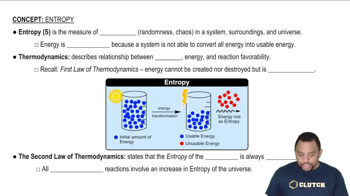
Entropy (∆S) is a measure of the disorder or randomness in a system. In the reaction A₂(g) ⇌ 2 A(g), the dissociation of one molecule into two increases the number of gas particles, leading to greater disorder. Therefore, this process typically has a positive ∆S, indicating an increase in entropy, which is a driving force for spontaneity in many reactions.
추천 영상:
가이드 코스
02:46
Entropy in Thermodynamics

Gibbs Free Energy (∆G)

Gibbs Free Energy (∆G) combines enthalpy and entropy to determine the spontaneity of a reaction at constant temperature and pressure. The relationship is given by the equation ∆G = ∆H - T∆S. A negative ∆G indicates a spontaneous process, while a positive ∆G suggests non-spontaneity. Evaluating the signs of ∆H and ∆S is crucial for predicting the sign of ∆G and the spontaneity of the reaction.
추천 영상:
가이드 코스
01:51
Gibbs Free Energy of Reactions