Given the standard heats of formation shown in Appendix B, what is ΔH° in kilojoules for the reaciton CaCO3(s) → CaO(s) + CO2(g)?
검증된 단계별 안내
1
Identify the chemical reaction: \( \text{CaCO}_3(s) \rightarrow \text{CaO}(s) + \text{CO}_2(g) \).
Recall that the standard heat of formation (\( \Delta H_f^\circ \)) is the change in enthalpy when one mole of a compound is formed from its elements in their standard states.
Use the formula for the standard enthalpy change of a reaction: \( \Delta H^\circ = \sum \Delta H_f^\circ (\text{products}) - \sum \Delta H_f^\circ (\text{reactants}) \).
Look up the standard heats of formation for each substance involved in the reaction: \( \Delta H_f^\circ (\text{CaCO}_3(s)) \), \( \Delta H_f^\circ (\text{CaO}(s)) \), and \( \Delta H_f^\circ (\text{CO}_2(g)) \).
Substitute the values into the formula: \( \Delta H^\circ = [\Delta H_f^\circ (\text{CaO}(s)) + \Delta H_f^\circ (\text{CO}_2(g))] - [\Delta H_f^\circ (\text{CaCO}_3(s))] \) and calculate the result.
비슷한 문제에 대한 검증된 영상 답변:
이 영상 해법은 위 문제에 도움이 된다고 튜터들이 추천한 것입니다.
영상 길이:
4m
영상 재생:
0 댓글
주요 개념
질문에 올바르게 답하기 위해 반드시 이해해야 하는 핵심 개념들은 다음과 같습니다.
Standard Heat of Formation
The standard heat of formation (ΔH°f) is the change in enthalpy when one mole of a compound is formed from its elements in their standard states. It is a crucial value used in thermodynamics to calculate the heat changes in chemical reactions. Each substance has a specific ΔH°f value, which can be found in tables, such as Appendix B.
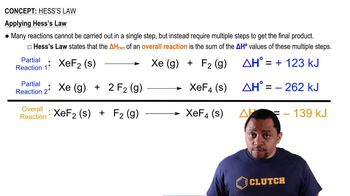
Hess's Law states that the total enthalpy change for a reaction is the same, regardless of the number of steps taken to achieve the reaction. This principle allows us to calculate the enthalpy change for a reaction by using the standard heats of formation of the reactants and products, making it essential for solving problems involving ΔH°.
Enthalpy change (ΔH°) refers to the heat content change during a chemical reaction at constant pressure. It can be calculated using the formula ΔH° = ΣΔH°f(products) - ΣΔH°f(reactants). Understanding how to apply this formula is vital for determining the heat released or absorbed in a reaction, such as the one involving calcium carbonate.


 검증된 단계별 안내

 02:34
02:34