Ch.9 - Thermochemistry: Chemical Energy
McMurry - Chemistry 8th Edition
McMurry8th EditionChemistryISBN: 9781292336145당신이 사용하는 게 아니라요?교과서 변경
9장, 문제 113

Given the standard heats of formation shown in Appendix B, what is ΔH° in kilojoules for the reaciton 3 N2O4(g) + 2 H2O(l) → 4 HNO3(aq) + 2 NO(g)

검증된 단계별 안내
1
Identify the standard heats of formation (ΔH_f°) for each compound involved in the reaction from Appendix B.
Write the balanced chemical equation: 3 N_2O_4(g) + 2 H_2O(l) → 4 HNO_3(aq) + 2 NO(g).
Use the formula for the standard enthalpy change of the reaction: ΔH° = Σ(ΔH_f° of products) - Σ(ΔH_f° of reactants).
Calculate the sum of the standard heats of formation for the products: 4(ΔH_f° of HNO_3) + 2(ΔH_f° of NO).
Calculate the sum of the standard heats of formation for the reactants: 3(ΔH_f° of N_2O_4) + 2(ΔH_f° of H_2O).

비슷한 문제에 대한 검증된 영상 답변:

이 영상 해법은 위 문제에 도움이 된다고 튜터들이 추천한 것입니다.
영상 길이:
4m

주요 개념

질문에 올바르게 답하기 위해 반드시 이해해야 하는 핵심 개념들은 다음과 같습니다.

Standard Heat of Formation (ΔH°f)

The standard heat of formation (ΔH°f) is the change in enthalpy when one mole of a compound is formed from its elements in their standard states. It is a crucial value used in thermodynamics to calculate the overall heat change in a chemical reaction. Each substance has a specific ΔH°f value, which can be found in tables, and these values are essential for determining the enthalpy change of reactions.
추천 영상:
가이드 코스
02:34
Enthalpy of Formation

Hess's Law

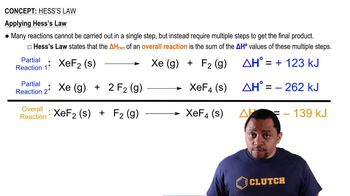
Hess's Law states that the total enthalpy change for a reaction is the sum of the enthalpy changes for the individual steps of the reaction, regardless of the pathway taken. This principle allows chemists to calculate the enthalpy change of a reaction by using known ΔH°f values of reactants and products, making it easier to analyze complex reactions that may occur in multiple steps.
추천 영상:

Enthalpy Change (ΔH)

Enthalpy change (ΔH) is a measure of the heat absorbed or released during a chemical reaction at constant pressure. It indicates whether a reaction is exothermic (releases heat, ΔH < 0) or endothermic (absorbs heat, ΔH > 0). Understanding ΔH is essential for predicting the energy changes associated with chemical reactions, which is vital for both theoretical and practical applications in chemistry.
추천 영상:
가이드 코스
02:34
Enthalpy of Formation