Ch.9 - Thermochemistry: Chemical Energy
McMurry - Chemistry 8th Edition
McMurry8th EditionChemistryISBN: 9781292336145당신이 사용하는 게 아니라요?교과서 변경
9장, 문제 40c

The following reaction is exothermic: (c) Is the reaction likely to be spontaneous at lower temperatures only, at higher temperatures only, or at all temperatures?

검증된 단계별 안내
1
insert step 1> Understand that an exothermic reaction releases heat, meaning the change in enthalpy (\( \Delta H \)) is negative.
insert step 2> Recall that the spontaneity of a reaction is determined by the Gibbs free energy change (\( \Delta G \)), which is given by the equation \( \Delta G = \Delta H - T\Delta S \), where \( T \) is the temperature and \( \Delta S \) is the change in entropy.
insert step 3> Consider that for a reaction to be spontaneous, \( \Delta G \) must be negative.
insert step 4> Analyze the equation \( \Delta G = \Delta H - T\Delta S \): since \( \Delta H \) is negative for an exothermic reaction, the sign of \( \Delta G \) will depend on the sign and magnitude of \( \Delta S \) and the temperature \( T \).
insert step 5> Conclude that if \( \Delta S \) is positive, the reaction is more likely to be spontaneous at all temperatures, but if \( \Delta S \) is negative, the reaction is more likely to be spontaneous at lower temperatures.

비슷한 문제에 대한 검증된 영상 답변:

이 영상 해법은 위 문제에 도움이 된다고 튜터들이 추천한 것입니다.
영상 길이:
2m

주요 개념

질문에 올바르게 답하기 위해 반드시 이해해야 하는 핵심 개념들은 다음과 같습니다.

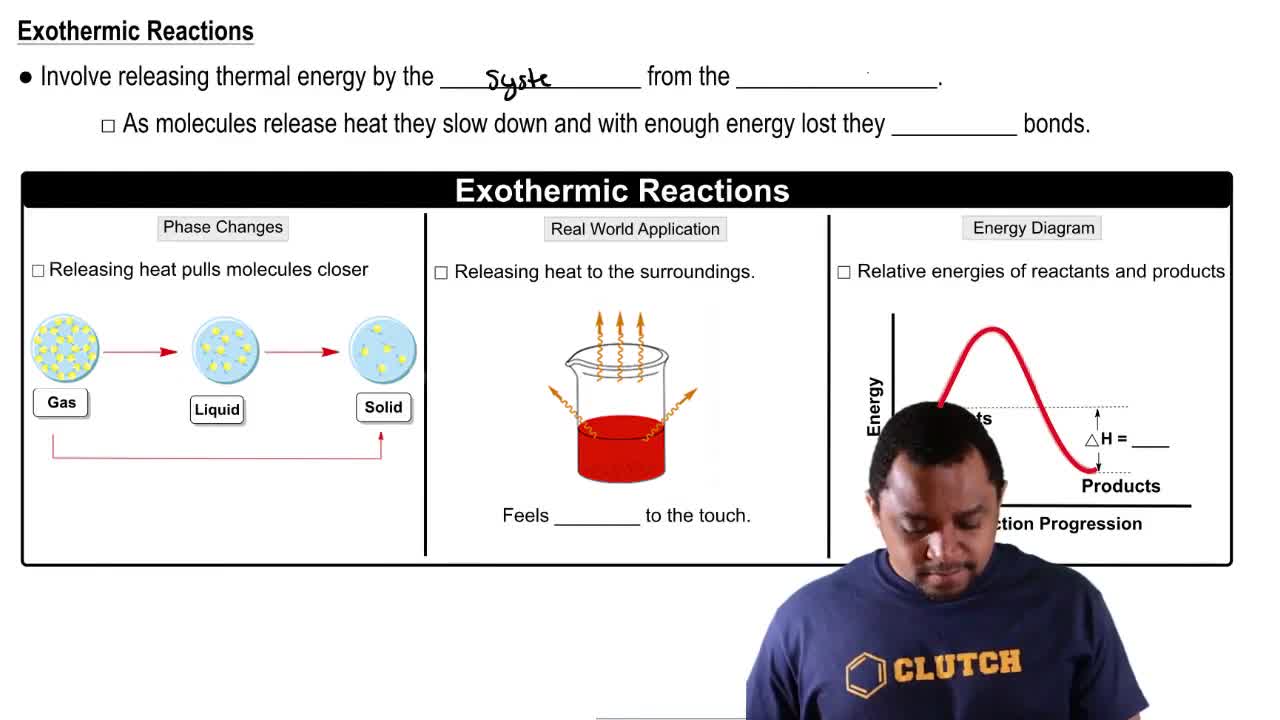
Exothermic Reactions

Exothermic reactions are chemical processes that release energy, usually in the form of heat, to the surroundings. This release of energy often results in an increase in temperature of the surrounding environment. Understanding whether a reaction is exothermic helps predict its behavior under different temperature conditions, particularly in relation to spontaneity.
추천 영상:
가이드 코스
02:38
Endothermic & Exothermic Reactions

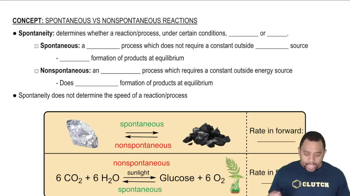
Spontaneity of Reactions

A reaction is considered spontaneous if it occurs without the need for continuous external energy input. The spontaneity of a reaction is determined by the change in Gibbs free energy (ΔG); if ΔG is negative, the reaction is spontaneous. Factors such as enthalpy, entropy, and temperature play crucial roles in determining whether a reaction will be spontaneous under specific conditions.
추천 영상:
가이드 코스
04:20
Spontaneity of Processes

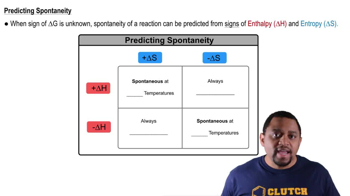
Temperature's Effect on Spontaneity

Temperature significantly influences the spontaneity of reactions, particularly those involving changes in entropy. For exothermic reactions, lower temperatures generally favor spontaneity due to the negative ΔH (enthalpy change). However, at higher temperatures, the entropy change (ΔS) can also affect spontaneity, making it essential to consider both enthalpy and entropy when evaluating reaction behavior across different temperature ranges.
추천 영상:
가이드 코스
01:17
Spontaneity and Temperature