Ch.9 - Thermochemistry: Chemical Energy
McMurry - Chemistry 8th Edition
McMurry8th EditionChemistryISBN: 9781292336145당신이 사용하는 게 아니라요?교과서 변경
9장, 문제 38b

The reaction of A with B to give D proceeds in two steps: (1) A + B → C ΔH° = -20 kJ (2) C + B → D ΔH° = +50 kJ (3) A + 2B → D ΔH° = ? (b) What is the value of ΔH° for the overall reaction A + 2 B → D ΔH° = ?

검증된 단계별 안내
1
Identify the given reactions and their enthalpy changes. The first reaction is A + B → C with an enthalpy change ΔH° = -20 kJ. The second reaction is C + B → D with an enthalpy change ΔH° = +50 kJ.
Understand that the overall reaction A + 2B → D can be obtained by adding the two given reactions. This means you sum up the left-hand sides and the right-hand sides of the reactions respectively.
Add the reactions: (A + B) + (C + B) = C + (D). Simplify this to get A + 2B = D, which matches the overall reaction provided.
Add the enthalpy changes for the individual steps to find the overall enthalpy change ΔH° for the reaction A + 2B → D. This is done by adding ΔH° = -20 kJ and ΔH° = +50 kJ.
The sum of the enthalpy changes will give you the ΔH° for the overall reaction A + 2B → D. This is the value you need to find.

비슷한 문제에 대한 검증된 영상 답변:

이 영상 해법은 위 문제에 도움이 된다고 튜터들이 추천한 것입니다.
영상 길이:
3m

주요 개념

질문에 올바르게 답하기 위해 반드시 이해해야 하는 핵심 개념들은 다음과 같습니다.

Enthalpy Change (ΔH°)

Enthalpy change (ΔH°) is a measure of the heat absorbed or released during a chemical reaction at constant pressure. A negative ΔH° indicates an exothermic reaction, where heat is released, while a positive ΔH° indicates an endothermic reaction, where heat is absorbed. Understanding ΔH° is crucial for predicting the energy changes associated with chemical reactions.
추천 영상:
가이드 코스
02:34
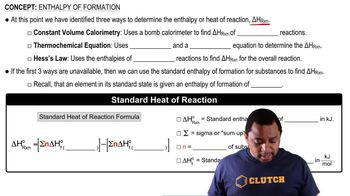
Enthalpy of Formation

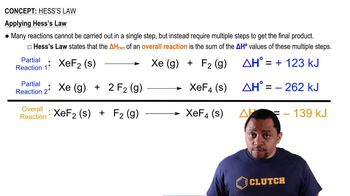
Hess's Law

Hess's Law states that the total enthalpy change for a reaction is the sum of the enthalpy changes for the individual steps of the reaction, regardless of the pathway taken. This principle allows us to calculate the overall ΔH° for a reaction by adding the ΔH° values of the steps involved, making it essential for solving multi-step reactions.
추천 영상:

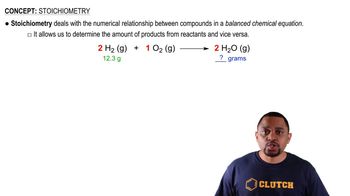
Reaction Stoichiometry

Reaction stoichiometry involves the quantitative relationships between reactants and products in a chemical reaction. It is important for determining how much of each substance is consumed or produced. In this context, understanding stoichiometry helps in balancing the overall reaction and applying Hess's Law correctly to find the overall ΔH°.
추천 영상:
가이드 코스
01:16
Stoichiometry Concept
관련 실천
교과서 질문

The following reaction is exothermic: (c) Is the reaction likely to be spontaneous at lower temperatures only, at higher temperatures only, or at all temperatures?

433
views

교과서 질문

Redraw the following diagram to represent the situation (b) when work has been lost by the system.

392
views
교과서 질문

The following reaction is exothermic:

(a) Write a balanced equation for the reaction (red spheres represent A atoms and ivory spheres represent B atoms)

574
views
교과서 질문

The reaction of A with B to give D proceeds in two steps: (1) A + B → C ΔH° = -20 kJ (2) C + B → D ΔH° = +50 kJ (3) A + 2B → D ΔH° = ? (a) Which Hess's law diagram represents the reaction steps and the overall reaction? Diagram 1 Diagram 2

522
views
교과서 질문
A reaction is carried out in a cylinder fitted with a movable piston. The starting volume is V = 5.00 L, and the appa- ratus is held at constant temperature and pressure. Assum- ing that ∆H = -35.0 kJ and ∆E = -34.8 kJ, redraw the piston to show its position after reaction. Does V increase, decrease, or remain the same?

1096
views
1
rank
교과서 질문
Acetylene, C2H2, reacts with H2 in two steps to yield ethane, CH3CH3: (1) HC?CH + H2 → H2C?CH2 ΔH° = -175.1 kJ (2) H2C?CH2 + H2 → CH3CH3 ΔH° = -136.3 kJ Which arrow (a–c) in the Hess's law diagram corresponds to which step, an2d which a2rrow cor2responds to the net reaction? Where are the reactants located on the diagram, and where are the products located?

963
views
1
rank