
Ch.14 - Chemical Kinetics
Tro - Chemistry: A Molecular Approach 4th Edition
Tro4th EditionChemistry: A Molecular ApproachISBN: 9780134112831당신이 사용하는 게 아니라요?교과서 변경
14장, 문제 96b

Consider the reaction in which HCl adds across the double bond of ethene: HCl + H2C=CH2 → H3C-CH2Cl The following mechanism, with the accompanying energy diagram, has been suggested for this reaction:
Step 1 HCl + H2C=CH2 → H3C=CH2+ + Cl-
Step 2 H3C=CH2+ + Cl- → H3C-CH2Cl
b. What is the expected order of the reaction based on the proposed mechanism?

검증된 단계별 안내
1
Step 1: Understand the reaction mechanism. The reaction occurs in two steps: Step 1 involves the formation of a carbocation intermediate, and Step 2 involves the reaction of this intermediate with a chloride ion.
Step 2: Identify the rate-determining step. The rate-determining step is the slowest step in the mechanism, which controls the overall reaction rate. In this mechanism, Step 1 is typically the rate-determining step because it involves the formation of the carbocation, which is often the slower process.
Step 3: Determine the molecularity of the rate-determining step. The molecularity refers to the number of reactant molecules involved in the rate-determining step. In Step 1, both HCl and ethene (H2C=CH2) are involved, making it a bimolecular step.
Step 4: Relate molecularity to reaction order. For elementary reactions, the order of the reaction is equal to the molecularity of the rate-determining step. Since Step 1 is bimolecular, the reaction is expected to be second order.
Step 5: Conclude the expected order of the reaction. Based on the proposed mechanism and the analysis of the rate-determining step, the expected order of the reaction is second order, with respect to the concentrations of HCl and ethene.

비슷한 문제에 대한 검증된 영상 답변:

이 영상 해법은 위 문제에 도움이 된다고 튜터들이 추천한 것입니다.
영상 길이:
4m

주요 개념

질문에 올바르게 답하기 위해 반드시 이해해야 하는 핵심 개념들은 다음과 같습니다.

Reaction Mechanism

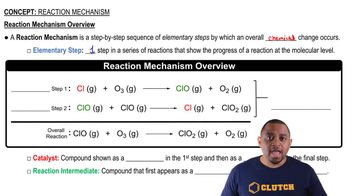
A reaction mechanism is a step-by-step description of the pathway taken by reactants to form products. It outlines the individual steps, including the formation of intermediates and the transition states. Understanding the mechanism helps predict the rate and order of the reaction, as it reveals how reactants interact and the sequence of events leading to product formation.
추천 영상:
가이드 코스
03:06
Reaction Mechanism Overview

Order of Reaction

The order of a reaction refers to the power to which the concentration of a reactant is raised in the rate law expression. It indicates how the rate of reaction is affected by the concentration of reactants. For example, a first-order reaction depends linearly on the concentration of one reactant, while a second-order reaction depends on the square of the concentration of one reactant or the product of the concentrations of two reactants.
추천 영상:
가이드 코스
00:36
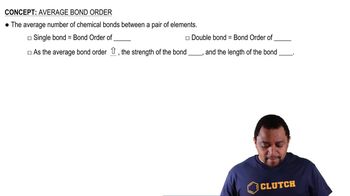
Average Bond Order

Intermediates

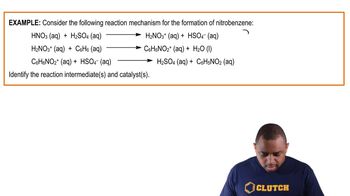
Intermediates are species that are formed during the reaction mechanism but are not present in the final products. They are typically unstable and exist only for a short duration. In the given reaction, the carbocation (H3C=CH2+) and chloride ion (Cl-) are intermediates that play a crucial role in determining the reaction's rate and order, as their formation and consumption influence the overall kinetics.
추천 영상:
가이드 코스
02:14
Reaction Mechanism Example