
Ch.9 - Chemical Bonding I: The Lewis Model
Tro - Chemistry: A Molecular Approach 4th Edition
Tro4th EditionChemistry: A Molecular ApproachISBN: 9780134112831당신이 사용하는 게 아니라요?교과서 변경
9장, 문제 94

NaCl has a lattice energy of -787 kJ/mol. Consider a hypothetical salt XY. X3+ has the same radius of Na+ and Y3- has the same radius as Cl-. Estimate the lattice energy of XY.

검증된 단계별 안내
1
insert step 1: Understand the concept of lattice energy, which is the energy required to separate one mole of an ionic solid into its gaseous ions. It is influenced by the charges of the ions and the distance between them.
insert step 2: Recognize that the lattice energy is proportional to the product of the charges of the ions and inversely proportional to the distance between them. This can be expressed as: \( U \propto \frac{q_1 \cdot q_2}{r} \), where \( q_1 \) and \( q_2 \) are the charges of the ions, and \( r \) is the distance between the ions.
insert step 3: Compare the charges of the ions in NaCl and XY. In NaCl, Na+ has a charge of +1 and Cl- has a charge of -1. In XY, X3+ has a charge of +3 and Y3- has a charge of -3.
insert step 4: Calculate the ratio of the product of the charges for XY to that of NaCl. For NaCl, the product is \( (+1) \times (-1) = -1 \). For XY, the product is \( (+3) \times (-3) = -9 \). The ratio is \( \frac{-9}{-1} = 9 \).
insert step 5: Estimate the lattice energy of XY by multiplying the lattice energy of NaCl by the ratio of the charge products. Since the lattice energy of NaCl is -787 kJ/mol, the estimated lattice energy of XY would be \( -787 \times 9 \) kJ/mol.

비슷한 문제에 대한 검증된 영상 답변:

이 영상 해법은 위 문제에 도움이 된다고 튜터들이 추천한 것입니다.
영상 길이:
5m

주요 개념

질문에 올바르게 답하기 위해 반드시 이해해야 하는 핵심 개념들은 다음과 같습니다.

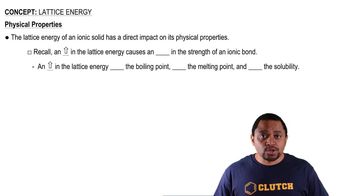
Lattice Energy

Lattice energy is the amount of energy released when gaseous ions combine to form an ionic solid. It is a measure of the strength of the forces between the ions in an ionic compound. A more negative lattice energy indicates a more stable ionic compound, as it reflects stronger ionic interactions. The lattice energy can be estimated using the charges and sizes of the ions involved.
추천 영상:

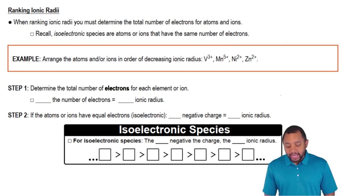
Ionic Radii

Ionic radii refer to the effective size of an ion in a crystal lattice. The size of an ion affects the distance between ions in the lattice, which in turn influences the lattice energy. For example, smaller ions can pack more closely together, leading to stronger electrostatic attractions and higher lattice energy. Understanding the ionic radii of the ions involved is crucial for estimating lattice energy.
추천 영상:
가이드 코스
03:56
Ranking Ionic Radii

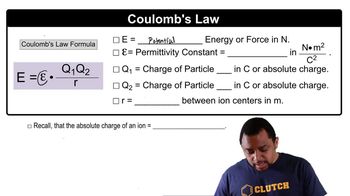
Coulomb's Law

Coulomb's Law describes the electrostatic interaction between charged particles. It states that the force between two charged ions is directly proportional to the product of their charges and inversely proportional to the square of the distance between them. This principle is fundamental in calculating lattice energy, as it helps to quantify the strength of the ionic bonds based on the charges and distances of the ions in the lattice.
추천 영상:
가이드 코스
01:15
Coulomb's Law Concept 2