
Ch.9 - Chemical Bonding I: The Lewis Model
Tro - Chemistry: A Molecular Approach 4th Edition
Tro4th EditionChemistry: A Molecular ApproachISBN: 9780134112831당신이 사용하는 게 아니라요?교과서 변경
9장, 문제 93

The reaction of Fe2O3(s) with Al(s) to form Al2O3(s) and Fe(s) is called the thermite reaction and is highly exothermic. What role does lattice energy play in the exothermicity of the reaction?

검증된 단계별 안내
1
Understand that lattice energy is the energy released when ions in the gas phase form an ionic solid. It is a measure of the strength of the forces holding the ions together in the solid.
In the thermite reaction, Fe2O3(s) and Al(s) react to form Al2O3(s) and Fe(s). The reaction can be represented as: \[ \text{Fe}_2\text{O}_3(s) + 2\text{Al}(s) \rightarrow \text{Al}_2\text{O}_3(s) + 2\text{Fe}(s) \]
Consider the lattice energy of the reactants and products. The lattice energy of Al2O3 is significantly higher than that of Fe2O3, meaning that more energy is released when Al2O3 forms compared to the energy required to break the lattice of Fe2O3.
The high lattice energy of Al2O3 contributes to the overall exothermic nature of the reaction. The formation of a more stable ionic compound (Al2O3) releases a large amount of energy, which is a key factor in the exothermicity of the thermite reaction.
Conclude that the difference in lattice energies between the reactants and products is a major contributor to the exothermic nature of the thermite reaction, as the formation of Al2O3 releases more energy than is consumed in breaking the bonds of Fe2O3.

비슷한 문제에 대한 검증된 영상 답변:

이 영상 해법은 위 문제에 도움이 된다고 튜터들이 추천한 것입니다.
영상 길이:
4m

주요 개념

질문에 올바르게 답하기 위해 반드시 이해해야 하는 핵심 개념들은 다음과 같습니다.

Lattice Energy

Lattice energy is the energy released when gaseous ions combine to form an ionic solid. It is a measure of the strength of the forces between the ions in an ionic compound. In the context of the thermite reaction, the formation of Al2O3 from Al and O2 involves the release of significant lattice energy, contributing to the overall exothermic nature of the reaction.
추천 영상:

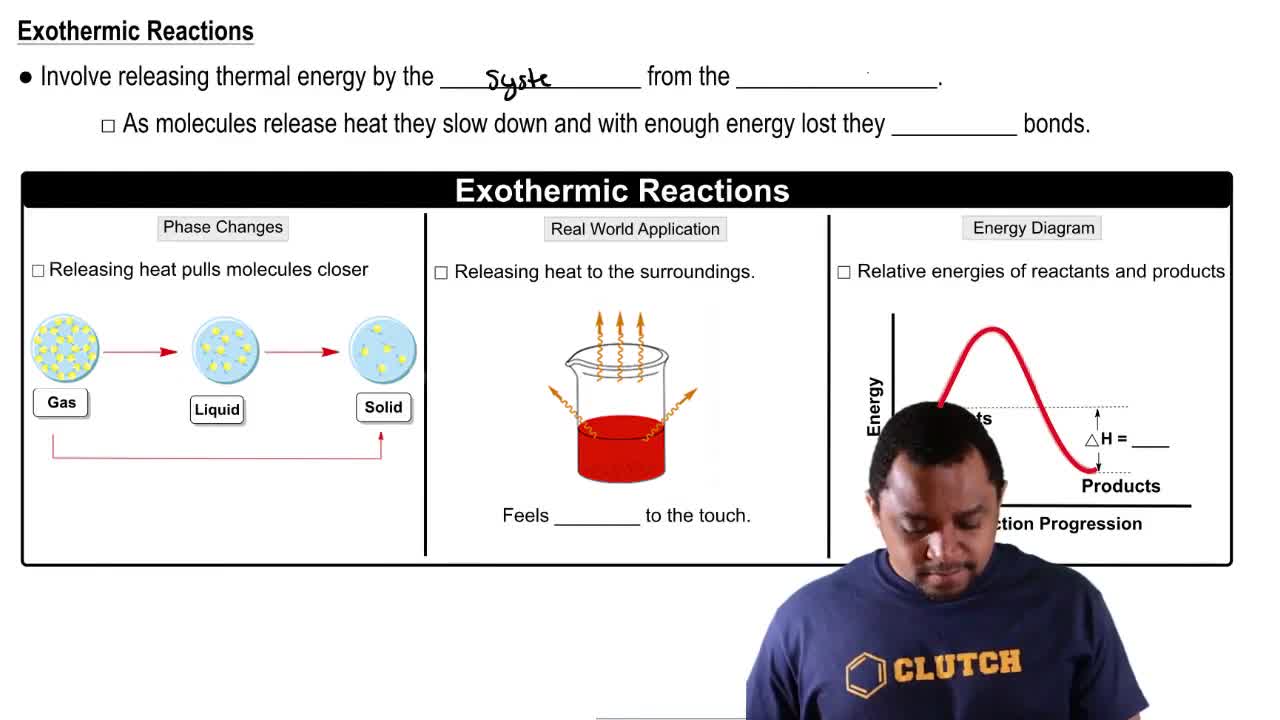
Exothermic Reactions

Exothermic reactions are chemical reactions that release energy, usually in the form of heat, to the surroundings. The thermite reaction is a classic example, where the energy released from the formation of stable products (like Al2O3 and Fe) is greater than the energy required to break the bonds in the reactants. This energy difference is what drives the reaction forward and results in a temperature increase.
추천 영상:
가이드 코스
02:38
Endothermic & Exothermic Reactions

Thermodynamics of Chemical Reactions

Thermodynamics in chemistry involves the study of energy changes during chemical reactions. Key principles include the concepts of enthalpy, entropy, and Gibbs free energy. In the thermite reaction, the high negative enthalpy change indicates that the products are more stable than the reactants, and the significant lattice energy released upon product formation is a crucial factor in understanding the reaction's exothermicity.
추천 영상:
가이드 코스
01:18
First Law of Thermodynamics