 뒤로
뒤로Chromosome Mapping and Genetic Linkage in Eukaryotes
스터디 가이드 - 스마트 노트
 자료에 맞춘 맞춤형 노트, 핵심 정의, 예시, 맥락을 확장해 제공합니다.
Chromosomal Structure and Gene Arrangement
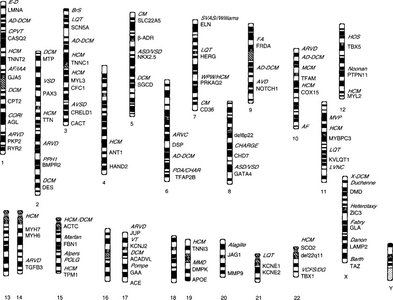
Genes on Chromosomes
Eukaryotic chromosomes contain large numbers of genes, each located at a fixed position known as a locus. Genes are arranged linearly along the chromosome, and their physical location is crucial for understanding inheritance patterns.
Gene locus: The specific physical location of a gene on a chromosome.
Independent assortment: Genes on different chromosomes segregate independently during meiosis.
Linkage: Genes located close together on the same chromosome may be inherited together.
Independent Assortment and Linkage
Independent Assortment
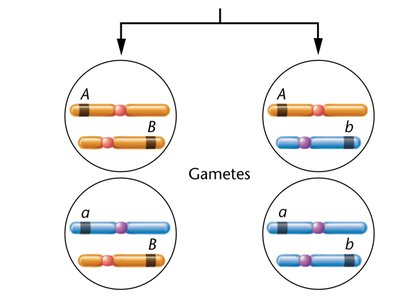
When genes are located on different chromosomes, they assort independently, resulting in a variety of gamete combinations.
Gamete formation: Each gamete receives one allele from each gene, leading to four possible combinations.
Complete Linkage
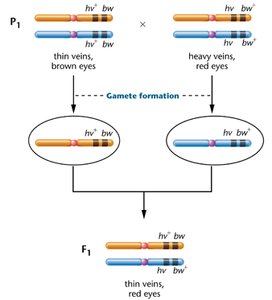
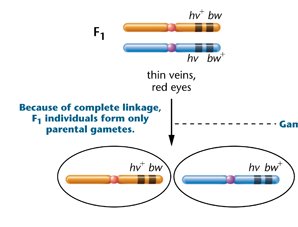
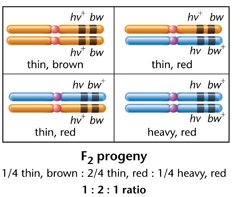
Genes that are very close together on the same chromosome do not undergo crossing over and are inherited as a unit, showing complete linkage.
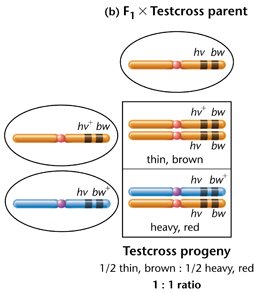
Complete linkage: No recombination occurs between the genes, so only parental gametes are produced.
Example: In Drosophila, genes for vein thickness (hv) and eye color (bw) can be completely linked.
Test Crosses and Linkage Analysis
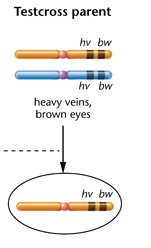
Test crosses are used to determine the genotype of an individual by crossing it with a homozygous recessive parent. The resulting progeny ratios reveal linkage relationships.
Test cross: Cross between a heterozygote and a homozygous recessive individual.
F2 ratios: Deviations from Mendelian ratios indicate linkage.
Crossing Over and Genetic Variation
Crossing Over Mechanism
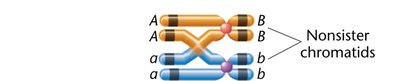
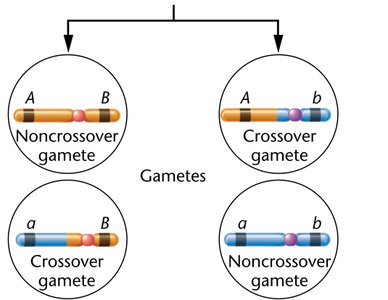
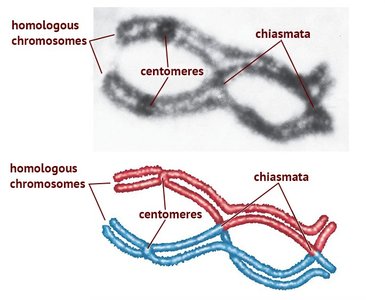
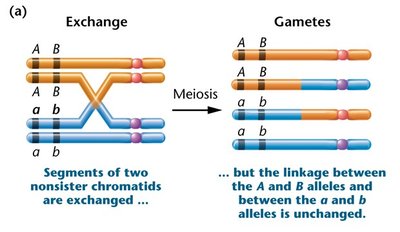
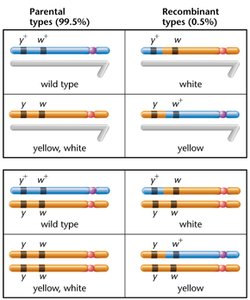
Crossing over occurs during meiosis between homologous chromosomes at regions called chiasmata. This process increases genetic variation by creating recombinant gametes.
Chiasmata: Physical sites where crossing over occurs.
Recombinant gametes: Gametes with new combinations of alleles due to crossing over.
Linkage Groups and Chromosome Mapping
Linkage Groups
Genes that are linked are considered to belong to the same linkage group. All genes on a chromosome theoretically form a single linkage group.
Linkage group: Set of genes located on the same chromosome and inherited together.
Chromosome Mapping Using Recombination Frequency
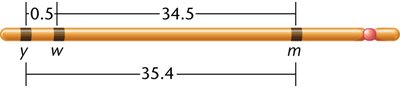
The frequency of recombination between two genes is proportional to their physical distance. This principle allows geneticists to construct chromosome maps.
Mapping unit (mu): 1 mu = 1% recombination frequency.
Gene mapping: Genes are mapped based on observed crossover frequencies.
Types of Crossovers
Single and Double Crossovers
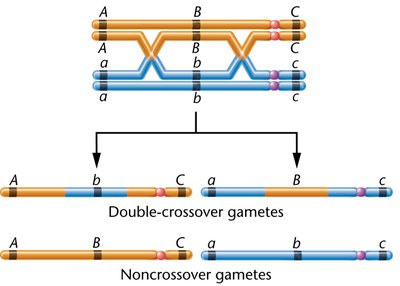
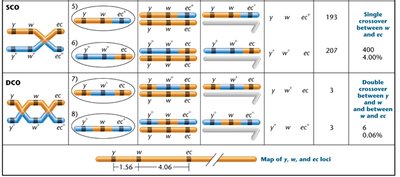
Single crossovers (SCOs) involve one exchange between chromatids, while double crossovers (DCOs) involve two exchanges. DCOs are rarer and their probability is calculated using the product law.
Single crossover (SCO): One exchange event between chromatids.
Double crossover (DCO): Two exchange events; probability is the product of individual crossover probabilities.
Three-Point Mapping and Drosophila Example
Three-Point Mapping
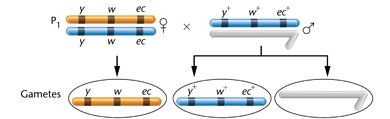
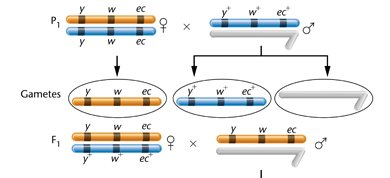
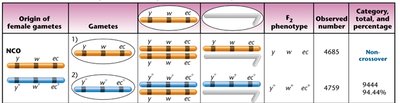
Three-point mapping uses recombination frequencies between three genes to determine their order and relative distances on a chromosome. This method is commonly applied in Drosophila genetics.
Three-point cross: Cross involving three genes to map their order and distances.
Mapping calculation: Add crossover frequencies to determine distances.




Limits to Mapping Accuracy
Mapping Limitations
Some crossovers are not detectable, and mapping estimates become less accurate as the distance between genes increases. Modern mapping techniques use DNA markers and bioinformatics for greater precision.
DNA markers: RFLPs, microsatellites, SNPs.
Bioinformatics: Computational tools for mapping and analysis.
Key Terms and Concepts
Chiasma: The site of crossing over between homologous chromosomes.
Recombination frequency: The percentage of recombinant offspring, used to estimate gene distances.
Product law: Probability of two independent events occurring together is the product of their individual probabilities.
Important Figures in Chromosome Mapping
Thomas Hunt Morgan
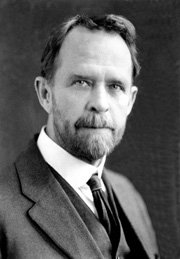
Thomas Hunt Morgan was a pioneering geneticist who first noted X-linkage and unexpected phenotypes in Drosophila, leading to the discovery of crossing over.
Alfred Sturtevant
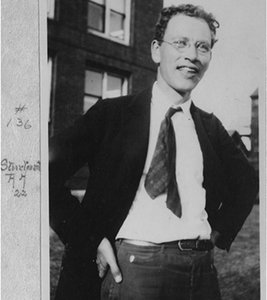
Alfred Sturtevant, a student of Morgan, developed the concept of chromosome mapping using recombination frequencies.
Formulas and Equations
Mapping unit calculation:
Double crossover probability:
Summary Table: Types of Crossovers
Type | Description | Result |
|---|---|---|
Single crossover (SCO) | One exchange between chromatids | Recombinant gametes |
Double crossover (DCO) | Two exchanges between chromatids | Rare recombinant gametes |
Complete linkage | No crossover occurs | Only parental gametes |
Summary Table: Chromosome Mapping Example
Gene Pair | Recombination Frequency (%) | Mapping Units (mu) |
|---|---|---|
y and w | 1.5 | 1.56 |
w and ec | 4.0 | 4.06 |
Additional info: Modern mapping techniques use molecular markers and computational analysis to increase accuracy and efficiency in gene mapping.
