 뒤로
뒤로DNA Replication and Transcription: Molecular Mechanisms and Regulation
스터디 가이드 - 스마트 노트
 자료에 맞춘 맞춤형 노트, 핵심 정의, 예시, 맥락을 확장해 제공합니다.
DNA Replication
Consensus Sequences and Replication Origins
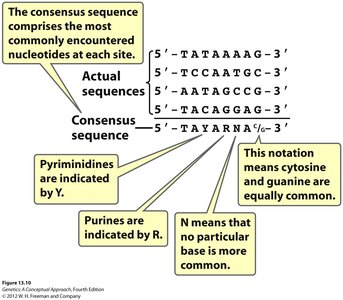
Consensus sequences are short stretches of DNA that are highly conserved across species, indicating their functional importance. These sequences are found at origins of replication and are recognized by specific proteins to initiate DNA replication.
Consensus Sequence: The most common nucleotide found at each position in a set of similar sequences. Conservation suggests functional importance.
Notation: Purines (A or G) are indicated by R, pyrimidines (C or T) by Y, and N means any nucleotide is equally common.
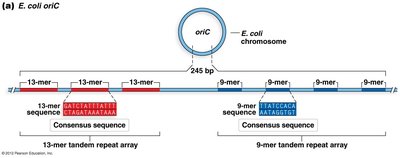
Example: The oriC region in E. coli contains both 13-mer and 9-mer consensus sequences essential for replication initiation.
Initiation of DNA Replication in Bacteria
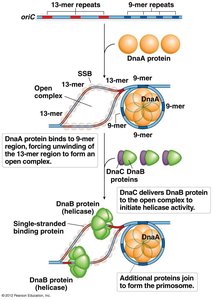
DNA replication in bacteria such as E. coli begins at a single origin of replication (oriC), where specific initiator proteins bind to consensus sequences to start the process.
DnaA: Binds first to 9-mer sequences, bends DNA, and disrupts hydrogen bonds in the A-T rich 13-mer region.
DnaB (Helicase): Unwinds the DNA helix using ATP, separating the two strands.
DnaC: Delivers DnaB to the DNA helix.
Single-Stranded Binding Proteins (SSB): Stabilize the unwound DNA.
Modes of Replication and Replication Forks
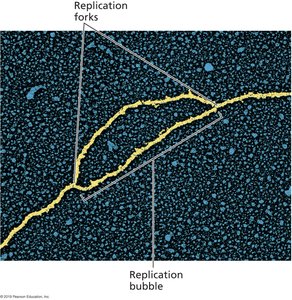
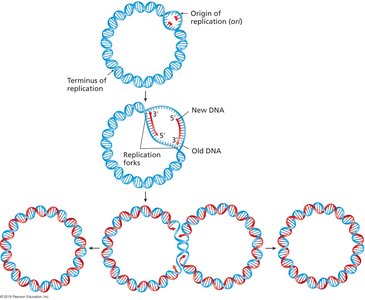
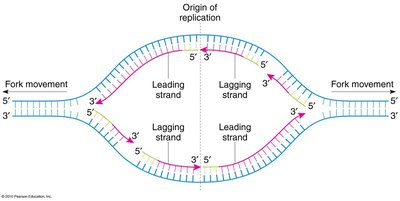
Replication is bidirectional from the origin, forming two replication forks that move away from the origin, creating a replication bubble.
Replicon: The unit of DNA in which replication is initiated and proceeds.
Bidirectional Replication: Both forks move in opposite directions, synthesizing new DNA.
Topoisomerase Function
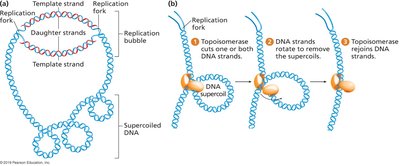
During replication, the unwinding of DNA introduces supercoiling ahead of the replication fork. Topoisomerases are enzymes that relieve this torsional strain by cutting and rejoining DNA strands.
Topoisomerase: Cuts one or both DNA strands, allows rotation to remove supercoils, and then rejoins the DNA.
Clinical Relevance: Bacterial topoisomerases are targets of fluoroquinolone antibiotics.
Leading and Lagging Strand Synthesis
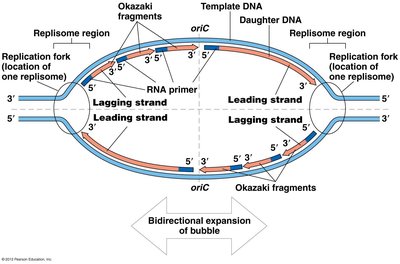
DNA polymerase III synthesizes new DNA strands at the replication fork. One strand (leading) is synthesized continuously, while the other (lagging) is synthesized discontinuously in short fragments called Okazaki fragments.
Leading Strand: Synthesized continuously in the direction of fork movement.
Lagging Strand: Synthesized discontinuously, forming Okazaki fragments that are later joined.
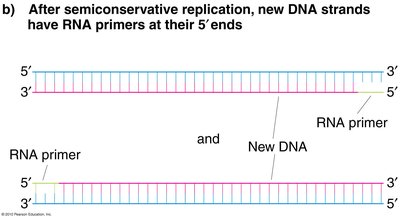
RNA Primers: Short RNA sequences synthesized by primase (DnaG) are required to initiate DNA synthesis.
Okazaki Fragment Processing and Ligation
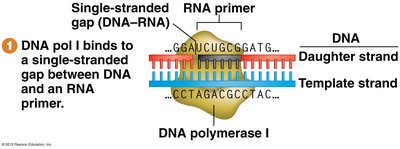
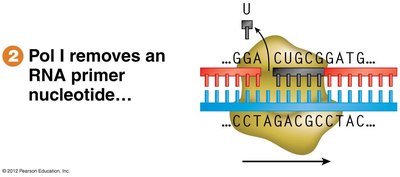
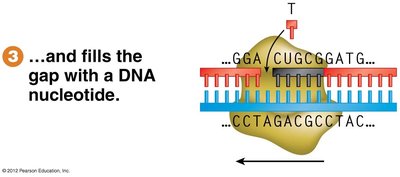
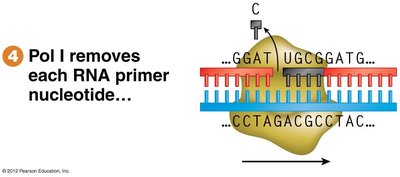
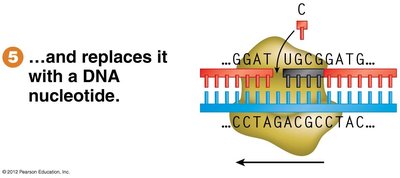
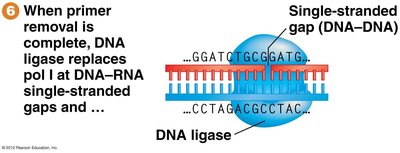
After synthesis, RNA primers are removed and replaced with DNA, and the fragments are joined to form a continuous strand.
DNA Polymerase I: Removes RNA primers (5' to 3' exonuclease activity) and fills in the gaps with DNA nucleotides.
DNA Ligase: Seals nicks in the sugar-phosphate backbone, joining Okazaki fragments.
Sliding Clamp and Processivity
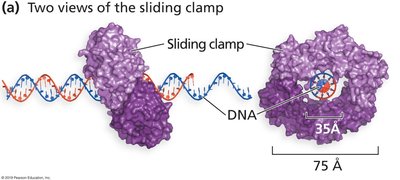
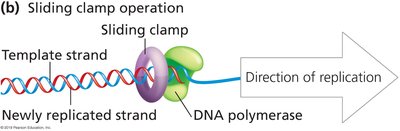
The sliding clamp is a protein complex that encircles DNA and holds DNA polymerase in place, greatly increasing the enzyme's processivity (the number of nucleotides added per binding event).
Sliding Clamp: Ensures efficient and rapid DNA synthesis by tethering DNA polymerase to the template strand.
Proofreading and Fidelity of DNA Replication
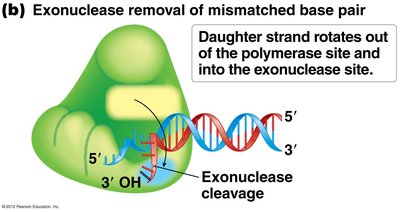
DNA polymerases possess proofreading activity, which allows them to remove incorrectly paired nucleotides and replace them with the correct ones, ensuring high fidelity during DNA replication.
Exonuclease Activity: The 3' to 5' exonuclease activity removes mismatched bases.
Polymerase Activity: DNA synthesis resumes after error removal.
Comparison of Bacterial and Eukaryotic DNA Replication
While the fundamental mechanisms of DNA replication are conserved, there are important differences between bacteria and eukaryotes.
Similarities: Both require topoisomerase, helicase, DNA polymerases, and ligase.
Differences: Eukaryotes have multiple origins of replication, more DNA polymerases, and unique mechanisms for primer removal and telomere replication.
Telomeres and Telomerase
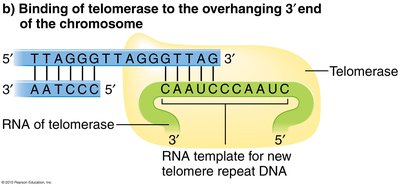
Telomeres are repetitive DNA sequences at the ends of linear eukaryotic chromosomes that protect chromosome ends from degradation. Telomerase is an enzyme that extends telomeres, counteracting the shortening that occurs during DNA replication.
Telomere Function: Prevents loss of important genetic information during replication.
Telomerase: A ribonucleoprotein complex with reverse transcriptase activity, using an RNA template to extend the 3' end of the chromosome.
Biological Importance: Telomerase activity is essential in germ-line and stem cells, and its reactivation is associated with cancer cell immortality.
Transcription and RNA Processing
RNA Synthesis (Transcription)
Transcription is the process by which RNA is synthesized from a DNA template. RNA polymerase catalyzes the formation of phosphodiester bonds, assembling RNA in the 5' to 3' direction.
Base Pairing: RNA uses uracil (U) instead of thymine (T); A pairs with U, C pairs with G.
Pulse-Chase Experiments: Demonstrated that RNA is synthesized in the nucleus and then transported to the cytoplasm for translation.
Classes of RNA
There are several classes of RNA, each with distinct functions in the cell.
Messenger RNA (mRNA): Encodes protein sequences; only RNA type translated into protein.
Transfer RNA (tRNA): Brings amino acids to the ribosome during translation.
Ribosomal RNA (rRNA): Combines with proteins to form ribosomes, the site of protein synthesis.
Small Nuclear RNA (snRNA): Involved in mRNA processing in eukaryotes.
Micro RNA (miRNA) and Small Interfering RNA (siRNA): Regulate gene expression and protect against viruses and transposons.
Ribozymes: RNA molecules with catalytic activity.
