 뒤로
뒤로Extensions and Modifications of Mendelian Genetics: Study Guide
스터디 가이드 - 스마트 노트
 자료에 맞춘 맞춤형 노트, 핵심 정의, 예시, 맥락을 확장해 제공합니다.
Extensions of Mendelian Genetics
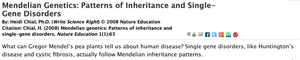
Introduction to Mendelian Genetics and Single-Gene Disorders
Mendelian genetics forms the foundation of classical genetics, describing how traits are inherited through single genes. Many human disorders, such as Huntington's disease and cystic fibrosis, follow Mendelian inheritance patterns. Understanding these principles is essential for analyzing genetic data and predicting outcomes.
Mendel's Principles: Traits are inherited according to predictable ratios based on dominant and recessive alleles.
Single-Gene Disorders: Disorders caused by mutations in a single gene, often inherited in a Mendelian fashion.
Inheritance Patterns: Includes autosomal dominant, autosomal recessive, and sex-linked traits.
Probability in Genetics: Used to predict the likelihood of specific genetic outcomes.
Examples of Human Genetic Disorders
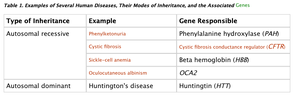
Human genetic disorders can be classified by their mode of inheritance. Autosomal recessive disorders require two copies of the mutant allele, while autosomal dominant disorders require only one.
Type of Inheritance | Example | Gene Responsible |
|---|---|---|
Autosomal recessive | Phenylketonuria | Phenylalanine hydroxylase (PAH) |
Autosomal recessive | Cystic fibrosis | CFTR |
Autosomal recessive | Sickle-cell anemia | Beta hemoglobin (HBB) |
Autosomal recessive | Oculocutaneous albinism | OCA2 |
Autosomal dominant | Huntington's disease | Huntingtin (HTT) |
Modification of Mendelian Ratios
Complex Genetic Disorders and Multifactorial Inheritance
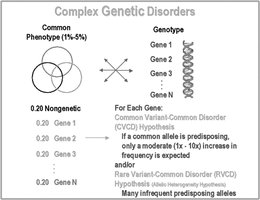
Not all genetic disorders follow simple Mendelian patterns. Multifactorial diseases involve multiple genes and environmental factors, resulting in complex inheritance patterns.
Multifactorial Disease: More than one gene and environmental factors contribute to the phenotype.
Example: Celiac disease requires mutations in HLA genes and environmental triggers; over 100 non-HLA genes may influence susceptibility.
Alleles and Genetic Polymorphism
Alleles are alternative forms of the same gene. The most common allele in a population is called the wild-type allele, which typically promotes normal function and reproductive success. Genetic polymorphism occurs when multiple wild-type alleles exist in a population.
Wild-type allele: Most prevalent, normal function.
Mutant allele: Less common, may alter protein function, can be dominant or recessive.
Dominant and Recessive Alleles
Dominant alleles mask the effect of recessive alleles in heterozygotes. Recessive mutant alleles often result in loss-of-function, producing less functional protein.
Loss-of-function: Mutant allele produces defective or insufficient protein.
Gain-of-function: Mutant allele produces new or abnormal protein function.
Haploinsufficiency: One wild-type copy is not enough for normal function.
Symbolizing Alleles
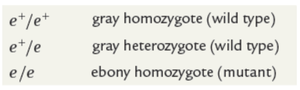
Standard conventions use uppercase letters for dominant alleles and lowercase for recessive. Superscripts may denote alternative alleles, and wild-type alleles in Drosophila are indicated by a plus sign (+).
Genotype | Phenotype |
|---|---|
e+/e+ | Gray homozygote (wild type) |
e+/e | Gray heterozygote (wild type) |
e/e | Ebony homozygote (mutant) |
Non-Mendelian Inheritance Patterns
Incomplete Dominance
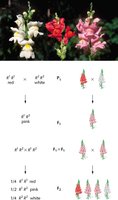
Incomplete dominance occurs when the heterozygote exhibits a phenotype intermediate between the two homozygotes. The classic example is flower color in snapdragons, where crossing red and white yields pink offspring.
Phenotypic Ratio: 1:2:1 in F2 generation, not the 3:1 ratio of simple Mendelian inheritance.
Mechanism: 50% of the dominant protein is not sufficient for the full phenotype.
Codominance and Multiple Alleles
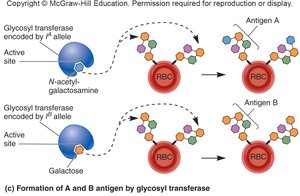
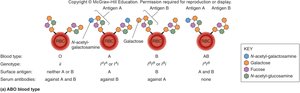
Codominance occurs when both alleles in a heterozygote are fully expressed. The ABO blood group system is a classic example, with three alleles (IA, IB, i) producing four phenotypes.
IA and IB: Codominant, both expressed in AB individuals.
i: Recessive to both IA and IB.
Phenotypes: Type A, B, AB, and O blood.
Multiple Alleles
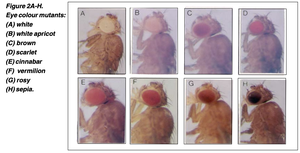
Some genes have more than two alleles, such as the white locus in Drosophila, which affects eye color. Over 100 alleles exist at this locus, contributing to a range of pigment phenotypes.
Lethal Alleles and Deviations from Mendelian Ratios
Lethal Alleles
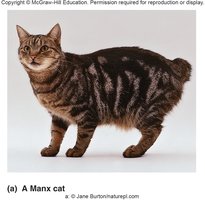
Lethal alleles cause death, often due to mutations in essential genes. They are usually recessive and may result in modified Mendelian ratios, such as the Manx cat example.
Conditional lethal: Lethal only under certain environmental conditions.
Semilethal: Kill some, but not all, individuals in a population.
Pleiotropy
Pleiotropic Effects
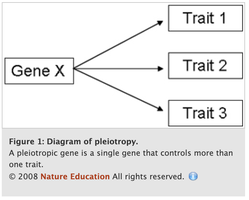
Pleiotropy occurs when a single gene affects multiple traits. This is common in genes that influence cell function in various ways or are expressed in different tissues or developmental stages.
Example: Cystic fibrosis gene affects lungs, pancreas, and other organs.
Example: PKU gene affects brain and skin pigmentation.
Sex-Influenced and Sex-Limited Traits
Sex-Influenced Traits
These traits are dominant in one sex but recessive in the other. For example, scurs in cattle are dominant in males and recessive in females.
Sex-Limited Traits
Traits that occur only in one sex, often responsible for sexual dimorphism. They may be autosomal or sex-linked.
Gene Interactions and Epistasis
Gene Interactions
Two or more genes can influence a single trait, resulting in modified Mendelian ratios. Biochemical pathways and organ development often involve multiple genes.
Epistasis
Epistasis is the interaction between two non-allelic genes where the expression of one gene is masked or suppressed by another. Types include dominant and recessive epistasis.
Dominant epistasis: Dominant allele at one locus masks expression at another.
Recessive epistasis: Two recessive alleles at one locus mask expression at another.
Example: Bombay phenotype in humans, coat color in labradors.
Penetrance and Expressivity
Incomplete Penetrance
Not all individuals with a particular genotype express the expected phenotype. Penetrance is described at the population level.
Example: BRCA1/2 mutations increase cancer risk but do not guarantee disease.
Variable Expressivity
The degree to which a trait is expressed can vary among individuals with the same genotype.
Example: Polydactyly may result in different numbers of extra fingers or toes.
Extranuclear Inheritance and Maternal Effects
Extranuclear Inheritance
Inheritance patterns can be affected by genes outside the nucleus, such as those in mitochondria and chloroplasts. These are often transmitted maternally.
Organelle heredity: Phenotype affected by mitochondrial or chloroplast genes.
Maternal effect: Offspring's phenotype determined by mother's genotype.
Summary Table: Key Terms and Concepts
Term | Definition |
|---|---|
Incomplete dominance | Heterozygote phenotype is intermediate between homozygotes |
Codominance | Both alleles are fully expressed in heterozygotes |
Multiple alleles | More than two alleles exist for a gene |
Lethal alleles | Alleles that cause death, often modifying expected ratios |
Epistasis | One gene masks or modifies the expression of another |
Complementation | Two mutations in different genes restore wild-type phenotype |
Extranuclear inheritance | Inheritance from genes outside the nucleus |
Incomplete penetrance | Not all individuals with a genotype express the phenotype |
Variable expressivity | Degree of phenotype expression varies |
Maternal effects | Offspring phenotype determined by mother's genotype |
