 뒤로
뒤로Extensions of Mendelian Genetics: Modified Inheritance Patterns and Gene Interactions
스터디 가이드 - 스마트 노트
 자료에 맞춘 맞춤형 노트, 핵심 정의, 예시, 맥락을 확장해 제공합니다.
Extensions of Mendelian Genetics
Introduction to Extensions of Mendelian Analysis
Classical Mendelian genetics describes inheritance patterns based on simple dominant and recessive relationships. However, many traits do not follow these strict rules, leading to modified ratios and new inheritance patterns. Extensions of Mendelian genetics explore how changes in allele relationships and gene interactions affect phenotypic outcomes.
Assumptions in Classical Mendelian Genetics
Unit factors occur in pairs: Traits are determined by genes, which occur in pairs in diploid organisms.
Dominance/recessive relationship: One allele may mask the expression of another.
Segregation: Alleles separate during gamete formation (Meiosis I).
Independent assortment: Genes for different traits assort independently.
These assumptions can be modified, resulting in new inheritance patterns and ratios.
Modified Ratios and Basic Types of Extensions
Relationship between alleles of a single gene: Complete dominance, incomplete dominance, co-dominance, multiple alleles.
Relationship between multiple genes for a single trait: Gene interactions such as epistasis, complementation, additive effects.
Combination of the above: Complex inheritance patterns involving both allele and gene interactions.
Relationship Between Alleles
Complete Dominance
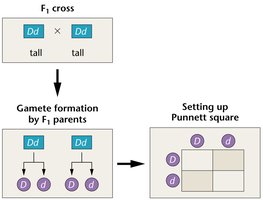
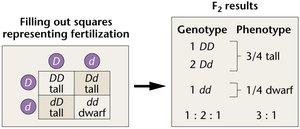
In complete dominance, one allele completely masks the effect of the other. The classic Mendelian monohybrid cross produces a 3:1 phenotypic ratio in the F2 generation.
Example: Tall (D) vs. dwarf (d) plants.
Genotypic ratio: 1 DD : 2 Dd : 1 dd
Phenotypic ratio: 3 tall : 1 dwarf
Incomplete Dominance
Neither allele is completely dominant. Heterozygotes display an intermediate phenotype between the two homozygotes. The genotypic and phenotypic ratios are both 1:2:1.
Example: Red x White flowers produce Pink flowers in the F1 generation.
Genotypic ratio: 1 AA : 2 Aa : 1 aa
Phenotypic ratio: 1 red : 2 pink : 1 white
Molecular basis: Often due to loss-of-function alleles and dosage effects.
Co-dominance
Both alleles produce distinct gene products that are expressed simultaneously in heterozygotes. The phenotype shows both parental traits.
Example: MN blood typing, where both M and N antigens are present in heterozygotes.
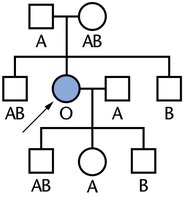
ABO blood groups: A and B alleles are co-dominant, O is recessive.
Multiple Alleles
More than two alleles exist for a single gene locus, increasing the variety of genotypes and phenotypes. In diploid organisms, only two alleles can be present at a time.
Example: ABO blood groups (A, B, O alleles).
Example: White locus in Drosophila.
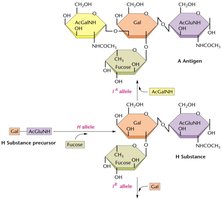
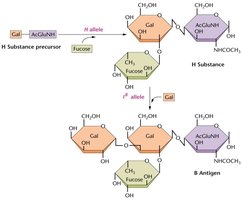
Molecular Basis of ABO and Bombay Phenotype
The ABO blood group system is determined by the presence of specific antigens on the surface of red blood cells. The Bombay phenotype arises when the H antigen precursor is not produced, preventing the expression of A or B antigens regardless of genotype.
Lethal Alleles
Definition and Effects
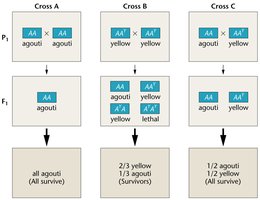
Lethal alleles cause death at some stage of development. They can be dominant or recessive and may have early or late onset. Some alleles are pleiotropic, affecting multiple traits.
Example: AY allele in mice is dominant for yellow coat color but recessive for lethality.
Modified ratio: Apparent 2:1 ratio in surviving offspring, underlying 1:2:1 genotypic ratio.
Sex Linkage (X-linkage)
Inheritance Patterns
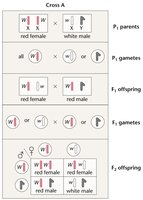
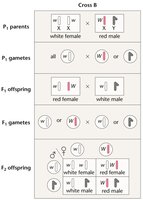
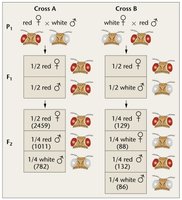
Genes located on the X chromosome exhibit unique inheritance patterns, as males (XY) are hemizygous for X-linked genes. Reciprocal crosses yield different ratios due to the difference in sex chromosomes.
Example: Eye color in Drosophila and other X-linked traits.
Y-linkage: Genes found only on the Y chromosome.
Multiple Gene Scenarios
Independent Multiple Genes
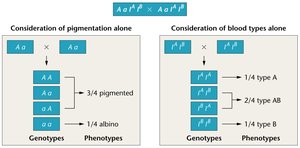
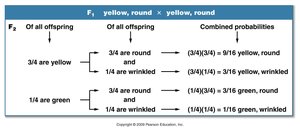
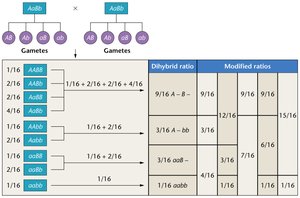
When two or more genes independently affect different traits, classical dihybrid crosses produce a 9:3:3:1 ratio. Alternative modes of inheritance in one or more genes can yield modified ratios.
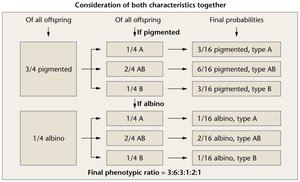
Example: Albinism (complete dominance) and ABO blood groups (multiple alleles, co-dominance).
Combined Probabilities and Modified Ratios
When considering both characteristics together, the final phenotypic ratio is determined by multiplying the probabilities for each trait.
Gene Interactions
Types of Gene Interactions
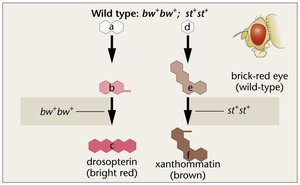
Gene interactions occur when two or more genes influence a single trait. These interactions modify classical Mendelian ratios and can be identified by their characteristic phenotypic ratios.
Epistasis: One gene masks or overrides the expression of another gene. Can be dominant or recessive.
Complementation: Both genes must have at least one dominant allele for the phenotype to be expressed.
Redundancy: Either gene with a dominant allele can produce the phenotype.
Additive: Each gene with a dominant allele contributes independently to the phenotype.
Polygenic/Quantitative: Multiple genes contribute additively to a continuous trait.
Novel/Synthetic: Presence of dominant alleles at both loci produces a new phenotype.
Suppression: One gene suppresses the expression of another gene's phenotype.
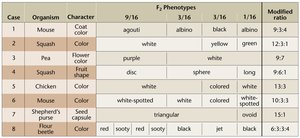
Common Modified Ratios
Gene interactions produce characteristic modified ratios in the F2 generation. These ratios help identify the type of interaction present.
Case | Organism | Character | 9/16 | 3/16 | 3/16 | 1/16 | Modified ratio |
|---|---|---|---|---|---|---|---|
1 | Mouse | Coat color | agouti | albino | black | albino | 9:3:4 |
2 | Squash | Color | white | yellow | green | 12:3:1 | |
3 | Pea | Flower color | purple | 9:7 | |||
4 | Squash | Fruit shape | disc | sphere | long | 9:6:1 | |
5 | Chicken | Color | white | colored | white | spotted | 13:3 |
6 | Mouse | Color | white-spotted | white | colored | white-spotted | 10:3:3 |
7 | Shepherd's purse | Seed capsule | triangular | 15:1 | |||
8 | Flour beetle | Color | red | sooty | black | jet black | 6:3:3:4 |
Solving Modified Ratio Problems
To solve problems involving gene interactions, define the genes and alleles, determine their individual and combined phenotypes, and use the 9:3:3:1 framework to identify modified ratios.
Summary
Extensions of Mendelian genetics reveal the complexity of inheritance patterns beyond simple dominant and recessive relationships. Understanding these extensions is crucial for interpreting genetic data and predicting phenotypic outcomes in both classical and modern genetics.
