 뒤로
뒤로Foundations of Genetics: From Classical Principles to Molecular Mechanisms
스터디 가이드 - 스마트 노트
 자료에 맞춘 맞춤형 노트, 핵심 정의, 예시, 맥락을 확장해 제공합니다.
Introduction to Genetics
History and Theories of Inheritance
Genetics is the scientific study of heredity and variation in living organisms. Early applications included the domestication of plants and animals through selective breeding (artificial selection), where humans bred organisms for specific phenotypic traits. In contrast, natural selection is an evolutionary process where environmental pressures select for advantageous traits over generations.
Epigenesis: The theory that organisms develop from substances present in sex cells.
Preformation: The belief that sex cells contain a miniature adult (homunculus) that grows into a full organism.
Pangenesis: The idea that particles (gemmules) from all parts of the body collect in reproductive organs and are passed to offspring.
Blending Theory: Proposed that offspring are a blend of parental traits, but Mendel showed inheritance is particulate (controlled by discrete units now called genes).
Modern genetics integrates molecular biology, biotechnology, and computational tools to study mutation, disease, and trait inheritance. Examples include:
Single nucleotide polymorphisms (SNPs): Small variations in DNA sequence that contribute to individual differences (e.g., lactose tolerance).
Biotechnology: Manipulation of biological systems for industrial or medical purposes (e.g., vitamin A production).
Gene therapy: Introduction of normal genes to treat genetic disorders.
Proteomics: Study of the full set of proteins in a cell.
Bioinformatics: Use of computational tools to analyze genetic data.
Chromosomal Fundamentals
Chromosomes are structures composed of DNA and proteins that carry genetic information. Key concepts include:
Homologous chromosomes: Chromosome pairs in diploid (2n) organisms; haploid (n) organisms have one set.
Chromosomal theory of inheritance: Genes are located on chromosomes and are transmitted via gametes (sperm/egg).
Mitosis: Division producing two identical (2n) somatic cells.
Meiosis: Division producing four non-identical (n) gametes.
Descriptive Genetics
Genotype: The genetic makeup (allele combination) of an organism for a trait (e.g., AA, Aa, aa).
Phenotype: Observable characteristics resulting from genotype and environment.
Alleles: Different versions of a gene.
Morphological traits: Affect appearance.
Physiological traits: Affect function.
Behavioral traits: Affect responses to the environment.
Major Divisions of Genetics
Transmission genetics: Study of how traits are passed to the next generation.
Molecular genetics: Study of gene structure and function at the molecular level.
Population genetics: Study of genetic variation within populations.
Genetic vs. Environmental Determination
Genetic determination: Traits defined by genes (e.g., sickle cell anemia, Down’s syndrome).
Environmental determination: Traits influenced by environment (e.g., diet affecting heart disease risk).
Developmental noise: Random variation in development (e.g., differences in fly eyes).
DNA and Chromosome Structure
DNA as the Genetic Material
DNA (deoxyribonucleic acid) is the hereditary material in all living organisms. Its structure consists of:
Phosphate group
Pentose sugar: Deoxyribose (DNA) or ribose (RNA)
Nitrogenous base: Adenine (A), Guanine (G), Cytosine (C), Thymine (T) (Uracil (U) in RNA replaces Thymine)
Combinations:
Nucleoside: Sugar + base
Nucleotide: Sugar + base + phosphate
Bases are classified as:
Purines: Double-ring (A, G)
Pyrimidines: Single-ring (C, T, U)
Chargaff’s rules: %A = %T and %C = %G
Phosphodiester bonds: Link nucleotides in a strand.
Hydrogen bonds: Hold complementary strands together (A-T: 2 bonds, C-G: 3 bonds).
Antiparallel strands: Strands run in opposite directions (5’ to 3’ and 3’ to 5’).
DNA forms:
B-DNA: Common, right-handed helix
A-DNA: Shorter, right-handed helix
Z-DNA: Left-handed helix
RNA vs. DNA
RNA uses ribose; DNA uses deoxyribose.
RNA uses uracil; DNA uses thymine.
RNA is usually single-stranded; DNA is double-stranded.
Ribozymes: RNA molecules with catalytic activity.
Types of RNA: rRNA (ribosomal), tRNA (transfer), mRNA (messenger).
Chromatin
Chromatin is the complex of DNA and proteins that forms chromosomes in eukaryotic cells.
DNA Replication
Models of DNA Replication
Conservative: Parental double helix remains intact; new double helix forms.
Dispersive: Parental and new DNA interspersed in both strands.
Semiconservative: Each new DNA has one parental and one new strand (supported by Meselson-Stahl experiment).
Principles of Nucleic Acid Synthesis
A template strand is required.
Synthesis occurs in the 5’ to 3’ direction.
Double-stranded nucleic acids are antiparallel.
DNA polymerase requires a primer to initiate synthesis.
Enzymes and Proteins in DNA Replication
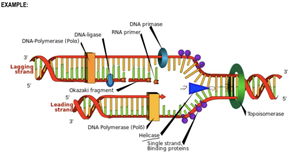
Helicase: Unwinds DNA at the replication fork.
Single-stranded binding proteins (SSBs): Stabilize unwound DNA.
Topoisomerase (DNA gyrase): Relieves supercoiling ahead of the fork.
Primase: Synthesizes RNA primers.
DNA Polymerase III: Main enzyme for DNA synthesis in prokaryotes.
DNA Polymerase I: Replaces RNA primers with DNA.
DNA Ligase: Joins Okazaki fragments on the lagging strand.
Origin of Replication and Replication Forks
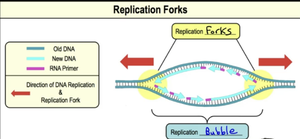
Replication begins at origins of replication (ORI).
Prokaryotes: One ORI; Eukaryotes: Multiple ORIs.
Replication forks are Y-shaped regions where DNA is unwound and synthesis occurs bidirectionally.
Unwinding the DNA
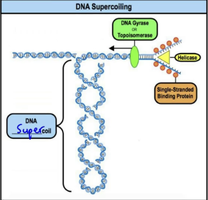
Topoisomerase: Relieves supercoiling.
Helicase: Unwinds DNA by breaking hydrogen bonds.
SSBs: Prevent reannealing and degradation of single strands.
Leading and Lagging Strands
Leading strand: Synthesized continuously in the direction of fork movement; requires one primer.
Lagging strand: Synthesized discontinuously in Okazaki fragments; each fragment requires a primer; fragments joined by DNA ligase.
DNA Polymerase Requirements
Template strand
Primer (RNA, made by primase)
DNA Repair and Proofreading
DNA polymerases have proofreading (3’ to 5’ exonuclease) activity to correct errors.
Other repair enzymes fix errors missed by proofreading.
Unrepaired errors can lead to mutations and diseases (e.g., cancer).
Telomeres and Telomerase
Telomeres: Repetitive, non-coding DNA at chromosome ends; shorten with each replication in most cells.
Telomerase: Enzyme that extends telomeres in germ cells and some cancer cells, preventing shortening and cellular aging.
Gene Expression: From Gene to Protein
Transcription Overview
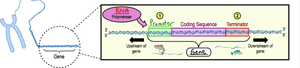
Transcription is the process of synthesizing RNA from a DNA template. Genes are DNA sequences that encode functional products (RNA or protein).
Promoter: DNA sequence where transcription begins (RNA polymerase binds).
Terminator: DNA sequence where transcription ends.
Upstream: Sequence before the gene (opposite direction of transcription).
Downstream: Sequence after the gene (same direction as transcription).
Transcription Steps
Initiation: RNA polymerase binds to the promoter and unwinds DNA.
Elongation: RNA polymerase synthesizes RNA in the 5’ to 3’ direction, pairing RNA nucleotides with the DNA template.
Termination: RNA polymerase stops at the terminator; in eukaryotes, the RNA transcript is processed before translation.
Key Features of Transcription
RNA sequence matches the coding DNA strand (except U for T).
RNA polymerase does not require a primer.
Prokaryotes: One RNA polymerase; uses sigma factor for promoter recognition; can produce polycistronic mRNA.
Eukaryotes: Multiple RNA polymerases (Pol I, II, III); require transcription factors; transcripts undergo processing (capping, splicing, polyadenylation).
Enhancers and silencers regulate transcription in eukaryotes.
Comparison: DNA vs. RNA Polymerase
Both synthesize nucleic acids using a DNA template.
DNA polymerase requires a primer and can proofread; RNA polymerase does not require a primer and lacks proofreading.
Summary Table: DNA vs. RNA
Feature | DNA | RNA |
|---|---|---|
Sugar | Deoxyribose | Ribose |
Bases | A, T, C, G | A, U, C, G |
Strandedness | Double-stranded | Single-stranded |
Function | Genetic storage | Information transfer, catalysis |
Key Equations
Chargaff’s Rule:
Direction of Synthesis:
