 뒤로
Genetics Exam Study Guide: DNA Replication, Gene Regulation, and Protein Synthesis
스터디 가이드 - 스마트 노트
 자료에 맞춘 맞춤형 노트, 핵심 정의, 예시, 맥락을 확장해 제공합니다.
Q1. Which cluster of terms accurately reflects the nature of DNA replication in prokaryotes?
Background
Topic: DNA Replication in Prokaryotes
This question tests your understanding of the mechanisms and terminology associated with DNA replication in prokaryotic cells, including the directionality, initiation point, and replication model.
Key Terms:
Bidirectional: Replication proceeds in two directions from the origin.
Fixed point of initiation: Replication starts at a specific site (origin).
Semiconservative: Each new DNA molecule contains one old strand and one new strand.
Step-by-Step Guidance
Recall that prokaryotic DNA replication begins at a specific origin (e.g., oriC in E. coli).
Consider whether replication proceeds in one direction or both directions from the origin.
Think about the model of replication: does each daughter DNA molecule contain one parental strand?
Review the definitions of conservative, semiconservative, and dispersive replication models.
Try solving on your own before revealing the answer!
Final Answer: D) fixed point of initiation, bidirectional, semiconservative
Prokaryotic DNA replication starts at a fixed origin, proceeds bidirectionally, and follows the semiconservative model.
Q2. DNA polymerase I is thought to add nucleotides ________.
Background
Topic: DNA Polymerase Function
This question tests your knowledge of the directionality of DNA synthesis and the role of DNA polymerase I during replication.
Key Terms:
Primer: Short nucleic acid sequence that provides a starting point for DNA synthesis.
5' and 3' ends: Directionality of nucleic acid strands.
DNA polymerase I: Enzyme that replaces RNA primers with DNA.
Step-by-Step Guidance
Recall that DNA polymerases synthesize DNA in a specific direction.
Consider the role of DNA polymerase I in removing RNA primers and filling in the gaps with DNA.
Think about whether nucleotides are added to the 5' or 3' end of the primer.
Review the directionality of DNA synthesis (5' to 3').
Try solving on your own before revealing the answer!
Final Answer: B) to the 3' end of the primer
DNA polymerase I adds nucleotides to the 3' end of the primer, synthesizing DNA in the 5' to 3' direction.
Q3. Which of the following is a short stretch of DNA on the lagging strand?
Background
Topic: DNA Replication - Lagging Strand
This question tests your understanding of the discontinuous synthesis of the lagging strand during DNA replication.
Key Terms:
Okazaki fragment: Short DNA segments synthesized on the lagging strand.
Lagging strand: Synthesized discontinuously away from the replication fork.
Primer: Initiates synthesis of each fragment.
Step-by-Step Guidance
Recall that the lagging strand is synthesized in short segments.
Identify the term used for these short segments.
Consider the role of DNA ligase in joining these fragments.
Review the difference between continuous and discontinuous synthesis.
Try solving on your own before revealing the answer!
Final Answer: A) Okazaki fragment
Okazaki fragments are short stretches of DNA synthesized on the lagging strand during replication.
Q4. Viral chromosomes exist in a variety of conformations and can be made up of ________.
Background
Topic: Viral Genetics
This question tests your knowledge of the diversity of viral genetic material and its possible forms.
Key Terms:
DNA: Deoxyribonucleic acid
RNA: Ribonucleic acid
Conformation: Shape or structure of the chromosome
Step-by-Step Guidance
Recall that viruses can have either DNA or RNA as their genetic material.
Consider whether viral chromosomes can be single- or double-stranded.
Think about whether proteins or lipids are part of the genetic material.
Review the possible combinations of nucleic acids in viral genomes.
Try solving on your own before revealing the answer!
Final Answer: C) DNA or RNA
Viral chromosomes can be composed of either DNA or RNA, in various conformations.
Q5. In E. coli, the genetic material is composed of ________.
Background
Topic: Prokaryotic Chromosome Structure
This question tests your knowledge of the physical structure and composition of the E. coli genome.
Key Terms:
Circular DNA: DNA forms a closed loop.
Double-stranded: Two complementary strands.
Prokaryote: Organism without a nucleus.
Step-by-Step Guidance
Recall the typical structure of bacterial chromosomes.
Consider whether the DNA is linear or circular.
Think about whether the genetic material is double- or single-stranded.
Review the role of RNA and protein in the genome.
Try solving on your own before revealing the answer!
Final Answer: A) circular, double-stranded DNA
E. coli's genetic material is a circular, double-stranded DNA molecule.
Q6. Chromatin of eukaryotes is organized into repeating interactions with protein octamers called nucleosomes. Nucleosomes are composed of which class of molecules?
Background
Topic: Chromatin Structure
This question tests your understanding of the molecular composition of nucleosomes and their role in DNA packaging.
Key Terms:
Nucleosome: DNA wrapped around a protein octamer.
Histones: Proteins forming the nucleosome core.
Octamer: Complex of eight proteins.
Step-by-Step Guidance
Recall the basic unit of chromatin structure in eukaryotes.
Identify the proteins that make up the nucleosome core.
Consider the role of histones versus other chromosomal proteins.
Review the composition of the nucleosome octamer.
Try solving on your own before revealing the answer!
Final Answer: A) histones
Nucleosomes are composed of histone proteins, which form the octamer core around which DNA is wrapped.
Q7. Which of the following histones is not part of the octamer found within a nucleosome?
Background
Topic: Nucleosome Structure
This question tests your knowledge of the specific histone proteins that make up the nucleosome core.
Key Terms:
Histone H1: Associated with linker DNA, not part of the octamer.
Histones H2A, H2B, H3, H4: Components of the octamer.
Step-by-Step Guidance
Recall the composition of the nucleosome octamer (which histones are included).
Identify which histone is associated with linker DNA rather than the core.
Review the function of each histone protein in chromatin structure.
Consider the role of H1 compared to H2A, H2B, H3, and H4.
Try solving on your own before revealing the answer!
Final Answer: A) H1
Histone H1 is not part of the nucleosome octamer; it binds to linker DNA between nucleosomes.
Q8. The genetic code is said to be triplet, meaning that there ________.
Background
Topic: Genetic Code
This question tests your understanding of how the genetic code specifies amino acids using sets of three nucleotides.
Key Terms:
Codon: Three-base sequence in mRNA that codes for an amino acid.
Triplet code: Each amino acid is specified by three bases.
Step-by-Step Guidance
Recall how many bases are required to specify a single amino acid.
Review the structure of mRNA and how codons are read during translation.
Consider the difference between codons and amino acids.
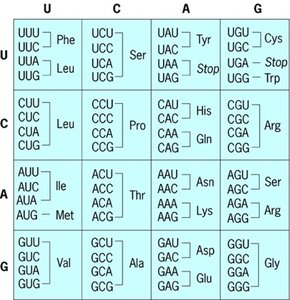
Look at the codon table to see the triplet nature of the code.
Try solving on your own before revealing the answer!
Final Answer: B) are three bases in mRNA that code for an amino acid
The genetic code is triplet, meaning each amino acid is specified by three bases (a codon) in mRNA.
Q9. When scientists were attempting to determine the structure of the genetic code, Crick and coworkers found that when three base additions or three base deletions occurred in a single gene, the wild-type phenotype was sometimes restored. These data supported the hypothesis that ________.
Background
Topic: Genetic Code Structure
This question tests your understanding of experimental evidence supporting the triplet nature of the genetic code.
Key Terms:
Triplet code: Three bases per codon.
Frameshift mutation: Addition or deletion of bases alters reading frame.
Wild-type phenotype: Normal, unmutated phenotype.
Step-by-Step Guidance
Recall the experiments involving base additions and deletions in genes.
Consider how adding or removing three bases affects the reading frame.
Think about why the wild-type phenotype can be restored with three base changes.
Review the implications for the structure of the genetic code.
Try solving on your own before revealing the answer!
Final Answer: E) the code is triplet
These experiments supported the hypothesis that the genetic code is read in triplets.
Q10. What is the name given to the three bases in a messenger RNA that bind to the anticodon of tRNA to specify an amino acid placement in a protein?
Background
Topic: Translation and Codons
This question tests your knowledge of the terminology used in translation, specifically the interaction between mRNA and tRNA.
Key Terms:
Codon: Three-base sequence in mRNA.
Anticodon: Complementary three-base sequence in tRNA.
Step-by-Step Guidance
Recall the process of translation and the role of mRNA and tRNA.
Identify the term for the three bases in mRNA that interact with tRNA.
Review the function of codons and anticodons in protein synthesis.
Consider the terminology used in genetics for these sequences.
Try solving on your own before revealing the answer!
Final Answer: E) codon
The three bases in mRNA that bind to the anticodon of tRNA are called codons.
Q11. What is the initiator triplet in both prokaryotes and eukaryotes? Which amino acid does this triplet recruit?
Background
Topic: Translation Initiation
This question tests your knowledge of the start codon and the amino acid it recruits during translation initiation.
Key Terms:
Initiator triplet: Start codon (AUG).
Methionine: Amino acid recruited by AUG.
Step-by-Step Guidance
Recall the universal start codon for translation.
Identify the amino acid specified by the start codon.
Review the differences (if any) between prokaryotes and eukaryotes.
Consider the role of AUG in protein synthesis.
Try solving on your own before revealing the answer!
Final Answer: D) AUG; methionine
The initiator triplet is AUG, which recruits the amino acid methionine in both prokaryotes and eukaryotes.
Q12. When examining the genetic code, it is apparent that ________.
Background
Topic: Genetic Code Redundancy
This question tests your understanding of the redundancy and specificity of the genetic code.
Key Terms:
Codon: Three-base sequence in mRNA.
Redundancy: Multiple codons can code for the same amino acid.
Ambiguity: One codon coding for multiple amino acids (not true for the genetic code).
Step-by-Step Guidance
Recall the concept of codon redundancy in the genetic code.
Review the codon table to see if multiple codons specify the same amino acid.
Consider whether any codon codes for more than one amino acid.
Think about the number of stop codons and amino acids.
Try solving on your own before revealing the answer!
Final Answer: C) there can be more than one codon for a particular amino acid
The genetic code is redundant; multiple codons can specify the same amino acid.
Q13. When considering the initiation of transcription, one often finds consensus sequences located in the region of the DNA where RNA polymerase(s) binds. Which of the following is a common consensus sequence?
Background
Topic: Transcription Initiation
This question tests your knowledge of promoter sequences and their role in transcription initiation.
Key Terms:
Consensus sequence: Common DNA sequence found in promoters.
TATAAT: Pribnow box, a prokaryotic promoter sequence.
Promoter: DNA region where RNA polymerase binds.
Step-by-Step Guidance
Recall the typical sequences found in prokaryotic promoters.
Identify the Pribnow box and its sequence.
Review the role of consensus sequences in transcription initiation.
Consider the function of other listed sequences.
Try solving on your own before revealing the answer!
Final Answer: A) TATAAT
The TATAAT sequence (Pribnow box) is a common consensus sequence in prokaryotic promoters.
Q14. Which of the following subunits of RNA polymerase confers promoter specificity in prokaryotes?
Background
Topic: RNA Polymerase Structure
This question tests your knowledge of the subunits of RNA polymerase and their roles in transcription.
Key Terms:
RNA polymerase: Enzyme that synthesizes RNA from DNA.
σ (sigma) subunit: Confers promoter specificity.
Promoter: DNA region where transcription begins.
Step-by-Step Guidance
Recall the structure of prokaryotic RNA polymerase.
Identify the subunit responsible for recognizing promoter sequences.
Review the function of each subunit in transcription.
Consider the role of the sigma factor in transcription initiation.
Try solving on your own before revealing the answer!
Final Answer: E) σ
The sigma (σ) subunit of RNA polymerase confers promoter specificity in prokaryotes.
Q15. Which of the following includes the three posttranscriptional modifications often seen in the maturation of mRNA in eukaryotes?
Background
Topic: mRNA Processing
This question tests your knowledge of the modifications that occur to mRNA after transcription in eukaryotic cells.
Key Terms:
5'-capping: Addition of a cap to the 5' end of mRNA.
3'-poly(A) tail: Addition of a polyadenylate tail to the 3' end.
Splicing: Removal of introns and joining of exons.
Step-by-Step Guidance
Recall the three main modifications to eukaryotic mRNA.
Identify the purpose of each modification.
Review the order in which these modifications occur.
Consider the role of splicing in generating mature mRNA.
Try solving on your own before revealing the answer!
Final Answer: A) 5'-capping, 3'-poly(A) tail addition, splicing
These are the three main posttranscriptional modifications seen in eukaryotic mRNA maturation.
Q16. Which of the following is a type of mutation where one wild-type allele in a heterozygote is not able to produce the wild-type phenotype?
Background
Topic: Mutation Types
This question tests your understanding of genetic mutations and their effects on phenotype.
Key Terms:
Haploinsufficiency: One wild-type allele is insufficient for normal function.
Loss-of-function: Mutation results in reduced or absent protein function.
Null mutation: Complete loss of function.
Step-by-Step Guidance
Recall the definition of haploinsufficiency.
Consider the effect of having only one functional allele in a heterozygote.
Review the difference between haploinsufficiency and other mutation types.
Think about the phenotypic outcome in heterozygotes.
Try solving on your own before revealing the answer!
Final Answer: A) haploinsufficiency
Haploinsufficiency occurs when one wild-type allele is not enough to produce the wild-type phenotype.
Q17. Mutations that arise in nature, from no particular artificial agent, are called ________.
Background
Topic: Mutation Origin
This question tests your knowledge of the terminology for naturally occurring mutations.
Key Terms:
Spontaneous mutation: Occurs naturally without artificial induction.
Induced mutation: Caused by external agents.
Step-by-Step Guidance
Recall the difference between spontaneous and induced mutations.
Identify the term for mutations arising without artificial agents.
Review examples of spontaneous mutations.
Consider the terminology used in genetics for mutation origin.
Try solving on your own before revealing the answer!
Final Answer: C) spontaneous mutations
Mutations that arise naturally, without artificial agents, are called spontaneous mutations.
Q18. When an amino group in cytosine or adenine is converted to a keto group it is called ________.
Background
Topic: DNA Damage and Mutation
This question tests your knowledge of chemical changes in DNA bases and their consequences.
Key Terms:
Deamination: Removal of an amino group from a base.
Tautomer: Isomeric form of a base.
Depurination: Loss of a purine base.
Step-by-Step Guidance
Recall the chemical process that converts an amino group to a keto group.
Identify the term for this modification.
Review the consequences of deamination for DNA stability.
Consider the difference between deamination and other base modifications.
Try solving on your own before revealing the answer!
Final Answer: B) deamination
Deamination is the conversion of an amino group to a keto group in DNA bases.
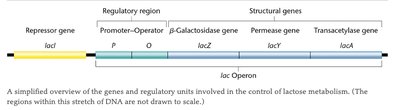
Q19. If lactose is accumulating outside of E. coli and is unable to enter, then which structural gene of the lac operon is most likely mutated?
Background
Topic: Lac Operon Function
This question tests your understanding of the roles of structural genes in the lac operon, specifically those involved in lactose transport.
Key Terms:
lacY: Encodes permease, which transports lactose into the cell.
lacZ: Encodes β-galactosidase, which breaks down lactose.
lacA: Encodes transacetylase.
Step-by-Step Guidance
Recall the function of each structural gene in the lac operon.
Identify which gene product is responsible for lactose transport.
Consider the consequences of a mutation in the permease gene.
Review the symptoms of lactose accumulation outside the cell.
Try solving on your own before revealing the answer!
Final Answer: B) lacY
The lacY gene encodes permease, which is responsible for transporting lactose into the cell.
Q20. A constitutive mutation in the lac operon may be of several types. Name two types of constitutive mutations.
Background
Topic: Lac Operon Regulation
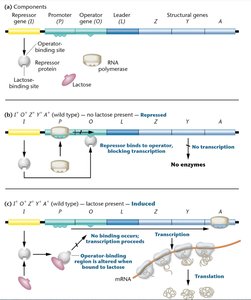
This question tests your understanding of mutations that result in continuous expression of the lac operon, regardless of environmental conditions.
Key Terms:
LacI-: Mutation in the repressor gene.
LacOc: Mutation in the operator region.
Constitutive mutation: Causes continuous expression.
Step-by-Step Guidance
Recall the regulatory components of the lac operon.
Identify mutations that disrupt normal regulation and cause constitutive expression.
Review the effects of mutations in the repressor and operator regions.
Consider the terminology for these mutations.
Try solving on your own before revealing the answer!
Final Answer: A) LacI- and LacOc
Mutations in the repressor gene (LacI-) and operator region (LacOc) are constitutive mutations.
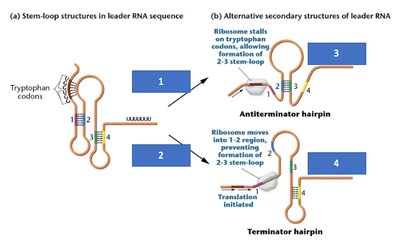
Q10 (Part II). The above in the attenuation model for regulating the tryptophan operon. Please fill in the word or phrases that best describes what is in the 4 blue boxes above.
Background
Topic: Attenuation in the trp Operon
This question tests your understanding of the regulatory mechanism of attenuation in the tryptophan operon, including the role of charged tRNATrp and stem-loop structures.
Key Terms:
Attenuation: Regulatory mechanism controlling transcription termination.
Stem-loop: Secondary structure in leader RNA.
Charged tRNATrp: tRNA carrying tryptophan.
Step-by-Step Guidance
Recall the conditions under which the ribosome stalls or moves through the leader sequence.
Identify the effect of charged tRNATrp availability on stem-loop formation.
Review the consequences for transcription (proceeds or terminates).
Match the descriptions to the blue boxes in the diagram.
Try solving on your own before revealing the answer!
Final Answer:
Box 1: tRNATrp is NOT available
Box 2: tRNATrp is available
Box 3: transcription proceeds
Box 4: transcription terminates
These phrases describe the regulatory outcomes in the attenuation model for the trp operon.
Q (Part III). Write and draw out the process of elongation only in the translation process of proteins in prokaryotes. Do not write out the steps to initiation and termination!
Background
Topic: Translation Elongation in Prokaryotes
This question tests your ability to describe and illustrate the steps involved in the elongation phase of protein synthesis in prokaryotes.
Key Terms:
Elongation: Addition of amino acids to the growing polypeptide chain.
Ribosome: Site of protein synthesis.
tRNA: Transfers amino acids to the ribosome.
Peptidyl transferase: Enzyme activity forming peptide bonds.
Step-by-Step Guidance
Recall the three main steps of elongation: codon recognition, peptide bond formation, and translocation.
Describe how the ribosome moves along the mRNA, bringing in new tRNAs.
Explain the role of elongation factors (EF-Tu, EF-G) in the process.
Illustrate the movement of tRNAs through the A, P, and E sites of the ribosome.
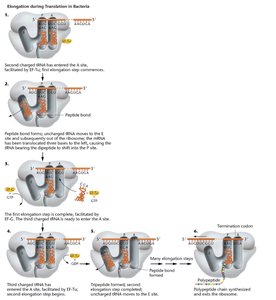
Try solving on your own before revealing the answer!
Final Answer:
During elongation, the ribosome moves along the mRNA, bringing in tRNAs to the A site, forming peptide bonds at the P site, and releasing tRNAs from the E site. Elongation factors facilitate these steps, and the polypeptide chain grows until a stop codon is reached.
Q (Part IV). Describe how lactose metabolism in E. coli is regulated by an inducible system. All answers should have an illustrative component to receive full credit.
Background
Topic: Regulation of the lac Operon
This question tests your understanding of the inducible regulation of lactose metabolism in E. coli, including the roles of regulatory regions, structural genes, and positive/negative control mechanisms.
Key Terms:
lac operon: Cluster of genes involved in lactose metabolism.
Inducible system: Expression is turned on in response to an inducer (lactose).
Repressor: Protein that blocks transcription in the absence of lactose.
CAP (catabolite activator protein): Facilitates transcription in the absence of glucose.
Step-by-Step Guidance
Draw and label the lac operon, including the regulatory region and structural genes (lacZ, lacY, lacA).
Describe the function of lacZ (β-galactosidase) and lacY (permease).
Explain the negative control mechanism: how the repressor binds to the operator in the absence of lactose.
Illustrate the response of the operon in the presence and absence of lactose.
Describe the positive control mechanism: how CAP and cAMP regulate transcription in response to glucose levels.
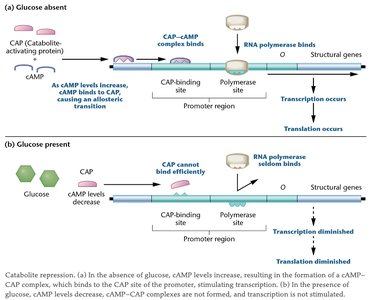
Try solving on your own before revealing the answer!
Final Answer:
Lactose metabolism in E. coli is regulated by the lac operon, an inducible system. The operon includes regulatory regions and structural genes (lacZ, lacY, lacA). In the absence of lactose, the repressor binds to the operator, blocking transcription. In the presence of lactose, the repressor is inactivated, allowing transcription. CAP and cAMP provide positive control, enhancing transcription when glucose is absent.
Q (Part IV e). Examine the genotype of the lac operon. Provide the gene activity by writing + or – in the presence or absence of lactose for the various E. coli genotypes.
Background
Topic: Lac Operon Genotype and Expression
This question tests your ability to predict β-galactosidase activity based on lac operon genotype and environmental conditions.
Key Terms:
β-galactosidase: Enzyme encoded by lacZ.
Genotype: Combination of regulatory and structural gene alleles.
Inducible expression: Activity depends on presence of lactose.
Step-by-Step Guidance
Review the genotype notation (I+O+Z+, etc.).
Recall the conditions for expression of β-galactosidase (presence/absence of lactose).
Predict gene activity (+ or –) for each genotype under both conditions.
Fill in the table based on your predictions.
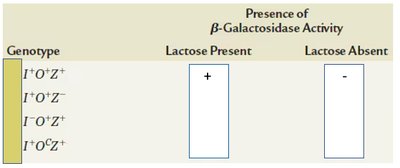
Try solving on your own before revealing the answer!
Final Answer:
For each genotype, β-galactosidase activity is present (+) when lactose is present and absent (–) when lactose is absent, unless a constitutive mutation is present.
