뒤로
뒤로Linkage and Chromosome Mapping in Eukaryotes
스터디 가이드 - 스마트 노트
 자료에 맞춘 맞춤형 노트, 핵심 정의, 예시, 맥락을 확장해 제공합니다.
Linkage and Mapping
Meiosis: Possible Outcomes for Multiple Genes
During meiosis, the arrangement and assortment of genes on chromosomes determine the types of gametes produced. The relationship between genes—whether they assort independently or are linked—affects genetic variation in offspring.
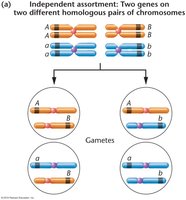
Independent Assortment: Genes located on different chromosomes assort independently, producing four types of gametes in equal proportions. This follows Mendel's Second Law.
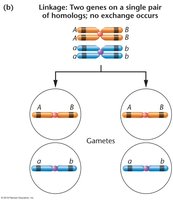
Complete Linkage: Genes located close together on the same chromosome do not undergo crossing over, resulting in only parental (noncrossover) gametes.
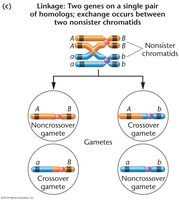
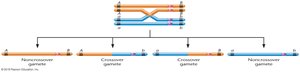
Linkage with Crossing Over: Genes on the same chromosome may undergo crossing over, producing both parental and recombinant (crossover) gametes. Crossing over occurs between nonsister chromatids.
Linkage Ratio and Linkage Groups
Linkage ratio refers to the unique phenotypic ratios observed in the F2 generation when genes are completely linked. Linkage groups are sets of genes located on the same chromosome, and their number corresponds to the haploid chromosome number.
Linkage Ratio: Complete linkage produces unique F2 ratios due to the absence of recombination.
Linkage Group: Genes on the same chromosome are inherited together unless crossing over occurs.
Parental Combination: Without crossing over, the original parental allele combinations remain together.
Crossing Over and Chiasmata
Crossing over is the exchange of genetic material between homologous chromosomes during meiosis, occurring at chiasmata (X-shaped intersections). The frequency of recombinant gametes depends on the distance between genes.
Chiasmata: Physical sites of crossover between homologous chromosomes.
Genetic Exchange: Genes closer together are less likely to have crossover events between them.
Chromosome Mapping and Recombination Frequency
Chromosome mapping estimates the relative distance between genes based on recombination frequency. The frequency of exchange is additive for multiple linked genes.
Sturtevant's Mapping: Recombination frequencies are used to construct genetic maps.
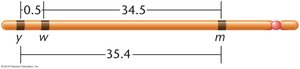
Example: If y-w = 0.5% and w-m = 34.5%, then y-m = 35.0% (additive).
Map Units (Centimorgans)
Map units, or centimorgans (cM), represent the relative distance between genes. One map unit equals 1% recombination frequency.
Definition: 1% recombination = 1 cM.
Relative Distance: Map units are not exact physical distances but reflect genetic linkage.
Single Crossovers (SCO)
Single crossovers occur between two nonsister chromatids and result in two parental and two recombinant chromosomes.
Products: 50% parental, 50% recombinant chromosomes.
Detection: Only crossovers between the genes of interest are detected.
Multiple Crossovers and Three-Point Mapping
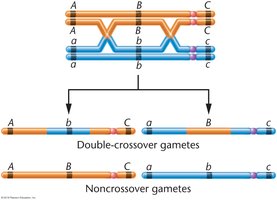
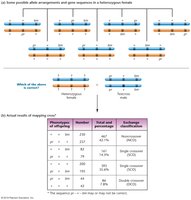
Double crossovers involve two exchanges of genetic material and are used to determine the order and distance between three linked genes. Three-point mapping requires the parent to be heterozygous for all three genes, phenotypic classes to reflect parental gametes, and a sufficient number of offspring.
Double Crossovers: Used to map three genes and determine their order.
Three-Point Mapping Criteria: Parent heterozygosity, phenotypic reflection of gametes, and large sample size.
Gene Order Determination
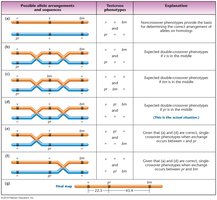
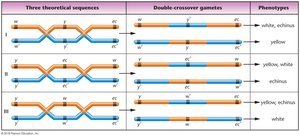
Gene order can be determined by analyzing double crossover products and comparing them to parental combinations. The gene that "switches" in the double crossover is in the middle.
Method 1: Test all possible gene orders and compare predicted DCO products to observed DCOs.
Method 2: Identify the gene that switches association in the DCO category.
Calculating Recombination Frequency (RF)
Recombination frequency is calculated by accounting for both single and double crossovers. It is proportional to the genetic distance between genes.
Formula:
Example:
Interpretation: 1% RF = 1 map unit (mu).
Interference and Coefficient of Coincidence
Interference describes the phenomenon where the observed frequency of double crossovers is less than expected. The coefficient of coincidence quantifies this difference.
Coefficient of Coincidence (C):
Interference (I):
Example: If expected DCO = 9.7%, observed DCO = 7.8%, then , (19.6% fewer DCOs than expected).
Summary Table: Linkage Mapping Concepts
Concept | Definition | Example/Application |
|---|---|---|
Independent Assortment | Genes on different chromosomes assort independently | Four gamete types, equal frequency |
Complete Linkage | Genes close together, no crossing over | Only parental gametes produced |
Linkage with Crossing Over | Genes on same chromosome, crossing over occurs | Both parental and recombinant gametes produced |
Map Unit (cM) | 1% recombination frequency | y-w = 0.5 cM, w-m = 34.5 cM |
Recombination Frequency | Proportion of recombinant gametes | |
Interference | Reduction in observed DCOs compared to expected |
Key Terms
Linkage: The tendency of genes located close together on a chromosome to be inherited together.
Crossing Over: The exchange of genetic material between homologous chromosomes during meiosis.
Chiasma: The physical site of crossover between chromatids.
Recombination Frequency: The proportion of recombinant offspring produced in a cross.
Map Unit (cM): A unit of genetic distance corresponding to 1% recombination.
Interference: The phenomenon where one crossover event reduces the probability of another nearby crossover.
Example Application
In Drosophila, mapping three X-linked genes (a, b, c) using offspring ratios allows determination of gene order and distances. Calculating recombination frequencies and interference provides insight into chromosome structure and genetic linkage.