 뒤로
뒤로Mendelian Genetics: Principles, Crosses, and Probability
스터디 가이드 - 스마트 노트
 자료에 맞춘 맞춤형 노트, 핵심 정의, 예시, 맥락을 확장해 제공합니다.
Mendelian Genetics
Introduction to Mendelian Genetics
Mendelian genetics is the foundation of classical genetics, describing how traits are inherited from one generation to the next through discrete units called genes. Gregor Mendel's experiments with pea plants established the basic principles of inheritance, which are still relevant in modern genetics.
Mendelian crosses: Controlled breeding experiments to study inheritance patterns.
Punnett squares: Visual tools to predict the outcome of genetic crosses.
Probability: Used to calculate the likelihood of specific genotypes and phenotypes.
Mendel’s Postulates
Mendel formulated four key postulates that explain the patterns of inheritance observed in his experiments:
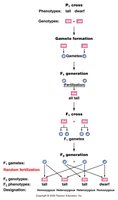
Unit factors in pairs: Genes exist in pairs in organisms, one inherited from each parent.
Dominance/recessiveness: In a pair of genes, one may mask the expression of the other (dominant vs. recessive).
Segregation: During gamete formation, paired genes separate so that each gamete receives only one.
Independent assortment: Genes for different traits assort independently during gamete formation.
Example: In pea plants, the gene for tallness (T) is dominant over dwarfness (t).
Chromosome Theory of Inheritance
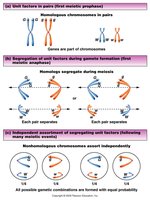
The chromosome theory of inheritance connects Mendel’s principles to the behavior of chromosomes during meiosis. Genes are located on chromosomes, and their segregation and independent assortment are explained by the movement of chromosomes during cell division.
Unit factors in pairs: Homologous chromosomes carry gene pairs.
Segregation: Homologous chromosomes separate during meiosis I.
Independent assortment: Chromosomes assort independently, forming various combinations.
Mendelian Crosses: Methods
Punnett Square
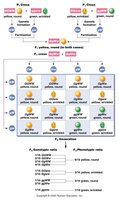
The Punnett square is a diagram used to predict the outcome of a genetic cross. It shows all possible combinations of parental alleles and their resulting genotypes and phenotypes.
One-factor cross: Involves a single gene pair (e.g., Tt x Tt).
Two-factor cross: Involves two gene pairs (e.g., AaBb x AaBb).
Forked-Line Method (Branch Diagram)
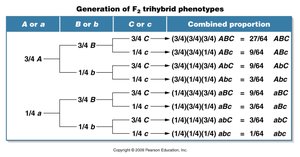
The forked-line method is used for multi-gene crosses, allowing calculation of genotype and phenotype frequencies by branching probabilities for each gene pair.
Step 1: Determine all possible gametes from each parent.
Step 2: Determine all possible combinations of gametes from both parents.
Step 3: Translate genotype to phenotype.
Test Cross
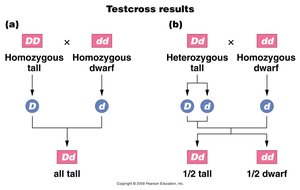
A test cross is used to determine the genotype of an individual with a dominant phenotype by crossing it with a homozygous recessive individual.
Purpose: To reveal whether the dominant phenotype is homozygous or heterozygous.
Results: If all offspring show the dominant trait, the parent is homozygous; if offspring are split, the parent is heterozygous.
Probability in Mendelian Genetics
Sum Rule
The sum rule is used to calculate the probability of an outcome that can occur in multiple ways. Add the probabilities of each independent event.
Example: Probability of getting heads or tails in a coin toss:
Product Rule
The product rule is used to calculate the probability of two independent events occurring together. Multiply the probabilities of each event.
Example: Probability of getting heads twice in two coin tosses:
Conditional Probability
Conditional probability is the probability of an event given that another event has occurred. It is calculated as:
Example: Probability that a tall F2 plant is heterozygous:
Binomial Theorem
The binomial theorem is used to calculate the probability of specific combinations of outcomes in situations with two possible outcomes (e.g., boy/girl, dominant/recessive).
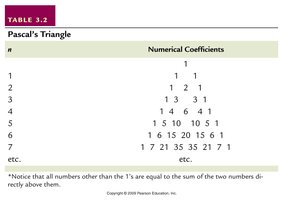
Coefficients: Number of ways a combination can occur, calculated using Pascal’s Triangle or the binomial formula.
Formula: where n = total events, s = number of times a occurs, t = number of times b occurs.
Pedigree Analysis
Modes of Inheritance
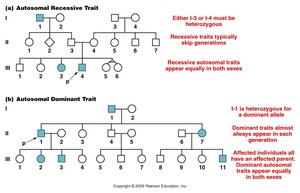
Pedigree analysis is used to study inheritance patterns in families. Two common modes are autosomal dominant and autosomal recessive inheritance.
Autosomal recessive: Traits typically skip generations and appear equally in both sexes.
Autosomal dominant: Traits appear in every generation and affect both sexes equally.
Useful Mathematical Rules for Mendelian Crosses
Number of Gametes, Genotypes, and Phenotypes
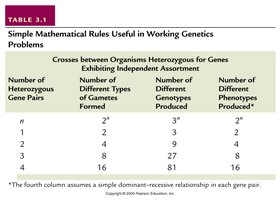
Simple mathematical rules help predict the number of possible gametes, genotypes, and phenotypes in crosses involving multiple gene pairs.
Number of Heterozygous Gene Pairs (n) | Number of Gametes | Number of Genotypes | Number of Phenotypes |
|---|---|---|---|
1 | 2 | 3 | 2 |
2 | 4 | 9 | 4 |
3 | 8 | 27 | 8 |
4 | 16 | 81 | 16 |
Sample Problems and Applications
Practice problems in Mendelian genetics often involve calculating the number of gametes, using the product rule, and applying the binomial theorem to predict outcomes in genetic crosses.
Number of gametes: where n = number of heterozygous gene pairs.
Product rule: Multiply probabilities for independent events.
Binomial theorem: Calculate probabilities for combinations in multiple trials.
Example: In a cross involving three gene pairs, the number of possible gametes is .
Conclusion
Mendelian genetics provides a framework for understanding inheritance patterns, predicting outcomes of genetic crosses, and applying probability to biological phenomena. Mastery of these principles is essential for further study in genetics, including extensions of Mendel’s principles and more complex inheritance patterns.
