 뒤로
뒤로Non-Mendelian and Extranuclear Inheritance: Study Notes for Genetics
스터디 가이드 - 스마트 노트
 자료에 맞춘 맞춤형 노트, 핵심 정의, 예시, 맥락을 확장해 제공합니다.
Non-Mendelian Inheritance
Overview of Non-Mendelian Inheritance
Non-Mendelian inheritance refers to genetic patterns that do not follow the classic laws established by Gregor Mendel. These include inheritance mechanisms involving extranuclear DNA, maternal effects, and infectious inheritance.
Extranuclear inheritance: Transmission of genetic material located outside the nucleus, such as in mitochondria and chloroplasts.
Maternal effect: Phenotype of offspring is determined by the genotype of the mother, not the offspring's own genotype.
Infectious inheritance: Traits are influenced by symbiotic or parasitic microorganisms present in the cytoplasm.
Extranuclear (Organellar) Inheritance
Chloroplast DNA (cpDNA) and Mitochondrial DNA (mtDNA)
Extranuclear inheritance involves genes found in organelles such as mitochondria and chloroplasts. These genes are inherited differently from nuclear genes, often showing uniparental (usually maternal) inheritance.
Chloroplast DNA (cpDNA): Circular, double-stranded, and distinct from nuclear DNA. Contains genes for photosynthesis and other functions.
Mitochondrial DNA (mtDNA): Circular, double-stranded, and encodes genes for respiration and energy production.
Chloroplastic Inheritance: Four o'clock Plants (Mirabilis jalapa)
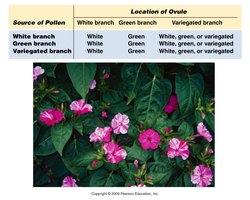
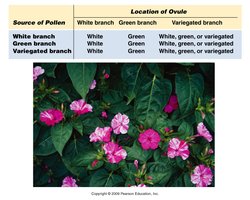
The inheritance of leaf color in four o'clock plants demonstrates maternal inheritance of chloroplasts. The phenotype of the offspring depends on the branch (ovule location) from which the egg is derived, not the pollen source.
White, green, and variegated branches produce offspring with corresponding leaf colors, regardless of pollen source.
This pattern is due to the transmission of chloroplasts from the mother plant.
Source of Pollen | White branch | Green branch | Variegated branch |
|---|---|---|---|
White branch | White | Green | White, green, or variegated |
Green branch | White | Green | White, green, or variegated |
Variegated branch | White | Green | White, green, or variegated |
Mechanism of Chloroplast Inheritance
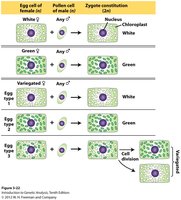
Chloroplasts are inherited from the egg cell, and the zygote's chloroplasts determine leaf color.
Eggs from white branches have only white chloroplasts; eggs from green branches have only green chloroplasts.
Variegated branches can produce eggs with either type or a mixture.
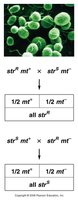
Chloroplastic Inheritance: Chlamydomonas strR
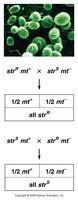
Two mating types: mt+ and mt-.
Chloroplast gene (strR) inheritance depends on mating type.
When mt+ mates with mt-, all progeny inherit strR from mt+.
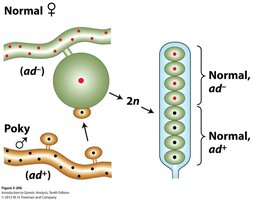
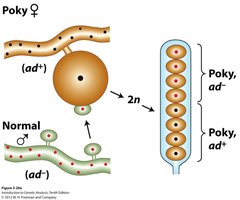
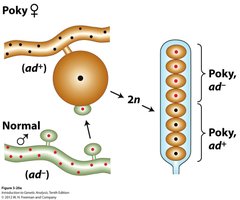
Mitochondrial Inheritance: Neurospora poky Mutants
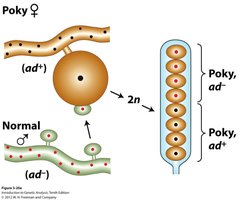
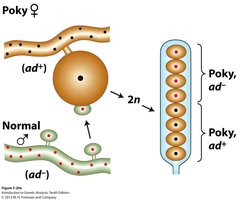
poky x WT (female poky): All progeny are poky.
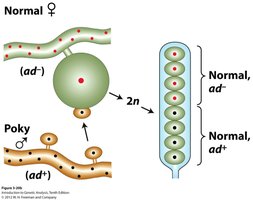
WT x poky (female WT): All progeny are WT.
Demonstrates maternal inheritance of mitochondria.
Mitochondrial Inheritance: Yeast Petite Mutants
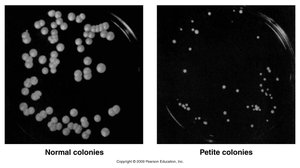
Petite mutants have defective mitochondria and form small colonies.
Inheritance can be biparental, but often shows maternal bias.
Types of Yeast Petite Mutants
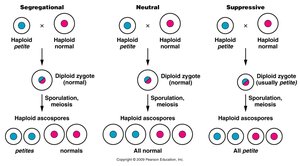
Nuclear: Segregational petites, inherited according to Mendelian rules.
Mitochondrial Neutral: All progeny are normal when crossed with normal.
Mitochondrial Suppressive: All progeny are petite when crossed with normal.
Molecular Features of cpDNA and mtDNA
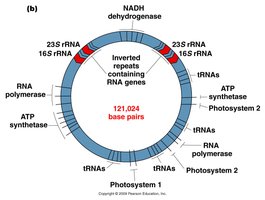
Chloroplast DNA (cpDNA)
cpDNA is circular, double-stranded, and lacks associated proteins. It is larger than mtDNA and contains genes for photosynthesis, transcription, and translation.
Size: ~100-225 kb
Contains photosynthetic genes, tRNAs, rRNAs, and non-coding regions
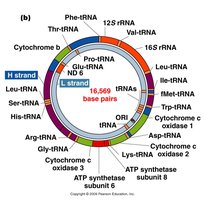
Mitochondrial DNA (mtDNA)
mtDNA is circular, double-stranded, and encodes genes for respiration and translation. It is smaller and has fewer non-coding regions than cpDNA.
Size: ~16-18 kb (in humans), variable in other organisms
Contains genes for respiratory proteins, tRNAs, rRNAs
Modified genetic code
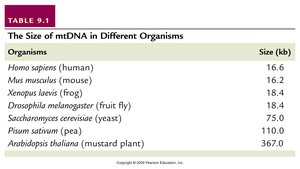
Size of mtDNA in Different Organisms
Organisms | Size (kb) |
|---|---|
Homo sapiens (human) | 16.6 |
Mus musculus (mouse) | 16.2 |
Xenopus laevis (frog) | 18.4 |
Drosophila melanogaster (fruit fly) | 18.4 |
Saccharomyces cerevisiae (yeast) | 75.0 |
Pisum sativum (pea) | 110.0 |
Arabidopsis thaliana (mustard plant) | 367.0 |
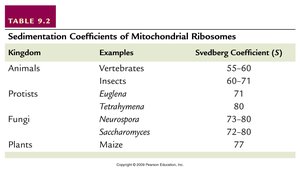
Sedimentation Coefficients of Mitochondrial Ribosomes
Kingdom | Examples | Svedberg Coefficient (S) |
|---|---|---|
Animals | Vertebrates | 55-60 |
Animals | Insects | 60-71 |
Protists | Euglena | 71 |
Protists | Tetrahymena | 80 |
Fungi | Neurospora | 73-80 |
Fungi | Saccharomyces | 72-80 |
Plants | Maize | 77 |
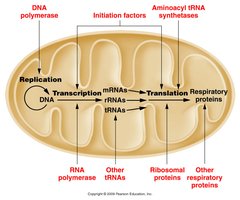
Mitochondrial Function and Gene Expression
Mitochondria carry out replication, transcription, and translation of their own DNA, producing proteins essential for respiration.
DNA polymerase, RNA polymerase, and ribosomes are present in mitochondria.
Proteins encoded by mtDNA are involved in oxidative phosphorylation.
Human Mitochondrial Mutations
Maternal (Non-Mendelian) Inheritance
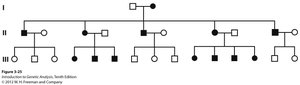
Mutations in mitochondrial genes are inherited maternally and can cause deficiencies in bioenergetic functions, affecting tissues with high energy demand.
Heteroplasmy: Presence of both normal and mutant mtDNA in a cell.
Diseases include Myoclonic epilepsy and ragged red fiber disease (MERRF), Leber’s hereditary optic neuropathy (LHON), and Kearns-Sayre syndrome (KSS).
Maternal Effect
Definition and Mechanism
Maternal effect occurs when the phenotype of the offspring is determined by the genotype of the mother, due to gene products stored in the egg.
Maternal genes are expressed in maternal tissues and influence the phenotype of the embryo/progeny.
Phenotype is dependent on maternal genotype, not paternal or zygotic genotype.
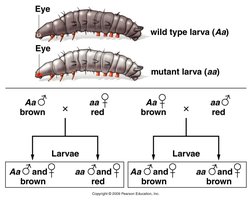
Example: Ephesia Pigmentation
A = functional pigment gene; a = non-functional.
Offspring become red as inherited pigment is diluted.
Example: Limnaea Coiling
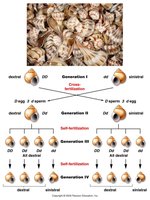
Direction of shell coiling in snails is determined by the maternal genotype.
Phenotype of offspring is not determined by their own genotype, but by the genotype of their mother.
Maternal Effect in Drosophila Embryogenesis
Maternal genes such as bicoid (bcd) are expressed in the egg and establish the anterior-posterior axis in the embryo.
Maternal vs. zygotic expression is crucial for early development.
Summary Table: Key Features of Extranuclear Inheritance
Type | Inheritance Pattern | Example |
|---|---|---|
Chloroplast | Maternal | Four o'clock plant leaf color |
Mitochondrial | Maternal | Neurospora poky mutants, human mitochondrial diseases |
Maternal Effect | Maternal genotype determines offspring phenotype | Limnaea coiling, Ephesia pigmentation, Drosophila embryogenesis |
Additional info: Academic context was added to clarify mechanisms, provide definitions, and expand on examples for completeness.
