뒤로
뒤로Sex Determination, Chromosomal Variation, and Extranuclear Inheritance
스터디 가이드 - 스마트 노트
 자료에 맞춘 맞춤형 노트, 핵심 정의, 예시, 맥락을 확장해 제공합니다.
Sex Determination and Sex Chromosomes
Introduction to Sex Determination
Sexual reproduction in diploid eukaryotes relies on the union of gametes, with sexual differentiation resulting in phenotypic dimorphism. Sex chromosomes, such as X and Y, are heteromorphic and distinguish one sex from another in many species. Some individuals exhibit intersex traits, which do not fit binary male or female categories.
X and Y Chromosomes in Sex Determination
The discovery of X and Y chromosomes as determinants of sex was a major milestone in genetics. Different species use various chromosomal systems for sex determination:
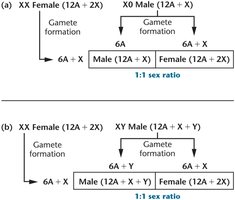
Protenor (XX/XO system): Females have two X chromosomes (XX), males have one (XO). Sex is determined by the random distribution of the X chromosome during gamete formation.
Lygaeus (XX/XY system): Females are XX, males are XY. Males produce gametes with either an X or Y chromosome, resulting in a 1:1 sex ratio.
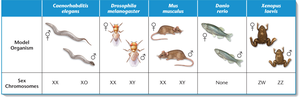
Some species, such as birds, have heterogametic females (ZW) and homogametic males (ZZ).
Sex Determination in Humans
Humans have 22 pairs of autosomes and one pair of sex chromosomes. Females are XX, males are XY. The Y chromosome determines maleness and contains the SRY gene, which encodes the testis-determining factor (TDF).
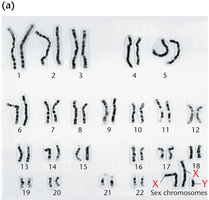
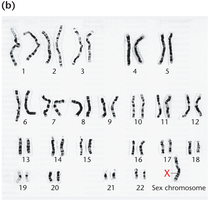
Klinefelter syndrome (47,XXY): Males with extra X chromosome, tall stature, underdeveloped testes, and some feminine features.
Turner syndrome (45,X): Females with a single X chromosome, short stature, underdeveloped ovaries, and other physical anomalies.
47,XXX syndrome: Females with three X chromosomes, variable effects.
47,XYY condition: Males with two Y chromosomes, often tall with possible intellectual disabilities.
Y Chromosome Structure and Function
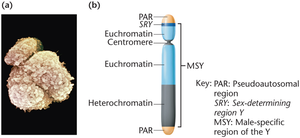
The Y chromosome contains about 75 genes, fewer than the X chromosome. Key regions include:
Pseudoautosomal regions (PARs): Homologous with X chromosome, allow pairing during meiosis.
MSY (Male-specific region of Y): Nonrecombining region, contains SRY gene.
SRY (Sex-determining region Y): Encodes TDF, triggers male development at 6–8 weeks of embryogenesis.
Sex Ratio in Humans
The sex ratio is the proportion of males to females in a population. The primary sex ratio refers to conception, while the secondary sex ratio refers to live births. Slightly more males are conceived and born than females, possibly due to equal production of X- and Y-bearing sperm and other biological factors.
Dosage Compensation and X-Inactivation
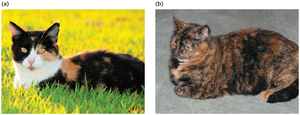
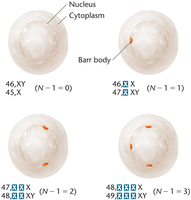
Dosage compensation balances X-linked gene expression between males (XY) and females (XX). In mammals, one X chromosome in females is randomly inactivated, forming a Barr body. This process is called X-inactivation and is explained by the Lyon hypothesis.
Barr bodies: Inactive, condensed X chromosomes visible in interphase cells.
Lyon hypothesis: X-inactivation is random and occurs early in embryonic development; all descendant cells maintain the same inactive X.
X-inactivation center (Xic): Region on X chromosome controlling inactivation, includes XIST gene.
Sex Determination in Drosophila and Other Species
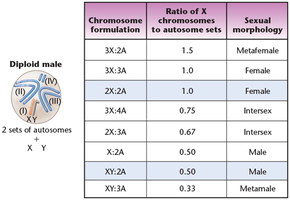
In Drosophila, sex is determined by the ratio of X chromosomes to sets of autosomes (A):
Chromosome Formulation | Ratio (X:A) | Sexual Morphology |
|---|---|---|
3X:2A | 1.5 | Metafemale |
2X:2A | 1.0 | Female |
XY:2A | 0.5 | Male |
XY:3A | 0.33 | Metamale |
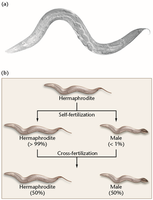
In Caenorhabditis elegans, most individuals are hermaphrodites (XX), with a small proportion of males (XO). Hermaphrodites can self-fertilize or mate with males.
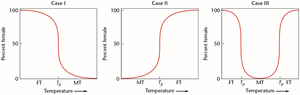
Temperature-Dependent Sex Determination in Reptiles
In many reptiles, sex is determined by the temperature during egg incubation. There are three main patterns of temperature-dependent sex determination (TSD), affecting the proportion of males and females produced.
Chromosome Mutations: Variation in Number and Arrangement
Introduction to Chromosome Mutations
Chromosome mutations (aberrations) involve changes in chromosome number or structure, leading to phenotypic variation. These include deletions, duplications, inversions, and translocations.
Variation in Chromosome Number: Terminology and Origin
Aneuploidy: Gain or loss of one or more chromosomes (e.g., monosomy, trisomy).
Euploidy: Complete sets of chromosomes (e.g., diploid, triploid, tetraploid).
Polyploidy: More than two sets of chromosomes, common in plants.
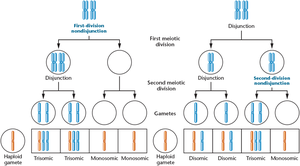
Nondisjunction during meiosis leads to aneuploidy by failing to separate homologous chromosomes properly.