 뒤로
Transcription and the Genetic Code: From DNA to RNA to Protein
스터디 가이드 - 스마트 노트
 자료에 맞춘 맞춤형 노트, 핵심 정의, 예시, 맥락을 확장해 제공합니다.
Transcription and the Genetic Code
Central Dogma of Molecular Biology
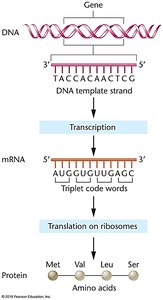
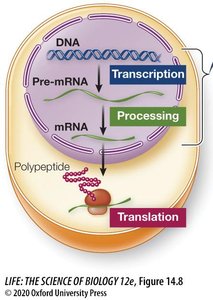
The central dogma describes the flow of genetic information from DNA to RNA to protein. This process involves two main steps: transcription and translation. Transcription is the synthesis of RNA from a DNA template, while translation is the synthesis of proteins from an RNA template.
Gene expression is regulated at multiple levels, including transcription and translation.
RNA acts as an intermediate between the gene (DNA) and the protein product.
Transcription produces an RNA sequence complementary to the DNA template strand.
Translation uses the RNA sequence as a template to assemble amino acids into a polypeptide.
DNA and RNA: Structure and Function
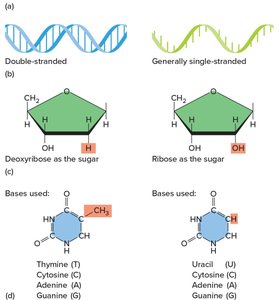
DNA and RNA are nucleic acids with distinct structural and functional properties. DNA stores genetic information, while RNA carries and processes this information for protein synthesis.
DNA is double-stranded, contains deoxyribose sugar, and uses the bases adenine (A), thymine (T), cytosine (C), and guanine (G).
RNA is generally single-stranded, contains ribose sugar, and uses the bases adenine (A), uracil (U), cytosine (C), and guanine (G).
RNA can function as an enzyme (ribozymes), while DNA cannot.
DNA is stable and persists, whereas RNA is short-lived.
Mechanism of Transcription
Overview of Transcription
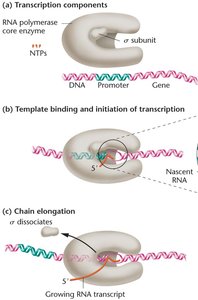
Transcription is the process by which RNA polymerase synthesizes RNA from a DNA template. It consists of three main stages: initiation, elongation, and termination.
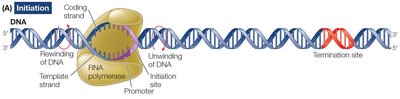
Initiation: RNA polymerase binds to the promoter region of DNA and unwinds the helix.
Elongation: RNA polymerase reads the template strand and synthesizes the RNA molecule.
Termination: RNA polymerase and the newly synthesized RNA are released from the DNA template.
RNA Polymerase (Prokaryotes)
Prokaryotic RNA polymerase is a multi-subunit enzyme responsible for transcription. It does not require a primer and can both initiate and elongate RNA synthesis.
Requires a DNA template and nucleoside triphosphates (NTPs).
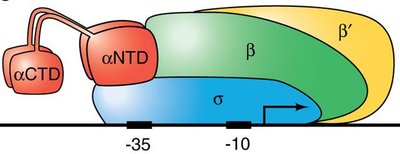
Core enzyme consists of multiple subunits: α (regulatory), β (catalytic), β' (DNA binding), ω (assembly), and σ (promoter recognition).
Holoenzyme includes the σ factor for initiation.
Initiation of Transcription
Transcription initiation involves the recognition of promoter sequences by RNA polymerase and associated factors. The promoter positions the polymerase for accurate transcription start.
Promoter regions contain consensus sequences such as the -10 (TATA/Pribnow box) and -35 elements in prokaryotes.
RNA polymerase holoenzyme binds to the promoter, forming a closed complex, then transitions to an open complex with a DNA bubble.
Abortive transcripts may be produced before promoter escape and processive elongation.
Elongation of Transcription
During elongation, RNA polymerase synthesizes RNA by reading the DNA template strand in the 3' to 5' direction and writing the RNA in the 5' to 3' direction.
RNA polymerase unwinds DNA, creating a transcription bubble (~10 base pairs).
RNA transcript is antiparallel and complementary to the DNA template strand.
RNA polymerase proofreads and corrects errors during synthesis.
Termination of Transcription
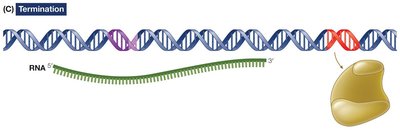
Termination occurs when RNA polymerase encounters a terminator sequence, leading to the release of the RNA transcript and dissociation from the DNA template.
Two main mechanisms: intrinsic (Rho-independent) and Rho-dependent.
Intrinsic termination involves a GC-rich inverted repeat followed by a poly-U sequence, forming a hairpin loop that stalls RNA polymerase.
Rho-dependent termination requires the Rho factor, which binds to the rut site and disrupts the RNA-DNA hybrid.
Transcription in Eukaryotes
Differences from Prokaryotes
Eukaryotic transcription occurs in the nucleus and involves three distinct RNA polymerases, chromatin remodeling, and complex regulation by transcription factors and regulatory elements.
RNA polymerase I, II, and III transcribe different classes of genes.
Chromatin structure must be relaxed for transcription to occur.
General transcription factors (GTFs) and regulatory elements (enhancers, silencers) modulate transcription.
Post-transcriptional processing includes splicing, 5'-capping, polyadenylation, and RNA editing.
Promoter Structure and Transcription Factors (Eukaryotes)
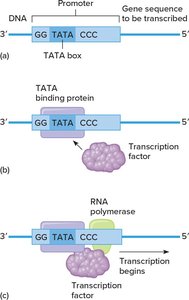
Eukaryotic promoters contain multiple cis-acting elements, including the core promoter (TATA box), proximal elements, and distal enhancers/silencers. Transcription factors facilitate RNA polymerase binding and regulate gene expression.
Core promoter: -30 TATA box (Goldberg-Hogness box), consensus sequence TATA(A/T)AAR.
General transcription factors (TFII family) assemble at the promoter to form the pre-initiation complex (PIC).
Regulatory transcription factors act as activators or repressors, linking gene expression to environmental signals.
Termination and Polyadenylation (Eukaryotes)
Termination in eukaryotes is linked to polyadenylation. Cleavage of the pre-mRNA at the polyadenylation signal destabilizes RNA polymerase II, leading to dissociation.
Polyadenylation signal: AAUAAA and G/U sequences.
Protein factors cleave pre-mRNA and add a poly-A tail (up to 500 adenines).
Xrn2 exonuclease degrades RNA and dislodges RNA polymerase II.
Post-Transcriptional Modifications
Eukaryotic pre-mRNA undergoes several modifications before becoming mature mRNA. These modifications are essential for mRNA stability, nuclear export, and translation.
Addition of a 5'-cap (m7G) for stability and ribosome recognition.
Splicing removes introns and joins exons.
Polyadenylation adds a poly-A tail for stability and translation efficiency.
RNA editing alters individual nucleotides, producing transcript diversity.
Splicing and Alternative Splicing
Splicing removes introns from pre-mRNA, leaving only exons in the mature mRNA. Alternative splicing allows a single gene to produce multiple protein variants.
Spliceosome-mediated splicing involves snRNAs and snRNPs recognizing consensus sequences at exon-intron boundaries.
Self-splicing introns use ribozymes for auto-catalytic removal.
Alternative splicing can involve exon skipping, intron retention, and regulation by cis and trans factors.
RNA Editing
RNA editing modifies individual nucleotides in the RNA sequence, resulting in transcript and protein diversity. It is distinct from splicing and can involve base substitution or insertion/deletion.
Deaminase enzymes alter codons (e.g., C to U, A to I).
Editing can produce truncated or functionally altered proteins.
The Genetic Code
Structure and Properties of the Genetic Code
The genetic code specifies which amino acids are used to build proteins. It is a triplet code, with each codon consisting of three nucleotides.
There are 64 possible codons: 61 code for amino acids, 1 codes for START, and 3 are STOP codons.
The code is degenerate (redundant but not ambiguous), allowing multiple codons for the same amino acid.
The wobble hypothesis explains flexible base pairing at the third codon position.
The code is nearly universal across organisms, with minor exceptions.
Codons are non-overlapping within an open reading frame (ORF).
Examples and Applications
Mutations that alter the reading frame (frameshift mutations) disrupt protein synthesis.
Conservative substitutions at the second codon position often result in similar amino acids.
Multiple, overlapping ORFs can exist within the same transcript (e.g., bacteriophage φX174).
