Ch. 7 - Sex Determination and Sex Chromosomes
Klug - Concepts of Genetics 12th Edition
Klug12th EditionConcepts of GeneticsISBN: 9780135564776당신이 사용하는 게 아니라요?교과서 변경
7장, 문제 22

The genes encoding the red- and green-color-detecting proteins of the human eye are located next to one another on the X chromosome and probably evolved from a common ancestral pigment gene. The two proteins demonstrate 76 percent homology in their amino acid sequences. A normal-visioned woman (with both genes present on each of her two X chromosomes) has a red-color-blind son who was shown to have one copy of the green-detecting gene and no copies of the red-detecting gene. Devise an explanation for these observations at the chromosomal level (involving meiosis).

검증된 단계별 안내
1
Step 1: Understand the genetic context. The red- and green-color-detecting genes are located close together on the X chromosome, which means they are linked genes. Since males have only one X chromosome, they inherit their X chromosome from their mother and a Y chromosome from their father.
Step 2: Consider the mother's genotype. She has two X chromosomes, each carrying both the red- and green-detecting genes. This means she is likely heterozygous or homozygous for these genes, with normal vision because both genes are present on each X chromosome.
Step 3: Analyze meiosis in the mother. During meiosis, homologous chromosomes undergo recombination (crossing over), which can exchange segments between the red- and green-detecting gene loci. This can produce recombinant X chromosomes with altered gene combinations.
Step 4: Explain the son's genotype. The son inherited one X chromosome from his mother that contains the green-detecting gene but lacks the red-detecting gene. This suggests that a deletion or unequal crossing over occurred during meiosis, removing the red-detecting gene from that X chromosome.
Step 5: Summarize the chromosomal explanation. The son's red-color blindness results from inheriting an X chromosome missing the red-detecting gene due to a recombination event or deletion during maternal meiosis, while retaining the green-detecting gene. This explains the presence of one green gene and absence of the red gene on his single X chromosome.

비슷한 문제에 대한 검증된 영상 답변:

이 영상 해법은 위 문제에 도움이 된다고 튜터들이 추천한 것입니다.
영상 길이:
1m

주요 개념

질문에 올바르게 답하기 위해 반드시 이해해야 하는 핵심 개념들은 다음과 같습니다.

X-linked Inheritance

X-linked inheritance refers to genes located on the X chromosome, which affect males and females differently due to their sex chromosome composition. Males have one X and one Y chromosome, so a single defective gene on the X chromosome can cause a trait or disorder, like red-green color blindness, to be expressed. Females have two X chromosomes, so they can be carriers without showing symptoms if only one X carries the mutation.
추천 영상:

Meiosis and Chromosomal Segregation

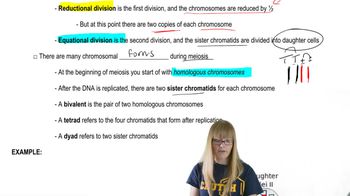
Meiosis is the process of cell division that produces gametes with half the chromosome number. During meiosis, homologous chromosomes pair and can exchange segments through crossing over. This recombination can lead to deletions or duplications of genes, explaining how a son might inherit a missing red-detecting gene if a crossover event deleted it on the X chromosome inherited from his mother.
추천 영상:
가이드 코스
05:30
Meiosis Overview

Gene Duplication and Homology

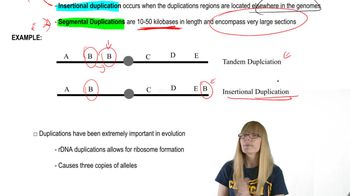
Gene duplication occurs when a gene is copied in the genome, often leading to gene families with similar sequences and functions. The red- and green-detecting pigment genes are paralogs, sharing 76% amino acid sequence homology, indicating they evolved from a common ancestral gene. Their close proximity on the X chromosome makes them susceptible to unequal crossing over, which can cause gene loss or rearrangement.
추천 영상:
관련 실천
교과서 질문

Cat breeders are aware that kittens expressing the X-linked calico coat pattern and tortoiseshell pattern are almost invariably females. Why are they certain of this?

493
views
교과서 질문
What is the role of the enzyme aromatase in sexual differentiation in reptiles?
697
views
교과서 질문

Predict the potential effect of the Lyon hypothesis on the retina of a human female heterozygous for the X-linked red-green color blindness trait.

685
views
교과서 질문

In mice, the Sry gene is located on the Y chromosome very close to one of the pseudoautosomal regions that pairs with the X chromosome during male meiosis. Given this information, propose a model to explain the generation of unusual males who have two X chromosomes (with an Sry-containing piece of the Y chromosome attached to one X chromosome).

1027
views
교과서 질문

In the wasp Bracon hebetor, a form of parthenogenesis (the development of unfertilized eggs into progeny) resulting in haploid organisms is not uncommon. All haploids are males. When offspring arise from fertilization, females almost invariably result. P. W. Whiting has shown that an X-linked gene with nine multiple alleles (Xₐ, Xb, etc.) controls sex determination. Any homozygous or hemizygous condition results in males, and any heterozygous condition results in females. If an Xₐ/Xb female mates with an Xₐ male and lays 50 percent fertilized and 50 percent unfertilized eggs, what proportion of male and female offspring will result?

613
views
교과서 질문

The Amami spiny rat (Tokudaia osimensis) lacks a Y chromosome, yet scientists at Hokkaido University in Japan have reported that key sex-determining genes continue to be expressed in this species. Provide possible explanations for why male differentiation can still occur in this mammalian species despite the absence of a Y chromosome.

844
views