Reciprocal crosses of experimental animals or plants sometimes give different results in the F1. What are two possible genetic explanations? How would you distinguish between these two possibilities (i.e., what crosses would you perform, and what would the results tell you)?
Ch. 17 - Organelle Inheritance and the Evolution of Organelle Genomes

17장, 문제 2
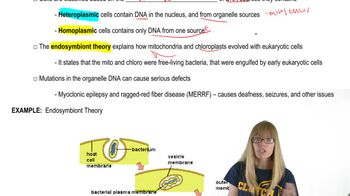
How are some of the characteristics of the organelles (the mitochondria and chloroplasts) explained by their origin as ancient bacterial endosymbionts?
검증된 단계별 안내1
span>Step 1: Understand the endosymbiotic theory, which suggests that mitochondria and chloroplasts originated from free-living bacteria that were engulfed by an ancestral eukaryotic cell.
span>Step 2: Recognize that mitochondria and chloroplasts have their own DNA, which is circular and similar to bacterial DNA, supporting the idea of their bacterial origin.
span>Step 3: Note that these organelles have double membranes, consistent with the engulfing mechanism where the inner membrane is derived from the original bacterial membrane and the outer membrane from the host cell's membrane.
span>Step 4: Observe that mitochondria and chloroplasts replicate independently of the cell cycle through a process similar to binary fission, which is characteristic of bacteria.
span>Step 5: Consider the presence of ribosomes within mitochondria and chloroplasts that resemble bacterial ribosomes in size and sensitivity to antibiotics, further supporting their bacterial ancestry.

비슷한 문제에 대한 검증된 영상 답변:
이 영상 해법은 위 문제에 도움이 된다고 튜터들이 추천한 것입니다.
영상 길이:
2m주요 개념
질문에 올바르게 답하기 위해 반드시 이해해야 하는 핵심 개념들은 다음과 같습니다.
Endosymbiotic Theory
The endosymbiotic theory posits that certain organelles, specifically mitochondria and chloroplasts, originated from free-living bacteria that were engulfed by ancestral eukaryotic cells. This symbiotic relationship allowed the host cell to utilize the bacteria's metabolic capabilities, leading to the evolution of complex cells. Evidence supporting this theory includes similarities in DNA and ribosomes between these organelles and prokaryotic cells.
추천 영상:
가이드 코스
Organelle DNA Characteristics
Mitochondrial Function
Mitochondria are known as the powerhouses of the cell, responsible for producing adenosine triphosphate (ATP) through cellular respiration. Their bacterial ancestry is reflected in their double membrane structure and the presence of their own circular DNA, which is similar to that of bacteria. This unique origin allows mitochondria to perform specialized functions that are crucial for energy metabolism in eukaryotic cells.
추천 영상:
가이드 코스
Functional Genomics
Chloroplast Function
Chloroplasts are organelles found in plant cells and some protists, responsible for photosynthesis, the process of converting light energy into chemical energy. Like mitochondria, chloroplasts have a double membrane and contain their own DNA, indicating their evolutionary origin from cyanobacteria. This relationship explains their ability to capture sunlight and produce glucose, which is vital for plant energy and growth.
추천 영상:
가이드 코스
Functional Genomics
관련 실천
교과서 질문
717
views
교과서 질문
Draw a graph depicting the relative amounts of nuclear DNA present in the different stages of the cell cycle (G₁,S,G₂,M). On the same graph, plot the amount of mitochondrial DNA present at each stage of the cell cycle.
470
views
교과서 질문
What is the evidence that transfer of DNA from the organelles to the nucleus continues to occur?
454
views
교과서 질문
The human mitochondrial genome encodes only 22 tRNAs, but at least 32 tRNAs are needed for cytoplasmic translation. How are all codons in mitochondrial transcripts accommodated by only 22 tRNAs? The Plasmodium mitochondrial genome does not encode any tRNAs; how are genes of the Plasmodium mitochondrial genome translated?
814
views
