Reciprocal crosses of experimental animals or plants sometimes give different results in the F1. What are two possible genetic explanations? How would you distinguish between these two possibilities (i.e., what crosses would you perform, and what would the results tell you)?
Ch. 17 - Organelle Inheritance and the Evolution of Organelle Genomes

17장, 문제 3
The human mitochondrial genome encodes only 22 tRNAs, but at least 32 tRNAs are needed for cytoplasmic translation. How are all codons in mitochondrial transcripts accommodated by only 22 tRNAs? The Plasmodium mitochondrial genome does not encode any tRNAs; how are genes of the Plasmodium mitochondrial genome translated?
검증된 단계별 안내1
Understand the problem: The human mitochondrial genome encodes only 22 tRNAs, which is fewer than the 32 tRNAs required for cytoplasmic translation. Additionally, the Plasmodium mitochondrial genome does not encode any tRNAs. The question asks how translation is accomplished in these cases.
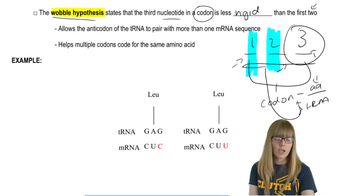
Step 1: Recognize the concept of 'wobble base pairing.' In mitochondria, the genetic code is slightly different from the standard code, and fewer tRNAs are required because of relaxed base-pairing rules at the third position of the codon. This allows one tRNA to recognize multiple codons.
Step 2: Explain how human mitochondria accommodate translation with only 22 tRNAs. The wobble hypothesis enables a single tRNA to pair with multiple codons that differ only at the third nucleotide position. This reduces the number of tRNAs needed for translation.
Step 3: Address the Plasmodium mitochondrial genome. Since it does not encode any tRNAs, translation of mitochondrial genes relies on importing tRNAs from the cytoplasm. These tRNAs are synthesized in the cytoplasm and transported into the mitochondria to facilitate translation.
Step 4: Summarize the key mechanisms: Human mitochondria use wobble base pairing to reduce the number of required tRNAs, while Plasmodium mitochondria import tRNAs from the cytoplasm to compensate for the lack of encoded tRNAs.

비슷한 문제에 대한 검증된 영상 답변:
이 영상 해법은 위 문제에 도움이 된다고 튜터들이 추천한 것입니다.
영상 길이:
2m주요 개념
질문에 올바르게 답하기 위해 반드시 이해해야 하는 핵심 개념들은 다음과 같습니다.
Mitochondrial Genome and tRNA
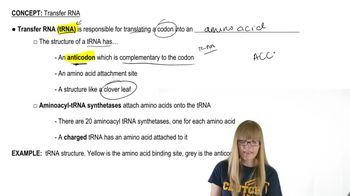
The mitochondrial genome is a small, circular DNA molecule found in mitochondria, encoding essential proteins and tRNAs for mitochondrial function. In humans, it encodes only 22 tRNAs, which are responsible for translating mitochondrial mRNA into proteins. This limited number of tRNAs is compensated by the ability of some tRNAs to recognize multiple codons due to wobble base pairing, allowing for efficient translation despite the apparent shortage.
추천 영상:
가이드 코스
tRNA
Codon Usage and Wobble Hypothesis
The wobble hypothesis explains how the third position of a codon can pair with multiple tRNA anticodons, allowing a single tRNA to recognize more than one codon. This flexibility is crucial in mitochondrial translation, where the limited number of tRNAs can still accommodate the full range of codons. This mechanism enables the translation of mitochondrial transcripts despite the fewer tRNAs available.
추천 영상:
가이드 코스
Translation:Wobble Hypothesis
Translation in Plasmodium Mitochondria
In Plasmodium, the organism responsible for malaria, the mitochondrial genome does not encode any tRNAs. Instead, translation of mitochondrial genes is facilitated by importing tRNAs from the cytoplasm. This adaptation allows Plasmodium to effectively translate its mitochondrial proteins without relying on its own tRNA synthesis, showcasing a unique evolutionary strategy.
추천 영상:
가이드 코스
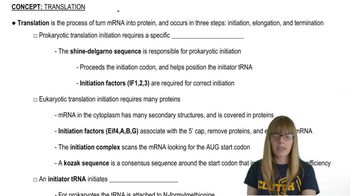
Translation initiation
관련 실천
교과서 질문
717
views
교과서 질문
Draw a graph depicting the relative amounts of nuclear DNA present in the different stages of the cell cycle (G₁,S,G₂,M). On the same graph, plot the amount of mitochondrial DNA present at each stage of the cell cycle.
470
views
교과서 질문
What is the evidence that transfer of DNA from the organelles to the nucleus continues to occur?
454
views
교과서 질문
How are some of the characteristics of the organelles (the mitochondria and chloroplasts) explained by their origin as ancient bacterial endosymbionts?
450
views
교과서 질문
What are the differences between the universal code and that found in the mitochondria of some species? Given that some changes (UGA =stop→Trp) have occurred multiple independent times in evolution, can you think of any selective advantage to the mitochondrial code?
789
views
