 뒤로
뒤로Acid-Base Equilibria and Transition-Metal Complexes: Study Notes for GOB Chemistry
스터디 가이드 - 스마트 노트
 자료에 맞춘 맞춤형 노트, 핵심 정의, 예시, 맥락을 확장해 제공합니다.
Acid-Base Equilibria
Introduction to Acids and Bases
Acids and bases are fundamental chemical species with distinct properties and behaviors in aqueous solutions. Understanding their definitions, strengths, and reactions is essential for mastering chemical equilibria and solution chemistry.
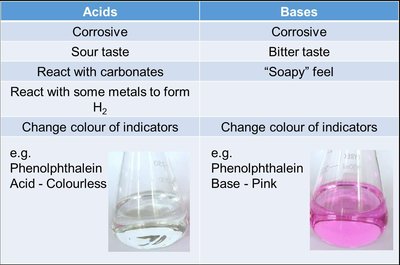
Acids: Substances that increase the concentration of H+ ions in water.
Bases: Substances that increase the concentration of OH- ions in water.
Corrosive nature: Both acids and bases can be corrosive, but acids typically taste sour and bases taste bitter and feel slippery.
Indicators: Substances that change color in the presence of acids or bases, such as phenolphthalein.
Arrhenius, Brønsted-Lowry, and Lewis Models
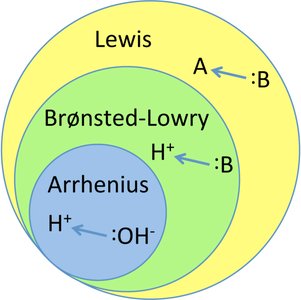
There are three main models for defining acids and bases, each broadening the scope of what constitutes an acid or base.
Arrhenius Model: Acids produce H+ in water; bases produce OH-.
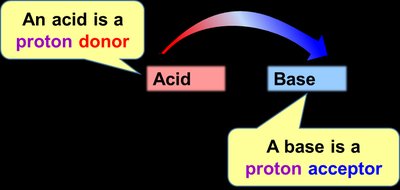
Brønsted-Lowry Model: Acids are proton donors; bases are proton acceptors.
Lewis Model: Acids accept electron pairs; bases donate electron pairs.
Strong and Weak Acids and Bases
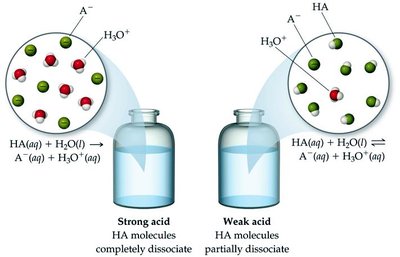
The strength of an acid or base depends on its degree of ionization in water.
Strong acids and bases: Ionize completely in water, acting as strong electrolytes.
Weak acids and bases: Ionize only partially, establishing equilibrium between ionized and unionized forms.
Polyprotic Acids
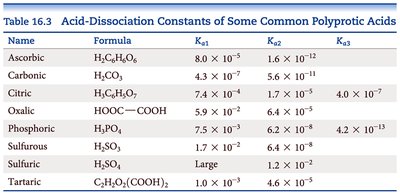
Polyprotic acids can donate more than one proton per molecule. Each ionization step has its own equilibrium constant (Ka).
Diprotic acids: Donate two protons (e.g., H2SO4).
Triprotic acids: Donate three protons (e.g., H3PO4).
Successive ionizations become less favorable (Ka1 > Ka2 > Ka3).
Autoionization of Water and the Ion-Product Constant (Kw)
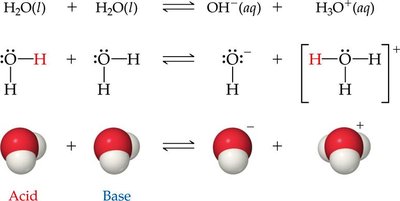
Water can act as both an acid and a base (amphiprotic), undergoing autoionization:
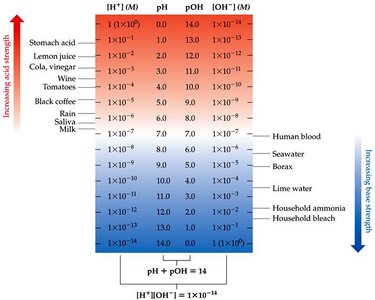
The equilibrium constant for this process is at 25°C.
The pH and pOH Scales
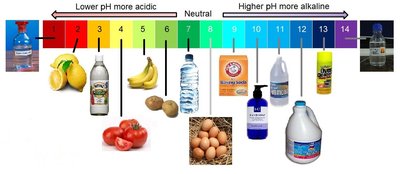
The pH scale quantifies the acidity or basicity of a solution. It is defined as:
at 25°C
Measuring pH
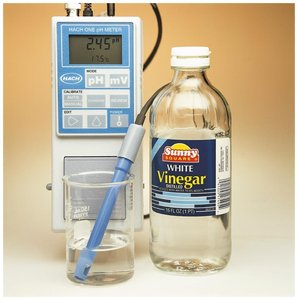
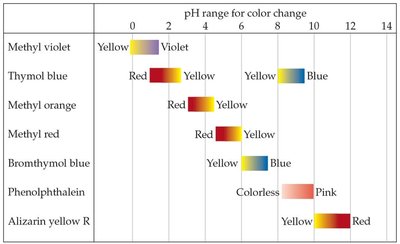
pH can be measured using pH meters for accuracy or indicators for quick, qualitative results.
pH meters: Use electrodes to detect voltage changes corresponding to pH.
Indicators: Compounds that change color depending on the pH of the solution.
Acid and Base Dissociation Constants (Ka and Kb)
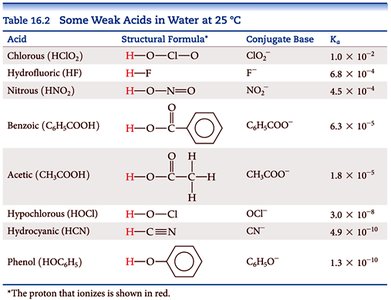
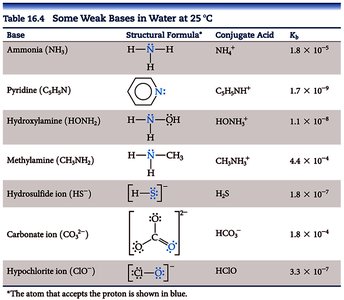
The strength of weak acids and bases is quantified by their dissociation constants:
pKa and pKb are the negative logarithms of Ka and Kb, respectively.
Relationship: at 25°C
Conjugate Acid-Base Pairs
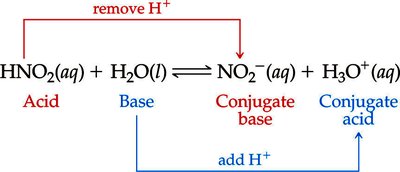
Every acid-base reaction involves the transfer of a proton, creating conjugate acid-base pairs. The acid donates a proton to become its conjugate base, and the base accepts a proton to become its conjugate acid.
Example:
Acid-Base Properties of Salt Solutions
Salts can produce acidic, basic, or neutral solutions depending on the acid-base properties of their constituent ions.
Anions of strong acids are neutral; anions of weak acids are basic.
Cations of strong bases are neutral; cations of weak bases or transition metals are acidic.
Factors Affecting Acid Strength
The strength of an acid depends on bond polarity, bond strength, and the stability of the conjugate base.
Binary acids: Strength increases with bond polarity and decreases with bond strength.
Oxyacids: Strength increases with the electronegativity of the central atom and the number of oxygen atoms.
Carboxylic acids: Resonance stabilization of the conjugate base increases acidity.
Transition-Metal Complexes
Metal-Ligand Bonding and Coordination Chemistry
Transition metals can form complex ions with molecules or ions called ligands. These complexes have unique chemical and physical properties, such as color and reactivity.
Ligands: Lewis bases that donate electron pairs to the metal center (Lewis acid).
Coordination number: The number of ligand atoms directly bonded to the metal ion, commonly 4 (tetrahedral/square planar) or 6 (octahedral).
Charge of complex: Sum of the charges of the metal ion and the ligands.
Summary Table: Key Acid-Base Concepts
Concept | Definition/Formula | Notes |
|---|---|---|
pH | Acidity scale (0-14) | |
pOH | Basicity scale (0-14) | |
Kw | Ion-product of water | |
Ka | Acid dissociation constant | |
Kb | Base dissociation constant | |
pKa | Lower pKa = stronger acid | |
pKb | Lower pKb = stronger base | |
Relationship | At 25°C |
Additional info: These notes cover all major aspects of acid-base equilibria, including definitions, calculations, and the relationship to chemical structure, as well as an introduction to transition-metal complexes as Lewis acid-base chemistry.
