 뒤로
뒤로Atoms and Radioactivity: Structure, Isotopes, and Medical Applications
스터디 가이드 - 스마트 노트
 자료에 맞춘 맞춤형 노트, 핵심 정의, 예시, 맥락을 확장해 제공합니다.
Atoms and Their Components
Subatomic Particles and Atomic Structure
Atoms are the fundamental building blocks of matter, composed of three main subatomic particles: protons, neutrons, and electrons. The arrangement and properties of these particles determine the identity and behavior of each element.
Protons: Positively charged particles located in the nucleus; each proton has a charge of +1 and a relative mass of 1 amu.
Neutrons: Neutral particles (no charge) also found in the nucleus; each neutron has a relative mass of 1 amu.
Electrons: Negatively charged particles found in the electron cloud surrounding the nucleus; each electron has a charge of -1 and a mass approximately 1/2000 that of a proton or neutron (effectively 0 amu).
The nucleus contains nearly all the mass of the atom, while the electron cloud occupies most of the atom's volume.
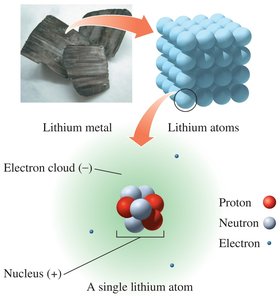
Additional info: The electron cloud is a region where electrons are likely to be found, and its size determines the atom's overall size.
Atomic Number and Mass Number
Defining Elements and Atomic Notation
The atomic number and mass number are essential for identifying elements and their isotopes. The atomic number is the number of protons in an atom, which defines the element. The mass number is the sum of protons and neutrons in the nucleus.
Atomic Number (Z): Number of protons in the nucleus; determines the element's identity and its position on the periodic table.
Mass Number (A): Total number of protons and neutrons in the nucleus.
Symbolic Notation: An element is represented as , where X is the element symbol, A is the mass number, and Z is the atomic number.
For a neutral atom, the number of electrons equals the number of protons.
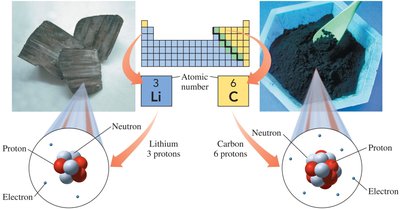

Example: For carbon-12: (6 protons, 6 neutrons, 6 electrons).
Isotopes and Atomic Mass
Understanding Isotopes and Calculating Atomic Mass
Isotopes are atoms of the same element with different numbers of neutrons, resulting in different mass numbers. The atomic mass of an element is the weighted average of the masses of all its naturally occurring isotopes.
Isotopes: Atoms with the same number of protons but different numbers of neutrons (e.g., , , ).
Atomic Mass: The average mass of all isotopes of an element, weighted by their natural abundance.
Isotopic notation can be written as the element name followed by the mass number (e.g., carbon-12).
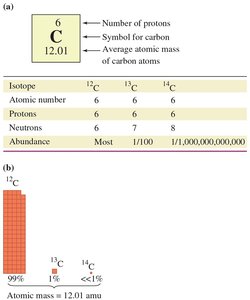
Example: Chlorine has two isotopes, chlorine-35 and chlorine-37. The atomic mass of chlorine (35.45 amu) indicates that chlorine-35 is more abundant.
Radioactivity and Radioisotopes
Types of Radiation and Their Properties
Radioactivity is the spontaneous emission of energy from the nucleus of unstable atoms. Radioisotopes are isotopes that emit radiation as they decay to become more stable. There are several types of nuclear radiation, each with distinct properties and biological effects.
Alpha (α) particles: Helium nuclei (), 2+ charge, low penetration (stopped by paper or skin).
Beta (β) particles: High-energy electrons (), 1- charge, moderate penetration (stopped by plastic or aluminum).
Gamma (γ) rays: High-energy electromagnetic radiation, no charge, high penetration (requires lead or concrete for shielding).
Positrons: Positive electrons (), emitted in some types of decay.
Neutrons: Neutral particles (), can penetrate deeply and are used to induce radioactivity.
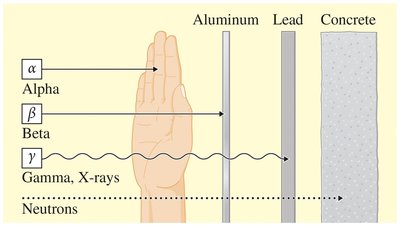
Biological Effects: Ionizing radiation can damage living cells by ionizing atoms, potentially leading to cancer or radiation sickness. The severity depends on the type, energy, and duration of exposure.
Penetration and Shielding of Radiation
Type | Penetration | Shielding |
|---|---|---|
Alpha (α) | Stops at skin | Paper, clothing |
Beta (β) | Will not penetrate past skin layer | Plastic, aluminum |
Gamma (γ) | Fully penetrates body | Lead, concrete |
Neutron | Fully penetrates body | Concrete, water |
Nuclear Equations and Radioactive Decay
Writing and Balancing Nuclear Equations
Nuclear equations represent the transformation of one nucleus into another during radioactive decay. The sum of atomic numbers and mass numbers must be equal on both sides of the equation.
Alpha decay: Emission of an alpha particle ().
Beta decay: Emission of a beta particle (); a neutron converts to a proton.
Gamma decay: Emission of gamma rays (); no change in atomic or mass number.
Positron emission: Emission of a positron (); a proton converts to a neutron.
Example: (Alpha decay of americium-241)
Example: (Beta decay of manganese-56)
Radiation Units and Half-Lives
Measuring Radioactivity and Calculating Half-Life
Radioactivity is measured by the number of disintegrations per second. The curie (Ci) and becquerel (Bq) are common units. The half-life of a radioisotope is the time required for half of the radioactive atoms to decay.
Physical half-life: Time for half the atoms to decay.
Biological half-life: Time for half the substance to be eliminated from the body.
Effective half-life: Combination of physical and biological half-lives.
Half-life calculation formula:
where n = number of half-lives elapsed.
Example: If the half-life of iodine-131 is 8 days, after 32 days (4 half-lives), a 100 mg sample will have mg remaining.
Medical Applications for Radioisotopes
Diagnostic and Therapeutic Uses
Radioisotopes are widely used in medicine for both diagnosis and treatment. Diagnostic procedures use small amounts of radioisotopes (tracers) with short half-lives to minimize radiation exposure. Therapeutic applications use higher doses to destroy diseased tissues, such as cancer cells.
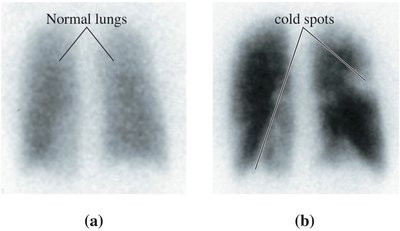
Diagnostic imaging: Technetium-99m is used to assess blood flow in the lungs; areas with abnormal tracer distribution indicate disease.
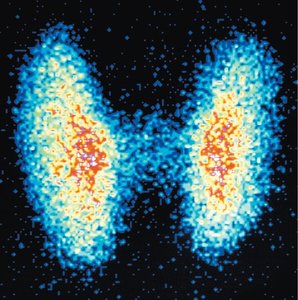
Treatment: Iodine-131 is used to treat thyroid cancer by destroying cancerous tissue.
External beam therapy: Gamma rays from cobalt-60 are directed at tumors.
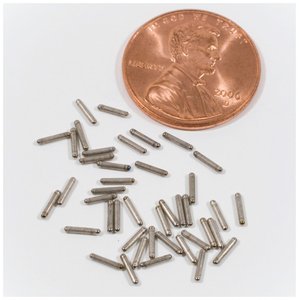
Brachytherapy: Radioactive seeds are implanted directly into tumors.
PET scans: Fluorine-18 is used to detect functional abnormalities in organs, especially the brain.
Additional info: PET scans detect gamma rays produced when positrons emitted by the tracer interact with electrons in the body.
