 뒤로
Carbohydrates: Chemical Properties, Disaccharides, and Polysaccharides
스터디 가이드 - 스마트 노트
 자료에 맞춘 맞춤형 노트, 핵심 정의, 예시, 맥락을 확장해 제공합니다.
Carbohydrates
Chemical Properties of Monosaccharides
Monosaccharides are simple sugars that exhibit important chemical properties, including oxidation and reduction. These reactions are fundamental to understanding carbohydrate metabolism and their role in biological systems.
Oxidation: Monosaccharides, especially those with an aldehyde group (aldoses), can be oxidized to form carboxylic acids. This occurs when the open-chain form is present, even though most monosaccharides exist in cyclic forms in solution.
Reducing Sugars: A carbohydrate that can reduce another substance (such as Benedict’s solution) is called a reducing sugar. The open-chain form of D-glucose is a classic example.
Oxidation of Fructose: Although fructose is a ketohexose and typically cannot be oxidized, it can undergo rearrangement in basic conditions (Benedict’s solution) to form glucose, which is then oxidized.
Reduction: The reduction of the carbonyl group in monosaccharides converts the aldehyde or ketone group to an alcohol, producing sugar alcohols (alditols). For example, D-glucose is reduced to D-sorbitol.
Naming Sugar Alcohols: The ose ending of the monosaccharide is replaced with itol to name the sugar alcohol.
Example: The reduction of D-mannose produces D-mannitol.
Disaccharides
Disaccharides are carbohydrates composed of two monosaccharide units joined by a glycosidic bond. They are formed through dehydration reactions and are important in nutrition and biochemistry.
Lactose: Found in milk, lactose consists of D-galactose and D-glucose linked by a β(1→4) glycosidic bond.
Maltose: Known as malt sugar, maltose is composed of two D-glucose molecules joined by an α(1→4) glycosidic bond. It is obtained from the hydrolysis of starch and used in cereals, candies, and brewing.
Sucrose: Table sugar, sucrose, consists of D-glucose and D-fructose linked by an α(1→2) glycosidic bond. Sucrose cannot form an open chain and is not a reducing sugar, giving a negative test with Benedict’s reagent.
Example: Melibiose is a disaccharide that is 30 times sweeter than sucrose, composed of galactose and glucose.
Polysaccharides
Polysaccharides are large carbohydrate molecules formed by joining many monosaccharide units. They serve structural and storage functions in plants and animals.
Starch: The primary storage form of glucose in plants, starch is composed of amylose (unbranched, α(1→4) bonds) and amylopectin (branched, α(1→4) and α(1→6) bonds).
Amylose: Makes up about 20% of starch and consists of 250–4000 glucose units in a continuous, helical chain connected by α(1→4) glycosidic bonds.
Amylopectin: Makes up about 80% of starch and is a branched-chain polysaccharide with both α(1→4) and α(1→6) glycosidic bonds.
Glycogen: The animal storage form of glucose, glycogen is similar to amylopectin but more highly branched. It is stored in the liver and muscles and hydrolyzed to maintain blood glucose levels.
Cellulose: The major structural unit of wood and plants, cellulose is composed of glucose units in unbranched chains connected by β(1→4) glycosidic bonds. It is insoluble in water and resistant to hydrolysis, and humans cannot digest it due to the lack of enzymes to break β(1→4) bonds.
Example: Starches are digested by amylase and maltase enzymes, providing about 50% of nutritional calories from glucose.
Comparison Table: Disaccharides and Polysaccharides
Carbohydrate | Monosaccharide Units | Type of Glycosidic Bond | Reducing Sugar? |
|---|---|---|---|
Lactose | Galactose + Glucose | β(1→4) | Yes |
Maltose | Glucose + Glucose | α(1→4) | Yes |
Sucrose | Glucose + Fructose | α(1→2) | No |
Amylose | Glucose (unbranched) | α(1→4) | No |
Amylopectin | Glucose (branched) | α(1→4), α(1→6) | No |
Glycogen | Glucose (highly branched) | α(1→4), α(1→6) | No |
Cellulose | Glucose (unbranched) | β(1→4) | No |
Structural Features of Polysaccharides
Polysaccharides differ in their structure based on the type of glycosidic bonds and degree of branching. These structural differences determine their biological function and digestibility.
Amylose: Unbranched, helical structure with α(1→4) bonds.
Amylopectin: Branched structure with α(1→4) bonds in the main chain and α(1→6) bonds at branch points.
Glycogen: Highly branched structure, similar to amylopectin but with more frequent branching.
Cellulose: Linear, unbranched structure with β(1→4) bonds, forming rigid fibers.
Example: Humans can digest starch (amylose and amylopectin) but not cellulose due to the inability to break β(1→4) bonds.
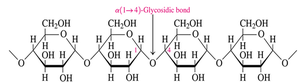
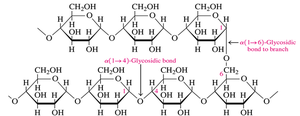
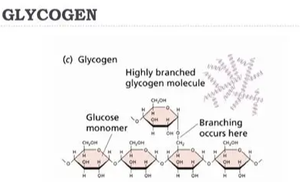
Additional info: The images above visually reinforce the structural differences between amylose, amylopectin, and glycogen, highlighting the types of glycosidic bonds and degree of branching.
Key Equations
Oxidation of Aldose:
Reduction of Monosaccharide:
Formation of Disaccharide:
