 뒤로
Carbohydrates: Fischer and Haworth Structures, Isomerism, and Health Implications
스터디 가이드 - 스마트 노트
 자료에 맞춘 맞춤형 노트, 핵심 정의, 예시, 맥락을 확장해 제공합니다.
Carbohydrates: Fischer Projections and Isomerism
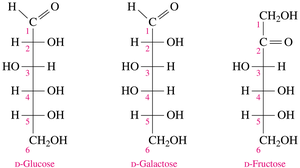
Fischer Projections of Monosaccharides
Fischer projections are a standardized way to represent the three-dimensional structure of monosaccharides in two dimensions. They are especially useful for distinguishing between different isomers of sugars.
Aldehyde group (most oxidized) is placed at the top of the projection.
Achiral group is placed at the bottom.
Each horizontal line represents bonds projecting out of the plane (toward the viewer), while vertical lines represent bonds going behind the plane.
D and L Notations in Fischer Projections
The D and L configuration of monosaccharides is determined by the position of the hydroxyl group (-OH) on the chiral carbon furthest from the carbonyl group:
If the -OH group is on the right, it is a D isomer.
If the -OH group is on the left, it is an L isomer.
Example: D-glucose, D-galactose, and D-fructose are all D isomers, as their -OH group on the reference carbon is on the right.
Important Monosaccharides
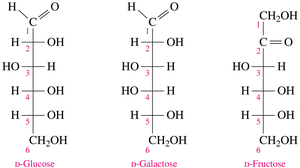
The most biologically significant monosaccharides are D-glucose, D-galactose, and D-fructose. All are hexoses (six-carbon sugars) and share the molecular formula C6H12O6, but differ in structure and function.
D-Glucose: Found in fruits, vegetables, corn syrup, and honey; also known as dextrose or blood sugar.
D-Galactose: Obtained from lactose in milk; important in brain and nervous system membranes.
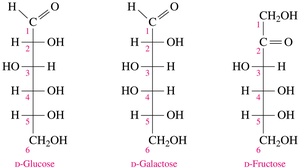
D-Fructose: Ketohexose; sweetest carbohydrate; found in honey and as a hydrolysis product of sucrose.
Monosaccharides: Structure and Biological Significance
D-Glucose
D-glucose is the most common hexose and serves as a primary energy source in the body. It is a building block for disaccharides (sucrose, lactose) and polysaccharides (cellulose, glycogen).
Found in: Fruits, vegetables, corn syrup, honey
Also known as: Dextrose, blood sugar
Role: Energy metabolism, structural component
D-Galactose
D-galactose is an aldohexose obtained from lactose and is crucial for cellular membranes, especially in the brain and nervous system.
Source: Milk (from lactose)
Role: Membrane structure in nervous tissue
D-Fructose
D-fructose is a ketohexose and is the sweetest naturally occurring carbohydrate. It is produced from the hydrolysis of sucrose and is a major component of high-fructose corn syrup.
Source: Honey, fruits, hydrolysis of sucrose
Sweetness: Twice as sweet as sucrose
Role: Sweetener in food industry
Health Implications: Hyperglycemia and Hypoglycemia
Normal Blood Glucose Levels
Glucose levels in the blood are tightly regulated. A glucose tolerance test measures blood glucose over several hours after ingestion.
Hyperglycemia
Hyperglycemia is a condition where blood glucose levels are abnormally high, often due to insufficient insulin production (as in diabetes mellitus).
Symptoms: Thirst, excessive urination, increased appetite, weight loss
Causes: Diabetes, excessive weight gain in older adults
Hypoglycemia
Hypoglycemia occurs when blood glucose levels drop rapidly, often due to overproduction of insulin. Symptoms include dizziness, weakness, and muscle tremors.
Causes: Overproduction of insulin
Symptoms: Dizziness, weakness, tremors
Haworth Structures of Monosaccharides
Formation of Haworth Structures
Haworth structures represent the cyclic forms of monosaccharides, which are the most stable forms for pentoses and hexoses. These rings are formed by the reaction of a carbonyl group with a hydroxyl group within the same molecule.
Pentoses: Five-membered rings
Hexoses: Six-membered rings
Drawing Haworth Structures
To convert a Fischer projection to a Haworth structure:
Turn the Fischer projection clockwise by 90°.
Groups on the right of the vertical chain are placed below the ring; groups on the left are placed above.
Fold the chain into a ring, bonding the oxygen on carbon 5 to carbon 1 (for hexoses).
Draw the -OH group on carbon 1 below the ring for the alpha isomer, above for the beta isomer.

Mutarotation of Alpha and Beta D-Glucose
In aqueous solution, cyclic forms of glucose can open and close, interconverting between alpha and beta isomers. This process is called mutarotation.
Alpha isomer: -OH on carbon 1 below the ring
Beta isomer: -OH on carbon 1 above the ring
Haworth Structures of Galactose and Fructose
Galactose and fructose also form cyclic structures:
Galactose: Aldohexose; differs from glucose in the arrangement of the -OH group on carbon 4.
Fructose: Ketohexose; forms a five-membered ring with carbon 2 at the right corner, bonding carbon 5's -OH to carbon 2.
Summary Table: Comparison of D-Glucose, D-Galactose, and D-Fructose
Monosaccharide | Type | Key Structural Feature | Biological Role |
|---|---|---|---|
D-Glucose | Aldohexose | -OH on C4 below ring | Energy source, building block |
D-Galactose | Aldohexose | -OH on C4 above ring | Membrane structure, milk sugar |
D-Fructose | Ketohexose | Five-membered ring, C2 at corner | Sweetener, energy source |
Key Equations and Formulas
Molecular formula for hexoses:
General mutarotation equation:
Additional info: Academic context was added to clarify the steps for drawing Haworth structures, mutarotation, and the health implications of glucose regulation.
