 뒤로
Carbohydrates: Structure, Classification, and Chirality
스터디 가이드 - 스마트 노트
 자료에 맞춘 맞춤형 노트, 핵심 정의, 예시, 맥락을 확장해 제공합니다.
Carbohydrates
Introduction to Carbohydrates
Carbohydrates are a major source of energy in the human diet and are composed of the elements carbon (C), hydrogen (H), and oxygen (O). They are also known as saccharides, meaning "sugars." Carbohydrates are produced by photosynthesis in plants and are oxidized in living cells to release energy.
Key Point 1: Carbohydrates are essential for energy production in biological systems.
Key Point 2: They are synthesized in plants using carbon dioxide, water, and energy from the sun.
Example: Glucose is a common carbohydrate produced by plants.
Types of Carbohydrates
Carbohydrates are classified based on their complexity:
Monosaccharides: The simplest carbohydrates, consisting of a single sugar unit.
Disaccharides: Composed of two monosaccharide units.
Polysaccharides: Contain many monosaccharide units linked together.
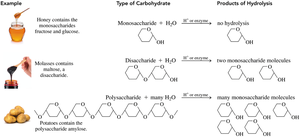
Example | Type of Carbohydrate | Products of Hydrolysis |
|---|---|---|
Honey contains monosaccharides fructose and glucose. | Monosaccharide + H2O | No hydrolysis |
Molasses contains maltose, a disaccharide. | Disaccharide + H2O | Two monosaccharide molecules |
Potatoes contain the polysaccharide amylose. | Polysaccharide + many H2O | Many monosaccharide molecules |
Monosaccharides
Structure and Classification
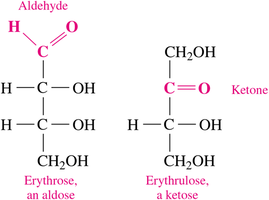
Monosaccharides contain several hydroxyl groups attached to a chain of three to eight carbon atoms. They are further classified based on the type of carbonyl group present:
Aldoses: Monosaccharides with an aldehyde group.
Ketoses: Monosaccharides with a ketone group.
Hydroxyl groups are present on all carbons except the carbonyl carbon.
Classification by Carbon Number
Monosaccharides are also classified by the number of carbon atoms:
Triose: Three carbon atoms
Tetrose: Four carbon atoms
Pentose: Five carbon atoms
Hexose: Six carbon atoms
An aldopentose is a five-carbon saccharide with an aldehyde group, while a ketohexose is a six-carbon saccharide with a ketone group. 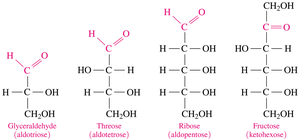
Isomerism in Carbohydrates
Structural vs. Stereoisomers
Structural Isomers: Molecules with the same molecular formula but different bonding arrangements.
Stereoisomers: Molecules with the same sequence of atoms but different spatial arrangements.
Chiral Molecules
Chirality and Its Importance
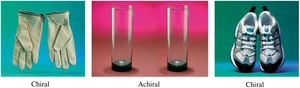
Chirality is a property where an object or molecule cannot be superimposed on its mirror image. Objects like hands, gloves, and shoes are chiral, while objects like glasses are achiral.
Key Point 1: Chiral molecules have nonsuperimposable mirror images.
Key Point 2: Achiral molecules have superimposable mirror images.
Example: Gloves and shoes are chiral; drinking glasses are achiral.
Chiral Carbon Atoms
A carbon atom is chiral if it is bonded to four different atoms or groups. Stereoisomers that cannot be superimposed are called enantiomers.
Enantiomers: Mirror images of a chiral molecule that cannot be superimposed.
Achiral Carbon: If two or more identical atoms are bonded to the same carbon, the molecule is achiral.
Fischer Projections
Drawing Fischer Projections
A Fischer projection is a two-dimensional representation of a molecule, commonly used for carbohydrates:
The most oxidized group is placed at the top.
Vertical lines represent bonds going back; horizontal lines represent bonds going forward.
The intersection of lines represents a carbon atom, often chiral.
Fischer Projections for Multiple Chiral Carbons
For molecules with two or more chiral carbons, Fischer projections are drawn by reversing the positions of all groups to show mirror images. 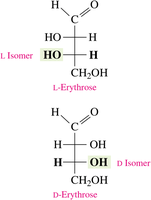
D and L Enantiomers
The designation as a D or L stereoisomer is determined by the position of the group attached to the chiral carbon farthest from the carbonyl group.
D Isomer: The hydroxyl group is on the right.
L Isomer: The hydroxyl group is on the left.
Chemistry Link to Health: Enantiomers in Biological Systems
Biological Significance of Enantiomers
Enantiomers can have different biological activities. For example, the enantiomers of carvone have distinct smells and are found in different plants.
L-Carvone: Found in spearmint, gives a minty aroma.
D-Carvone: Found in caraway seeds, gives a spicy aroma.
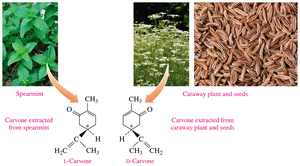 Additional info: The biological activity of enantiomers is crucial in pharmaceuticals, as only one enantiomer may be active or safe.
