 뒤로
Carboxylic Acids and Esters: Structure, Properties, and Reactions
스터디 가이드 - 스마트 노트
 자료에 맞춘 맞춤형 노트, 핵심 정의, 예시, 맥락을 확장해 제공합니다.
Carboxylic Acids and Esters
Introduction to Esters
Esters are a class of organic compounds derived from carboxylic acids and alcohols. They are commonly found in fats, oils, and are responsible for the characteristic aromas and flavors of many fruits. Esters play important roles in both biological and industrial contexts.
Definition: Esters are formed by the reaction of a carboxylic acid and an alcohol, typically in the presence of an acid catalyst and heat.
Occurrence: Esters are present in natural products such as fruits (bananas, oranges, strawberries) and are used in perfumes and flavorings.
Example: Ethyl butanoate provides the odor and flavor of pineapples.
Naming Esters
The nomenclature of esters follows a systematic approach based on the alcohol and carboxylic acid components. Esters have both IUPAC and common names.
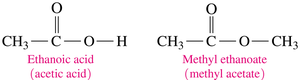
Structure: The name consists of two words: the first word is the alkyl group from the alcohol, and the second is the carboxylate name from the acid.
Naming Rule: Change the '-ic acid' ending of the carboxylic acid to '-ate'.
Example: Ethyl propanoate is derived from ethanol and propanoic acid.
Table: Examples of Esters and Their Names
Structure | IUPAC Name | Common Name |
|---|---|---|
CH3COOCH2CH3 | Ethyl ethanoate | Ethyl acetate |
CH3CH2COOCH3 | Methyl propanoate | Methyl propionate |
Phenyl group + butanoate | Ethyl benzoate | Ethyl benzoate |

Esterification
Esterification is the process by which esters are synthesized from carboxylic acids and alcohols. This reaction is catalyzed by acids and requires heat.
Reaction: Carboxylic acid + Alcohol → Ester + Water (in presence of acid catalyst and heat)
Mechanism: The hydrogen atom in the carboxylic acid group is replaced by an alkoxy group from the alcohol.
Example Equation:
Properties of Esters
Esters exhibit unique physical properties that distinguish them from other organic compounds. Their boiling points and solubility are influenced by their molecular structure.
Boiling Points: Esters have boiling points higher than alkanes and ethers, but lower than alcohols and carboxylic acids of similar mass. This is because esters cannot hydrogen bond to each other due to the absence of hydroxyl groups.
Solubility: Esters with two to five carbon atoms are soluble in water. As the carbon chain length increases, solubility decreases. The carbonyl oxygen can form hydrogen bonds with water molecules.
Example: Ethyl acetate is used as a solvent in fingernail polish, plastics, and lacquers.
Hydrolysis of Esters
Esters can be hydrolyzed by acids or bases, resulting in the formation of carboxylic acids and alcohols (acid hydrolysis) or carboxylate salts and alcohols (base hydrolysis).
Acid Hydrolysis
Reaction: Ester + Water → Carboxylic Acid + Alcohol (in presence of acid catalyst and heat)
Example Equation:
Base Hydrolysis (Saponification)
Reaction: Ester + Strong Base → Carboxylate Salt + Alcohol (in presence of heat)
Example Equation:
Esters in Health and Nature
Esters are significant in health and biological systems. For example, acetylsalicylic acid (aspirin) is an ester of salicylic acid and acetic acid, and methyl salicylate (oil of wintergreen) is used in skin ointments.
Aspirin: Produced by esterification of salicylic acid and acetic acid; less irritating to the stomach than salicylic acid.
Methyl Salicylate: Used as a counter-irritant in skin ointments; passes through the skin and produces heat to soothe sore muscles.
Esters in Fruits and Flavorings
Many fragrances and flavors in fruits and flowers are due to esters. Small esters are volatile and soluble in water, making them detectable by smell and taste.
Example: The odor of grapes is due to a specific ester.
Application: Esters are used in perfumes and artificial flavorings.
Summary Table: Esters in Fruits and Flavorings
Fruit/Flavor | Ester | Odor/Flavor |
|---|---|---|
Pineapple | Ethyl butanoate | Pineapple aroma |
Pear | Propyl ethanoate | Pear aroma |
Grape | Methyl anthranilate | Grape aroma |
Wintergreen | Methyl salicylate | Minty, pungent |
Banana | Isoamyl acetate | Banana aroma |
Concept Map
A concept map can help visualize the relationships between carboxylic acids, esters, their synthesis, properties, and hydrolysis reactions.


Additional info: The concept map and textbook cover reinforce the context of GOB Chemistry and the importance of esters in biological and chemical systems.
