 뒤로
뒤로Chapter 1: Matter and Measurements – GOB Chemistry Study Notes
스터디 가이드 - 스마트 노트
 자료에 맞춘 맞춤형 노트, 핵심 정의, 예시, 맥락을 확장해 제공합니다.
Chemistry: The Central Science
What is Chemistry?
Chemistry is the scientific study of matter, its properties, composition, and the changes it undergoes during chemical reactions. It is often called the central science because it connects physical sciences with life and applied sciences.
The Scientific Method
Steps of the Scientific Method
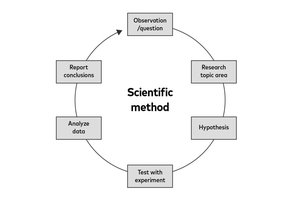
The scientific method is a systematic approach used by scientists to explore observations, answer questions, and solve problems. It involves several key steps:
Observation/Question: Identifying a phenomenon or problem to investigate.
Research Topic Area: Gathering background information.
Hypothesis: Proposing a tentative explanation or prediction.
Test with Experiment: Designing and conducting experiments to test the hypothesis.
Analyze Data: Interpreting experimental results.
Report Conclusions: Drawing conclusions and sharing findings.
Properties and Changes of Matter
Physical and Chemical Properties
Properties are characteristics useful for identifying a substance or object. They can be classified as:
Physical Properties: Observed without changing the substance's chemical identity (e.g., color, melting point, density).
Chemical Properties: Describe how a substance reacts with other substances (e.g., flammability, reactivity).
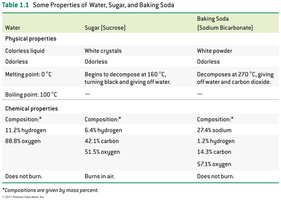
Examples of physical and chemical properties for water, sugar, and baking soda are shown below:
Property | Water | Sugar (Sucrose) | Baking Soda (Sodium Bicarbonate) |
|---|---|---|---|
Physical State | Colorless liquid | White crystals | White powder |
Odor | Odorless | Odorless | Odorless |
Melting Point | 0°C | Decomposes at 160°C | Decomposes at 270°C |
Boiling Point | 100°C | — | — |
Composition | 11.2% H, 88.8% O | 6.5% H, 42.1% C, 51.5% O | 27.4% Na, 1.2% H, 14.3% C, 57.1% O |
Burns? | Does not burn | Burns in air | Does not burn |
Physical and Chemical Changes
A physical change does not alter the chemical composition of a substance (e.g., melting, boiling, dissolving). A chemical change results in the formation of one or more new substances with different properties (e.g., burning, rusting).
Classification of Matter
States of Matter
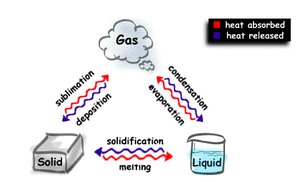
Matter exists in three primary states: solid, liquid, and gas. Changes of state involve energy transfer:
Solid to Liquid: Melting (heat absorbed)
Liquid to Gas: Evaporation (heat absorbed)
Gas to Liquid: Condensation (heat released)
Liquid to Solid: Solidification (heat released)
Solid to Gas: Sublimation (heat absorbed)
Gas to Solid: Deposition (heat released)
Classification by Composition
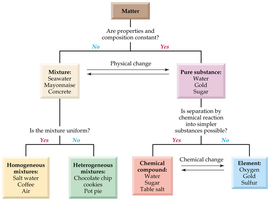
Matter can be classified as a pure substance or a mixture:
Pure Substance: Uniform composition; can be an element or a compound.
Mixture: Physical blend of two or more substances; can be homogeneous (uniform) or heterogeneous (non-uniform).
Elements and Compounds
Element: A fundamental substance that cannot be broken down by chemical means (e.g., oxygen, gold).
Compound: A pure substance composed of two or more elements chemically combined in a fixed ratio (e.g., water, table salt).
Chemical Elements and Symbols
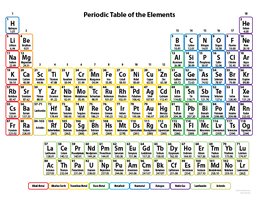
The Periodic Table
The periodic table organizes all known elements by increasing atomic number and similar chemical properties. Each element is represented by a unique symbol (e.g., H for hydrogen, O for oxygen).
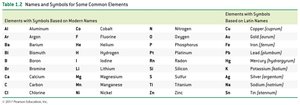
Names and Symbols of Common Elements
Element | Symbol |
|---|---|
Aluminum | Al |
Carbon | C |
Chlorine | Cl |
Iron | Fe |
Lead | Pb |
Magnesium | Mg |
Oxygen | O |
Sodium | Na |
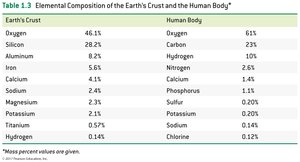
Elemental Composition of Earth and the Human Body
Element | Earth's Crust (%) | Human Body (%) |
|---|---|---|
Oxygen | 46.1 | 61 |
Silicon | 28.2 | — |
Carbon | — | 23 |
Hydrogen | 0.14 | 10 |
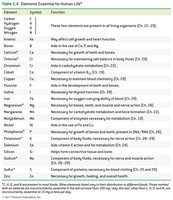
Elements Essential for Human Life
Element | Symbol | Function |
|---|---|---|
Carbon | C | Major constituent of all living organisms |
Oxygen | O | Essential for respiration |
Calcium | Ca | Important for bones and teeth |
Iron | Fe | Component of hemoglobin |
Physical Quantities, Units, and Scientific Notation
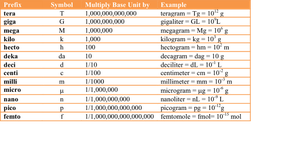
SI Units and Metric Prefixes
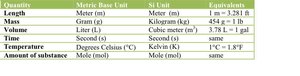
Physical quantities are measured using standard units. The International System of Units (SI) is used worldwide:
Mass: kilogram (kg)
Length: meter (m)
Volume: cubic meter (m3)
Temperature: kelvin (K)
Time: second (s)
Amount: mole (mol)
Scientific Notation
Scientific notation expresses numbers as the product of a number between 1 and 10 and a power of 10. This is useful for very large or small numbers.
Example:
Example:
Measurement and Significant Figures
Significant Figures
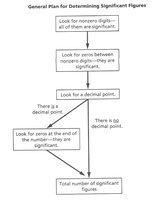
Significant figures are the digits in a measurement that are known with certainty plus one estimated digit. Rules for determining significant figures include:
All nonzero digits are significant.
Zeros between significant digits are significant.
Leading zeros are not significant.
Trailing zeros are significant if a decimal point is present.
Significant Figures in Calculations
Addition/Subtraction: The result should have the same number of decimal places as the measurement with the fewest decimal places.
Multiplication/Division: The result should have the same number of significant figures as the measurement with the fewest significant figures.
Unit Conversions and Dimensional Analysis
Conversion Factors
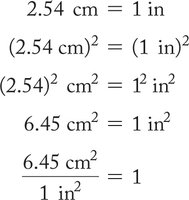
Unit conversions use conversion factors, which are ratios that express how many of one unit are equal to another unit. Dimensional analysis (factor-label method) is used to convert between units.
Example:
Temperature, Heat, and Energy
Temperature Scales
Temperature is a measure of the average kinetic energy of particles. Common scales include Celsius (°C), Fahrenheit (°F), and Kelvin (K). The Kelvin scale starts at absolute zero (0 K).
Heat and Specific Heat
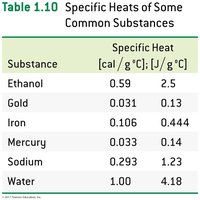
Heat is the energy transferred due to temperature difference. Specific heat is the amount of heat required to raise the temperature of 1 g of a substance by 1°C.
Substance | Specific Heat (cal/g°C) | Specific Heat (J/g°C) |
|---|---|---|
Water | 1.00 | 4.18 |
Ethanol | 0.59 | 2.5 |
Iron | 0.106 | 0.444 |
Density and Specific Gravity
Density
Density is defined as mass per unit volume:
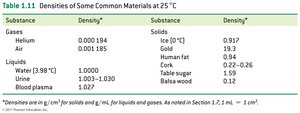
It is commonly expressed in g/mL or g/cm3 for liquids and solids, and g/L for gases.
Specific Gravity
Specific gravity is the ratio of the density of a substance to the density of water at the same temperature. It is a unitless quantity and is often measured using a hydrometer.
Example: If the density of isopropyl alcohol is 0.7855 g/mL, the volume needed for 25.0 g is:
