 뒤로
뒤로Chapter 3: Compounds—How Elements Combine (GOB Chemistry Study Guide)
스터디 가이드 - 스마트 노트
 자료에 맞춘 맞춤형 노트, 핵심 정의, 예시, 맥락을 확장해 제공합니다.
Compounds—How Elements Combine
Electron Arrangements and the Octet Rule
Atoms form compounds to achieve more stable electron arrangements. Electrons occupy specific energy levels, and the distribution of electrons determines chemical behavior.
Electron Cloud: The region around the nucleus where electrons are likely found.
Energy Levels: Electrons fill the lowest energy levels first, closest to the nucleus. Higher levels are farther away and closer together.
Maximum Electrons per Level: Calculated by , where n is the energy level number.
Valence Shell: The highest energy level containing electrons; valence electrons are involved in bonding.
Periodic Table Relationships: Elements in the same group have the same number of valence electrons; periods indicate the outermost energy level.
Octet Rule: Atoms tend to achieve eight electrons in their valence shell for stability (except helium, which has two).
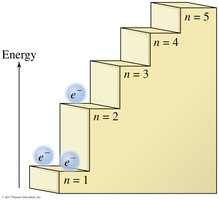
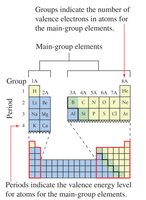
Example: Noble gases (Group 8A) are unreactive due to their full valence shells.
Ion Formation
Atoms gain or lose electrons to achieve an octet, forming ions with net charges.
Anions: Formed when atoms gain electrons (negative charge).
Cations: Formed when atoms lose electrons (positive charge).
Isoelectronic: Ions with the same number of electrons as the nearest noble gas.
Trends: Main group elements form predictable ions; transition metals may form multiple ions. Polyatomic ions are groups of atoms with a net charge.
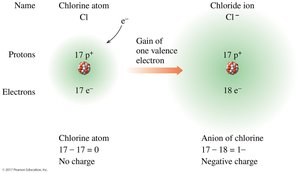
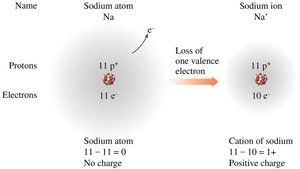
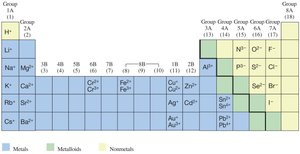
Naming Ions: Metals add 'ion' to the name; transition metals use Roman numerals; nonmetals change suffix to '-ide'; polyatomic ions often end in '-ate' or '-ite'.
Ionic Compounds—Electron Give and Take
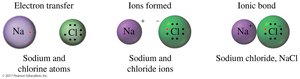
When metals and nonmetals combine, electrons are transferred, forming ionic bonds between oppositely charged ions.
Ionic Bond: Attraction between cation and anion.
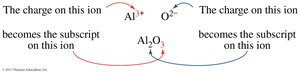
Formula: Ions combine so the compound has zero net charge; subscripts indicate the number of each ion.
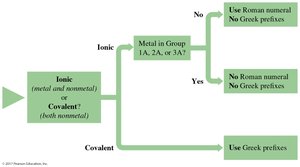
Naming: Combine cation and anion names; use Roman numerals for transition metals; keep polyatomic ion names unchanged.
Covalent Bond Formation
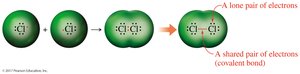
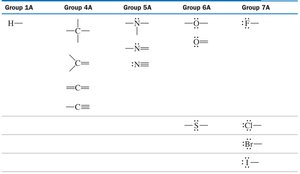
Nonmetals achieve octets by sharing electrons, forming covalent bonds. The smallest unit is a molecule.
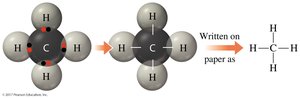
Electron-Dot Symbols: Show valence electrons and bonding.
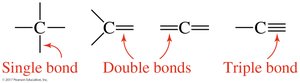
Bonding Pairs: Shared pairs of electrons represented as lines.
Bond Types: Single, double, and triple bonds correspond to sharing one, two, or three pairs of electrons.
Lewis Structures: Visualize molecular structure and bonding.
Naming: Binary covalent compounds use Greek prefixes to indicate the number of each element; the second element ends in '-ide'.

The Mole: Counting Atoms and Compounds
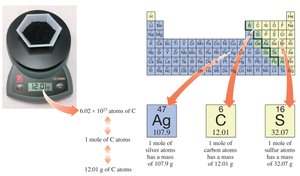
The mole is a counting unit for atoms and molecules, relating mass to number of particles.
Mole: 1 mole = particles (Avogadro's number).
Molar Mass: Mass of one mole of a substance in grams, numerically equal to atomic or formula mass.
Formula Weight: Sum of atomic masses in a compound.
Conversions: Use Avogadro's number and molar mass to convert between grams, moles, and number of particles.
Getting Covalent Compounds into Shape
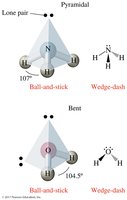
Molecular shape is determined by the arrangement of electron pairs around atoms, described by the VSEPR model.
VSEPR Model: Valence-shell electron-pair repulsion; electron pairs arrange to minimize repulsion.
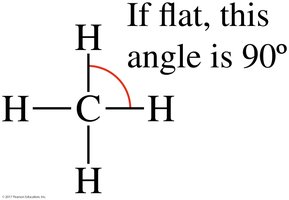
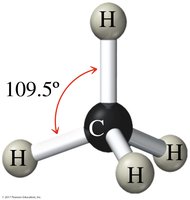
Bond Angles: Methane is tetrahedral with 109.5° angles; flat representation shows 90°.
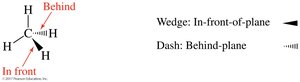
Wedges and Dashes: Indicate three-dimensional structure (wedge = in front, dash = behind).
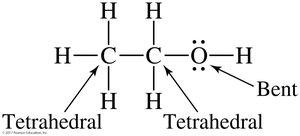
Shapes: Tetrahedral, trigonal planar, linear, pyramidal, bent, etc., depend on number of bonded atoms and lone pairs.
Nonbonded Electrons: Affect shape by repelling bonded pairs.
Electronegativity and Molecular Polarity
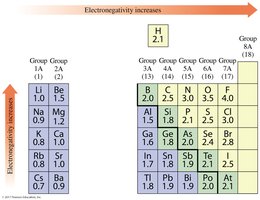
Electronegativity is an atom's ability to attract bonding electrons. Differences in electronegativity determine bond polarity and molecular polarity.
Electronegativity: Increases toward fluorine; highest in fluorine.
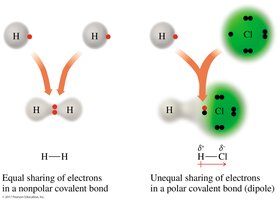
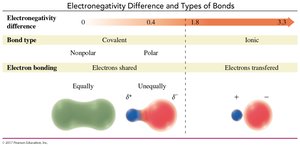
Bond Polarity: Nonpolar bonds share electrons equally; polar bonds share unequally, creating partial charges (δ+ and δ−).
Types of Bonds: Electronegativity difference of 1.8 or more forms ionic bonds; less than 1.8 forms covalent bonds (polar or nonpolar).
Molecular Polarity: Depends on bond polarity and molecular shape; dipoles may cancel or reinforce.
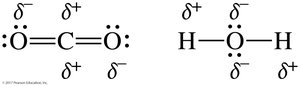
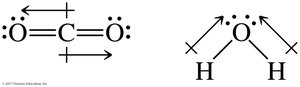
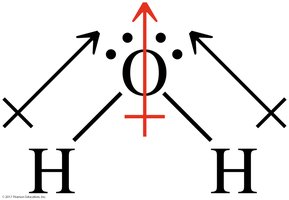
Example: CO2 is nonpolar due to linear shape; H2O is polar due to bent shape.
Summary Table: Types of Chemical Bonds
Bond Type | Electronegativity Difference | Electron Bonding | Example |
|---|---|---|---|
Nonpolar Covalent | 0 | Equally Shared | H2 |
Polar Covalent | 0.4–1.8 | Unequally Shared | HCl |
Ionic | >1.8 | Transferred | NaCl |
Study Guide: Key Learning Objectives
Arrange electrons in shells and predict valence electrons.
Apply the octet rule to ion and compound formation.
Name and write formulas for ionic and covalent compounds.
Calculate molar mass, moles, and number of particles.
Predict molecular shapes using VSEPR.
Determine bond and molecular polarity.
