 뒤로
Chapter 4: Molecular Compounds – Study Notes
스터디 가이드 - 스마트 노트
 자료에 맞춘 맞춤형 노트, 핵심 정의, 예시, 맥락을 확장해 제공합니다.
Chapter 4: Molecular Compounds
4.1 Covalent Bonds
Covalent bonds are a fundamental type of chemical bond where two atoms share one or more pairs of electrons. This sharing allows each atom to achieve a stable electron configuration, often resembling that of the nearest noble gas.
Covalent Bond: A bond formed by the sharing of electrons between two nonmetal atoms.
Molecule: A group of atoms held together by covalent bonds, forming a distinct entity.
Main group elements tend to react to achieve eight valence electrons (the octet rule), except hydrogen, which achieves two.
Nonmetals achieve an octet by sharing electrons in covalent bonds.
Example: The hydrogen molecule (H2) forms when two hydrogen atoms share their 1s electrons, resulting in a stable electron pair between them. This can be represented as H–H, H:H, or H2.
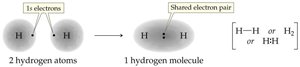
Bond Length: The optimal distance between the nuclei of two bonded atoms, where attractive and repulsive forces are balanced.
Other diatomic elements (e.g., N2, O2, F2, Cl2, Br2, I2) also form by sharing electrons.
Additional info: Covalent bonds differ from ionic bonds, where electrons are transferred rather than shared. Covalent bonds typically occur between nonmetals, while ionic bonds form between metals and nonmetals.
