 뒤로
뒤로Chemical Kinetics: Reaction Rates and Mechanisms
스터디 가이드 - 스마트 노트
 자료에 맞춘 맞춤형 노트, 핵심 정의, 예시, 맥락을 확장해 제공합니다.
Chemical Kinetics
Introduction to Kinetics
Chemical kinetics is the branch of chemistry that studies the speed (rate) at which chemical reactions occur and the factors that influence these rates. Understanding kinetics provides insight into the reaction mechanism, which is the step-by-step pathway by which reactants are converted into products.
Kinetics investigates how fast reactions proceed and what influences their rates.
It also helps elucidate the mechanism of reactions.
Key factors affecting reaction rates include: physical state, concentration, temperature, and catalysts.
Factors Affecting Reaction Rates
Physical State of Reactants
The physical state (solid, liquid, gas) and the degree of mixing of reactants influence how frequently molecules collide and react. Homogeneous mixtures react faster due to better contact between molecules.
Reactions occur when molecules collide; more homogeneous mixtures allow for more effective collisions.
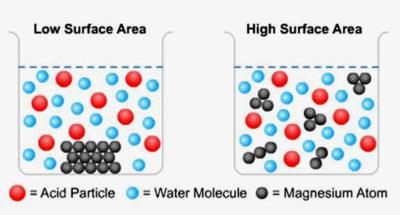
Increasing surface area (e.g., using a powder instead of a tablet) increases reaction rate because more particles are exposed for reaction.
Example: Powdered medicine dissolves and acts faster than a tablet due to greater surface area and immediate availability.
Concentration of Reactants
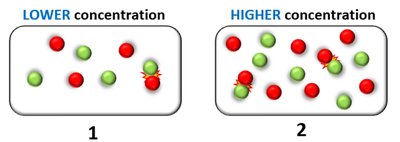
Increasing the concentration of reactants generally increases the reaction rate because more molecules are present, leading to more frequent collisions.
Higher concentration means more particles per unit volume, increasing collision frequency.
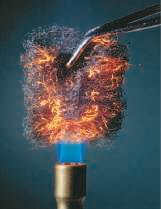
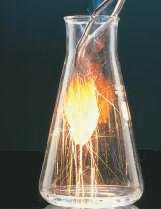
Example: Steel wool burns more vigorously in pure oxygen (100%) than in air (20% oxygen) due to higher reactant concentration.
Temperature
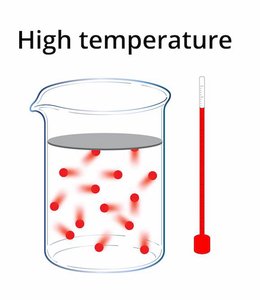
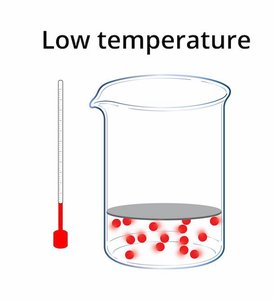
Raising the temperature increases the kinetic energy of molecules, resulting in more frequent and energetic collisions. This typically increases the reaction rate.
At higher temperatures, molecules move faster and collide more often and with greater energy.
Example: Food spoils faster at room temperature than in a refrigerator due to increased reaction rates at higher temperatures.
Catalysts
A catalyst is a substance that increases the rate of a reaction by providing an alternative pathway with a lower activation energy. Catalysts are not consumed in the reaction and are crucial in biological and industrial processes.
Catalysts speed up reactions without being used up.
They are essential in living organisms (e.g., enzymes).
Measuring Reaction Rates
Definition of Reaction Rate
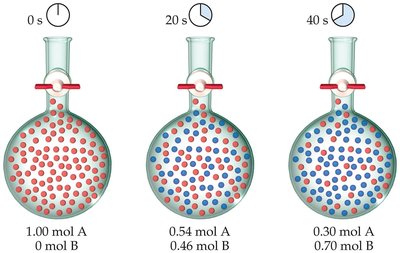
The rate of a reaction is the change in concentration of a reactant or product per unit time. It can be expressed as:
Average rate = for product B
Average rate = for reactant A (negative sign indicates decrease)
Instantaneous Rate
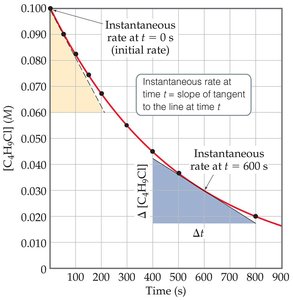
The instantaneous rate is the rate at a specific moment in time, determined by the slope of the tangent to the concentration vs. time curve.
Initial Rate
The initial rate is the instantaneous rate at the very start of the reaction (t = 0). It is often used for kinetic studies because rates change as reactants are consumed.
Stoichiometry and Rate
For reactions with different stoichiometric coefficients, the rate law must account for the ratio of reactants and products. For example:
For :
Rate Laws and Reaction Order
General Rate Law
The rate law expresses the relationship between the rate of a reaction and the concentration of reactants. For a general reaction:
k is the rate constant.
m and n are the reaction orders with respect to A and B, determined experimentally.
The overall order is .
Determining Reaction Order
If doubling [A] doubles the rate, the reaction is first order in A.
If doubling [A] quadruples the rate, the reaction is second order in A.
If changing [A] does not affect the rate, the reaction is zero order in A.
Example: Rate Law Determination
EXP | [NO] (M) | [H2] (M) | Initial Rate (M/s) |
|---|---|---|---|
1 | 0.10 | 0.10 | 1.23 × 10⁻³ |
2 | 0.10 | 0.20 | 2.46 × 10⁻³ |
3 | 0.20 | 0.10 | 4.92 × 10⁻³ |
Analysis shows the reaction is second order in NO and first order in H2:
Units of the Rate Constant (k)
Units depend on the overall order of the reaction.
For a first-order reaction: has units of s–1.
For a second-order reaction: has units of M–1s–1.
Integrated Rate Laws
First-Order Reactions
For a reaction where the rate depends on the concentration of one reactant to the first power:
Differential rate law:
Integrated rate law:
Plotting vs. yields a straight line with slope .
![First-order reaction: ln[A] vs. time](https://static.studychannel.pearsonprd.tech/study_guide_files/gob/sub_images/5927edd1_image_26.png)
Second-Order Reactions
Differential rate law:
Integrated rate law:
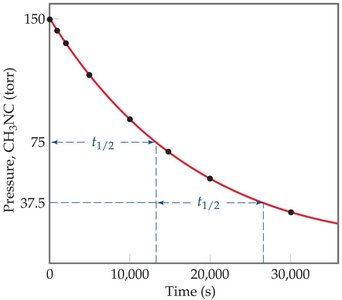
Half-Life
The half-life () is the time required for the concentration of a reactant to decrease by half.
For first-order: (independent of initial concentration)
For second-order:
Temperature and Reaction Rate
Effect of Temperature
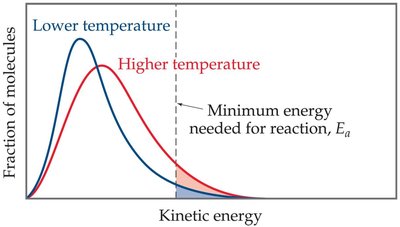
Increasing temperature increases the rate constant and thus the reaction rate. This is because more molecules have sufficient energy to overcome the activation energy barrier.
At higher temperatures, the distribution of molecular kinetic energies broadens, and more molecules exceed the activation energy ().
Activation Energy and the Arrhenius Equation
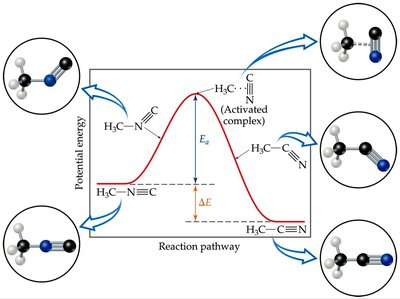
The minimum energy required for a reaction to occur is called the activation energy (). The Arrhenius equation relates the rate constant to temperature:
is the frequency factor, is the gas constant, is temperature in Kelvin.
Taking the natural logarithm:
A plot of vs. yields a straight line with slope .
Reaction Mechanisms
Elementary Steps and Molecularity
A reaction mechanism is the sequence of elementary steps by which a chemical change occurs. Each elementary step can be classified by its molecularity:
Unimolecular: Involves one molecule (first order).
Bimolecular: Involves two molecules (second order).
Termolecular: Involves three molecules (rare, third order).
Multistep Mechanisms and Intermediates
Many reactions proceed via multiple steps. The overall reaction is the sum of the elementary steps. Intermediates are species produced in one step and consumed in another; they do not appear in the overall equation.
Rate-Determining Step
In a multistep mechanism, the slowest step determines the overall reaction rate and the observed rate law.
Catalysts
Homogeneous and Heterogeneous Catalysis
Homogeneous catalyst: Catalyst is in the same phase as reactants (e.g., bromide ion in H2O2 decomposition).
Heterogeneous catalyst: Catalyst is in a different phase (e.g., solid metal in hydrogenation reactions).
p
Enzymes
Enzymes are biological catalysts that speed up specific reactions in living organisms. They have active sites where substrates bind, following a lock-and-key model.
Summary Table: Factors Affecting Reaction Rate
Factor | Effect on Rate | Explanation |
|---|---|---|
Physical State | ↑ with more surface area | More contact between reactants |
Concentration | ↑ with higher concentration | More frequent collisions |
Temperature | ↑ with higher temperature | More energetic collisions |
Catalyst | ↑ with catalyst present | Lowers activation energy |
