 뒤로
뒤로Chemical Reactions: Classification, Balancing, and Applications
스터디 가이드 - 스마트 노트
 자료에 맞춘 맞춤형 노트, 핵심 정의, 예시, 맥락을 확장해 제공합니다.
Chemical Reactions: Classification, Balancing, and Applications
Introduction to Chemical Reactions
Chemical reactions are processes in which substances (reactants) are transformed into new substances (products). Understanding how to classify, balance, and predict the outcomes of reactions is fundamental in chemistry. This section covers the law of conservation of mass, types of reactions, balancing equations, and the use of solubility rules and redox concepts.
Balancing Chemical Reactions
Law of Conservation of Mass
Definition: The law of conservation of mass states that matter is neither created nor destroyed during a chemical reaction. The total mass of reactants equals the total mass of products.
Application: When balancing equations, ensure the number of atoms of each element is the same on both sides of the equation.
Example: If 23 g of sodium reacts with 35 g of chlorine gas, 58 g of sodium chloride is formed.
Balancing by Inspection
Start by balancing the element that appears in the fewest compounds.
Balance polyatomic ions as units if they appear unchanged on both sides.
Balance hydrogen and oxygen atoms last.
Check your work by counting atoms of each element on both sides.
Practice Problems
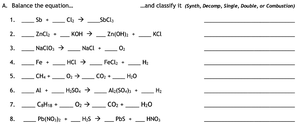
Balance equations by inspection and classify the reaction type (synthesis, decomposition, single replacement, double replacement, or combustion).
Types of Chemical Reactions
Classification of Reactions
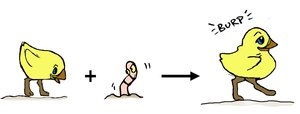
Synthesis (Combination): Two or more substances combine to form a single product. General form:
Decomposition: A single compound breaks down into two or more simpler substances. General form:
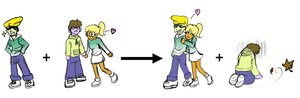
Single Replacement: An element replaces another element in a compound. General form:
Double Replacement: The ions of two compounds exchange places in an aqueous solution to form two new compounds. General form:
Combustion: A hydrocarbon reacts with oxygen to produce carbon dioxide and water, releasing energy. General form:

Activity Series
The activity series ranks metals and halogens by their reactivity. A more reactive element can replace a less reactive one in a compound.
Metals higher in the series will replace those lower in single replacement reactions.
Halogens follow a similar trend: F > Cl > Br > I.
Double Replacement and Solubility Rules
Solubility Rules
Used to predict whether a precipitate will form in a double replacement reaction.
Soluble: All nitrates, acetates, ammonium, and Group 1 salts; most chlorides, bromides, iodides (except with Ag, Pb, Hg); most sulfates (except with Ca, Sr, Ba, Hg, Pb, Ag).
Insoluble: Most carbonates, phosphates, hydroxides, sulfides, and oxides (with exceptions for Group 1 and ammonium).
Indicators of Chemical Change
Energy released (heat, light)
Gas evolution
Color change
Temperature change
Precipitate formation
Practice: Predicting Products and Net Ionic Equations
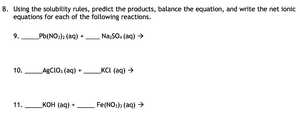
Use solubility rules to predict products, balance the equation, and write net ionic equations for double replacement reactions.
Net Ionic Equations
Definition and Steps
Net ionic equations show only the species that actually participate in the reaction (excluding spectator ions).
Steps:
Write the balanced molecular equation.
Write the complete ionic equation, showing all strong electrolytes as ions.
Identify and remove spectator ions.
Write the net ionic equation with states of matter.
Example: Net ionic:
Redox (Oxidation-Reduction) Reactions
Oxidation Numbers and Redox Identification
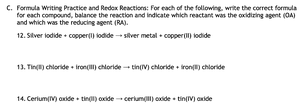
Redox reactions involve changes in oxidation numbers of elements.
Oxidation: Loss of electrons (increase in oxidation number).
Reduction: Gain of electrons (decrease in oxidation number).
Oxidizing agent (OA): Substance that is reduced.
Reducing agent (RA): Substance that is oxidized.
Example: Fe is reduced (from +3 to +2), Sn is oxidized (from +2 to +4).
Acid-Base Reactions and Neutralization
Acids and Bases
Acids: Substances that release hydrogen ions (H+) in water. The acidic hydrogen is listed first in the formula. Examples: HCl, HC2H3O2, H3PO4
Bases: Ionic compounds that release hydroxide ions (OH-) in water. Examples: NaOH, Mg(OH)2, Al(OH)3
Neutralization Reactions
When an acid reacts with a base, the products are a salt and water.
General equation:
Example:
A salt is any ionic compound that is not an acid or a base.
Summary Table: Types of Chemical Reactions
Type | General Equation | Example |
|---|---|---|
Synthesis | ||
Decomposition | ||
Single Replacement | ||
Double Replacement | ||
Combustion |
Additional info: The cartoon images included above (image_2, image_3, image_4, image_9) are directly relevant as they visually reinforce the concepts of synthesis, single replacement, double replacement, and acid-base neutralization reactions, respectively.
