뒤로
뒤로Compounds—How Elements Combine: Chapter 3 Study Guide (GOB Chemistry)
스터디 가이드 - 스마트 노트
 자료에 맞춘 맞춤형 노트, 핵심 정의, 예시, 맥락을 확장해 제공합니다.
Compounds—How Elements Combine
3.1 Electron Arrangements and the Octet Rule
Understanding how electrons are arranged in atoms is fundamental to predicting chemical behavior. The octet rule explains why elements form compounds: atoms seek stable electron configurations that often resemble those of noble gases.
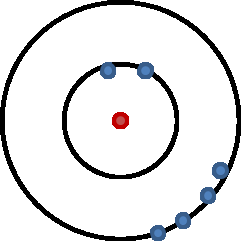
Electron Cloud: Electrons occupy regions around the nucleus called electron clouds, and their exact location is indeterminate.
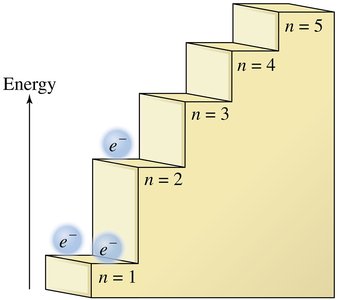
Energy Levels: Electrons fill discrete energy levels (n = 1, 2, 3, ...), starting from the lowest energy level closest to the nucleus.
Maximum Electrons per Level: The maximum number of electrons in a given energy level is calculated by .
Valence Electrons: Electrons in the highest energy level (valence shell) are called valence electrons and are responsible for chemical bonding.
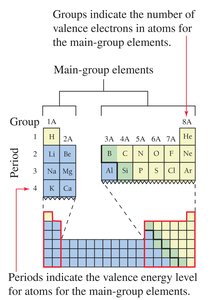
Periodic Table Relationships: Elements in the same group have the same number of valence electrons; periods indicate the outermost energy level.
Octet Rule: Atoms tend to gain, lose, or share electrons to achieve eight valence electrons, a stable configuration.
Noble Gases: Group 8A elements are unreactive due to their full valence shells.
3.2 In Search of an Octet, Part 1: Ion Formation
Atoms achieve octets by gaining or losing electrons, forming ions. The resulting charged particles are either cations (positive) or anions (negative).
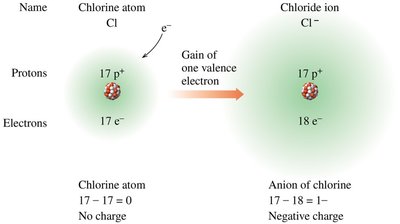
Anions: Formed when atoms gain electrons (e.g., Cl gains one electron to become Cl-).
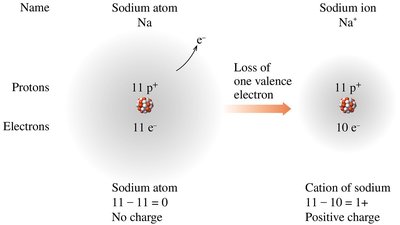
Cations: Formed when atoms lose electrons (e.g., Na loses one electron to become Na+).
Isoelectronic: Ions with the same number of electrons as a noble gas.
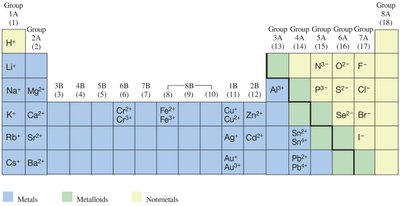
Periodic Trends: Groups 1A, 2A, 3A form cations; Groups 5A, 6A, 7A form anions. Transition metals may form multiple ions.
Polyatomic Ions: Groups of atoms acting as a single ion (e.g., SO42-, NH4+).
Naming Ions: Metal ions use the element name + "ion"; nonmetals use "-ide" suffix; transition metals use Roman numerals for charge.
3.3 Ionic Compounds—Electron Give and Take
Ionic compounds form when metals and nonmetals combine, transferring electrons to achieve octets. The resulting cations and anions are held together by ionic bonds.
Ionic Bond: Attraction between oppositely charged ions.
Formula Writing: Combine ions so the total charge is zero; use subscripts to indicate the number of each ion.
Examples: Ca2+ + O2- → CaO; Ca2+ + 2Br- → CaBr2.
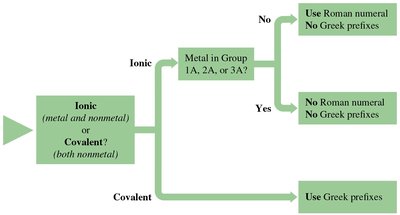
Naming: Name cation first, then anion; omit "ion"; use Roman numerals for transition metals.
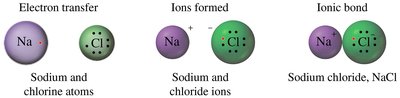
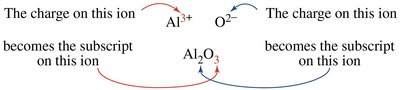
Table: Common Polyatomic Ions
Main Element | Formula of Ion | Name of Ion |
|---|---|---|
Hydrogen | OH- | Hydroxide |
Nitrogen | NH4+ | Ammonium |
Carbon | CO32- | Carbonate |
Sulfur | SO42- | Sulfate |
Phosphorus | PO43- | Phosphate |
Manganese | MnO4- | Permanganate |
Chlorine | ClO3- | Chlorate |
3.4 In Search of an Octet, Part 2: Covalent Bond Formation
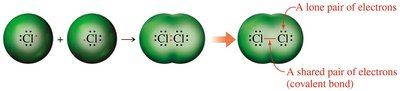
Nonmetals achieve octets by sharing electrons, forming covalent bonds. The resulting compounds are called molecules.
Covalent Bond: Shared pair of electrons between atoms.
Binary Covalent Compounds: Named using prefixes (mono-, di-, tri-, etc.) to indicate the number of each element; the second element ends with "-ide".
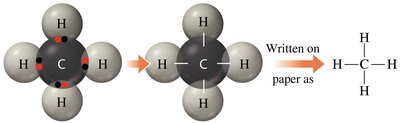
Lewis Structures: Visual representations of electron sharing; dots represent valence electrons, lines represent bonds.
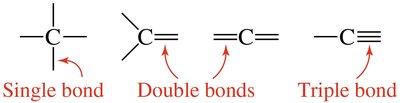
Bonding Patterns: Carbon forms four bonds, nitrogen three, oxygen two, halogens one.

3.5 The Mole: Counting Atoms and Compounds
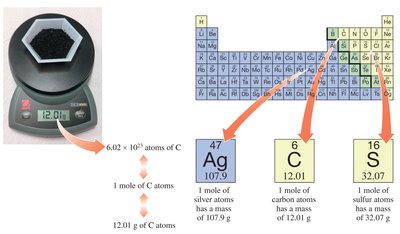
The mole is a counting unit in chemistry, relating mass to the number of atoms or molecules. Avogadro's number defines the number of particles in one mole.
Mole: 1 mole = particles (Avogadro's number).
Molar Mass: Mass of one mole of a substance, numerically equal to its atomic or formula weight in grams.
Conversions: Use molar mass to convert between grams and moles.
Formula Weight: Sum of atomic masses in a compound.
3.6 Getting Covalent Compounds into Shape
Molecular shape is determined by the arrangement of atoms and electron pairs around a central atom, described by the VSEPR model.
VSEPR Model: Valence-shell electron-pair repulsion theory predicts molecular geometry based on repulsion between electron groups.
Bond Angles: Linear (180°), trigonal planar (120°), tetrahedral (109.5°).
Wedge-Dash Notation: Used to represent three-dimensional structures on paper.
Effect of Lone Pairs: Lone pairs occupy more space, altering bond angles and molecular shape (e.g., bent, trigonal pyramidal).
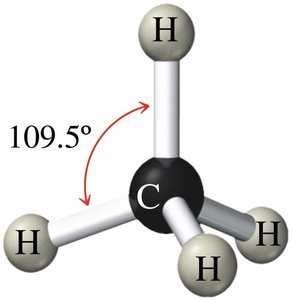
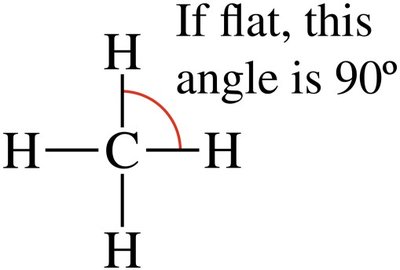
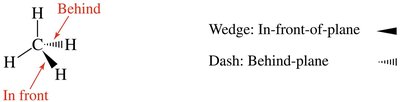
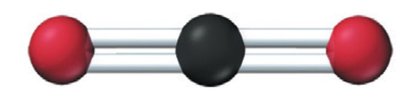
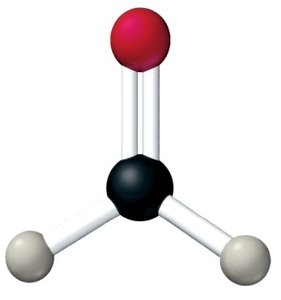
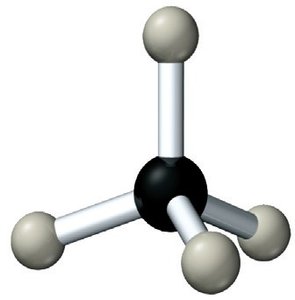
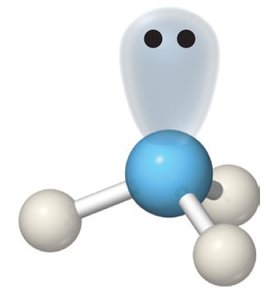
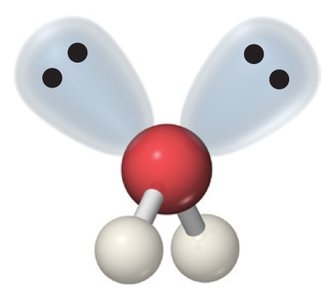
Table: Summary of Molecular Shapes
VSEPR Form | Molecular Shape | Bond Angle | Example |
|---|---|---|---|
AB4 | Tetrahedral | 109.5° | CH4 |
AB3N | Pyramidal | <109.5° | NH3 |
AB2N2 | Bent | <109.5° | H2O |
AB3 | Trigonal planar | 120° | H2CO |
AB2 | Linear | 180° | CO2 |
3.7 Electronegativity and Molecular Polarity
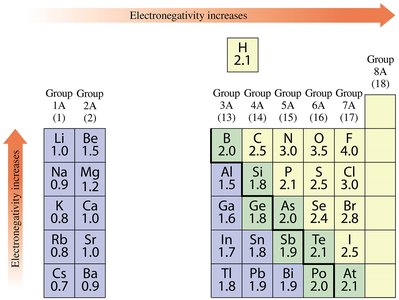
Electronegativity measures an atom's ability to attract electrons in a bond. Differences in electronegativity determine bond polarity and molecular polarity.
Electronegativity: Increases toward fluorine on the periodic table.
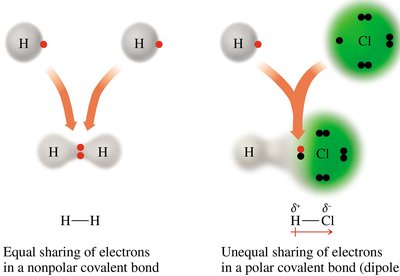
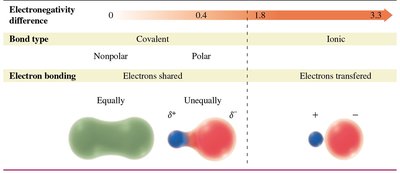
Bond Types: Nonpolar covalent (equal sharing), polar covalent (unequal sharing), ionic (electron transfer).
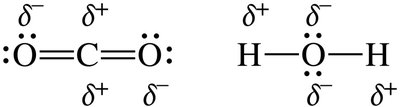
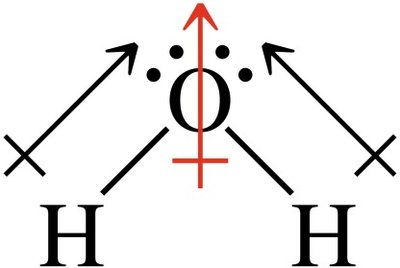
Polarity: Polar bonds have partial charges (δ+, δ-); molecular shape affects overall polarity.
Electronegativity Difference: <0.4 = nonpolar, 0.4–1.8 = polar, >1.8 = ionic.
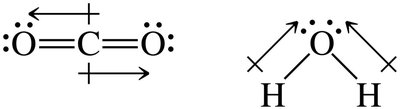
Molecular Polarity: Determined by both bond polarity and molecular shape (e.g., CO2 is nonpolar, H2O is polar).