 뒤로
Hydrocarbons: Structure, Classification, and Properties
스터디 가이드 - 스마트 노트
 자료에 맞춘 맞춤형 노트, 핵심 정의, 예시, 맥락을 확장해 제공합니다.
Hydrocarbons: Structure and Classification
Overview of Hydrocarbons
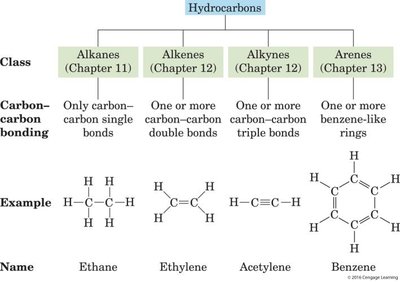
Hydrocarbons are organic compounds composed exclusively of carbon and hydrogen atoms. They are the foundational molecules in organic chemistry and are classified based on the types of bonds between carbon atoms and the presence of ring structures.
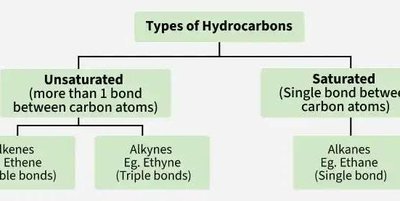
Alkanes: Only single bonds between carbon atoms (saturated hydrocarbons).
Alkenes: At least one carbon-carbon double bond (unsaturated hydrocarbons).
Alkynes: At least one carbon-carbon triple bond (unsaturated hydrocarbons).
Arenes (Aromatic hydrocarbons): Contain one or more benzene-like rings with delocalized electrons.
Examples of Hydrocarbons
Ethane (Alkane):
Ethylene (Alkene):
Acetylene (Alkyne):
Benzene (Arene):
Alkanes: Structure and Nomenclature
Bonding and Geometry
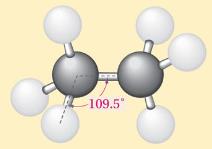
Alkanes are saturated hydrocarbons with only single bonds. Each carbon atom forms four single covalent bonds, resulting in a tetrahedral geometry with bond angles of approximately 109.5°.
Structural Representations
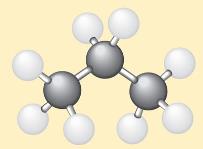
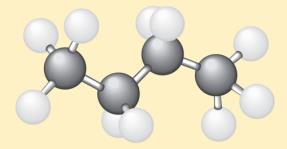
Alkanes can be represented in several ways:
Ball-and-stick models
Condensed structural formulas
Line-angle (skeletal) formulas
Naming Alkanes
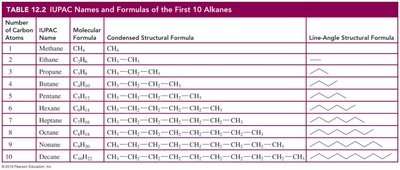
The IUPAC system is used to name alkanes. The first ten alkanes are especially important to memorize for foundational organic chemistry.
Number of Carbon Atoms | IUPAC Name | Molecular Formula | Condensed Structural Formula | Line-Angle Structural Formula |
|---|---|---|---|---|
1 | Methane | CH4 | CH4 | • |
2 | Ethane | C2H6 | CH3CH3 | / |
3 | Propane | C3H8 | CH3CH2CH3 | /\ |
4 | Butane | C4H10 | CH3CH2CH2CH3 | /\/ |
5 | Pentane | C5H12 | CH3CH2CH2CH2CH3 | /\/\ |
Common Substituents
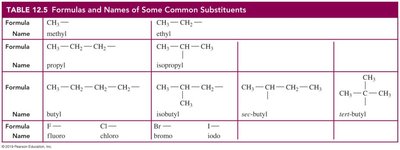
Substituents are groups attached to the main carbon chain. Common alkyl substituents include methyl, ethyl, propyl, and butyl groups. Halogen substituents are also common in organic chemistry.
Formula | Name |
|---|---|
CH3– | methyl |
CH3CH2– | ethyl |
CH3CH2CH2– | propyl |
CH3CH2CH2– | isopropyl |
F–, Cl–, Br–, I– | fluoro, chloro, bromo, iodo |
Isomerism and Conformations
Constitutional (Structural) Isomers
Constitutional isomers have the same molecular formula but different connectivity of atoms. For example, butane and isobutane are constitutional isomers of C4H10.
Conformations of Alkanes
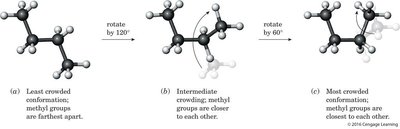
Alkanes can rotate around single bonds, leading to different spatial arrangements called conformations. The most stable conformation minimizes crowding (steric hindrance) between groups.
Cycloalkanes and Their Conformations
Cycloalkanes
Cycloalkanes are saturated hydrocarbons with carbon atoms arranged in a ring. The most common are cyclopentane and cyclohexane. These rings adopt non-planar conformations to minimize strain.
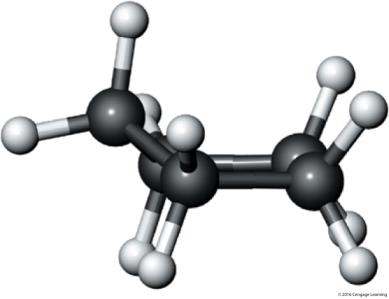
Cyclohexane: Chair and Boat Conformations
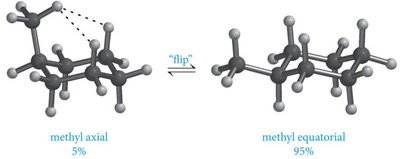
Cyclohexane exists mainly in two conformations: chair (most stable) and boat (less stable). The chair conformation minimizes torsional and steric strain, making it the lowest energy form.
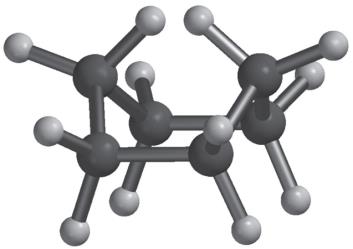
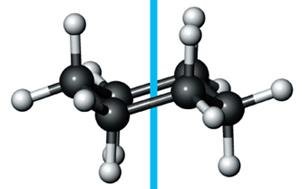
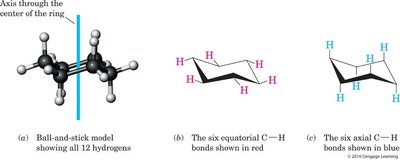
Axial and Equatorial Positions
In the chair conformation, each carbon has one axial and one equatorial hydrogen. Substituents prefer the equatorial position to minimize steric interactions.
Cis-Trans Isomerism in Cycloalkanes
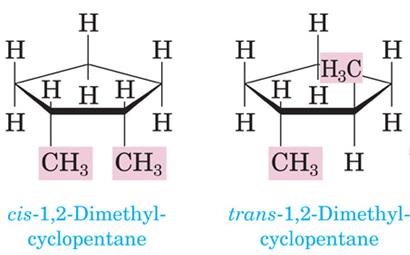
Cycloalkanes with two or more substituents can have cis (same side) or trans (opposite side) isomers, which differ in their physical and chemical properties.
Physical Properties of Alkanes
Intermolecular Forces: London Dispersion Forces
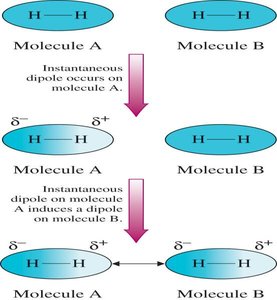
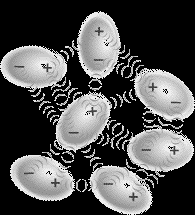
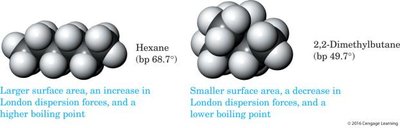
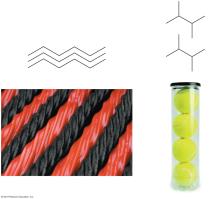
Alkanes are nonpolar and interact via weak London dispersion forces. These forces increase with molecular size and surface area.
Boiling and Melting Points
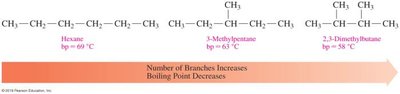
Boiling and melting points of alkanes increase with molecular weight and decrease with branching due to changes in surface area and intermolecular forces.
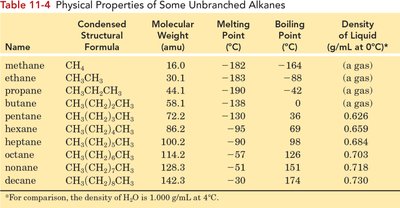

Name | Condensed Structural Formula | Molecular Weight (amu) | Melting Point (°C) | Boiling Point (°C) | Density (g/mL at 0°C) |
|---|---|---|---|---|---|
Methane | CH4 | 16.0 | -182 | -164 | gas |
Ethane | CH3CH3 | 30.1 | -183 | -88 | gas |
Propane | CH3CH2CH3 | 44.1 | -190 | -42 | gas |
Butane | CH3(CH2)2CH3 | 58.1 | -138 | 0 | gas |
Solubility and Density
Alkanes are insoluble in water but soluble in nonpolar solvents.
Liquid and solid alkanes are less dense than water (density < 1.0 g/mL).
Chemical Properties of Alkanes
Combustion
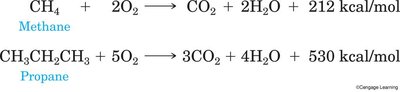
Alkanes undergo combustion in the presence of oxygen to produce carbon dioxide, water, and energy. This reaction is highly exothermic and is the basis for the use of hydrocarbons as fuels.
General equation for complete combustion:
Alkenes and Alkynes
Structure and Nomenclature
Alkenes contain at least one carbon-carbon double bond, while alkynes contain at least one carbon-carbon triple bond. The presence of multiple bonds introduces unsaturation and affects the geometry and reactivity of the molecule.
Alkene bond angle: 120° (trigonal planar)
Alkyne bond angle: 180° (linear)
Polyenes and Isoprene Units
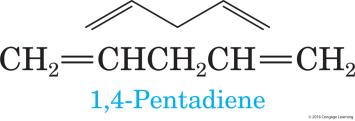
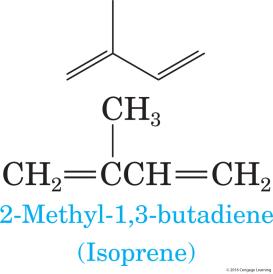
Polyenes are hydrocarbons with multiple double bonds. Isoprene units are the building blocks of terpenes, a class of biologically important polyenes.
Cis-Trans Isomerism in Alkenes
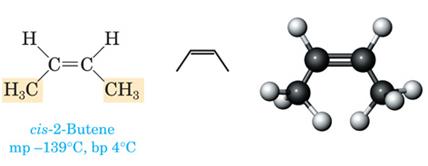
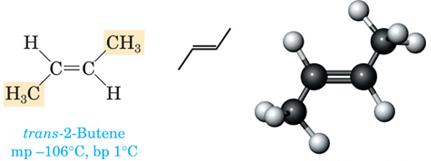
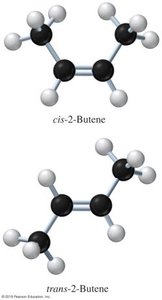
Alkenes can exhibit cis-trans (geometric) isomerism due to restricted rotation around the double bond. Cis isomers have substituents on the same side, while trans isomers have them on opposite sides.
Fatty Acids: Saturated vs Unsaturated
Structure and Classification
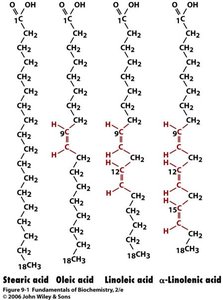
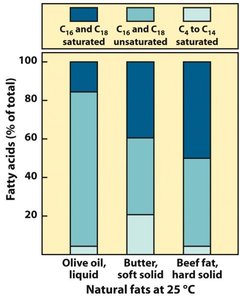
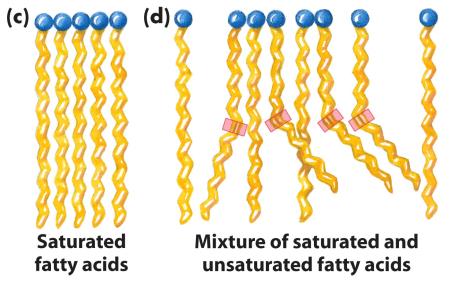
Fatty acids are long-chain hydrocarbons with a carboxylic acid group. They are classified as saturated (no double bonds) or unsaturated (one or more double bonds). Unsaturated fatty acids in nature are usually cis isomers, which introduce kinks in the hydrocarbon chain and lower melting points.
Addition Reactions of Alkenes
Types of Addition Reactions
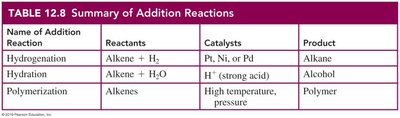
Alkenes undergo addition reactions across the double bond. Common types include:
Name of Addition Reaction | Reactants | Catalysts | Product |
|---|---|---|---|
Hydrogenation | Alkene + H2 | Pt, Ni, or Pd | Alkane |
Hydration | Alkene + H2O | H+ (strong acid) | Alcohol |
Polymerization | Alkenes | High temperature, pressure | Polymer |
Hydrogenation
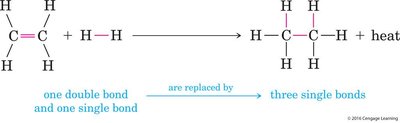
Hydrogenation adds hydrogen across the double bond, converting an alkene to an alkane. This reaction requires a metal catalyst and is exothermic.
Hydration
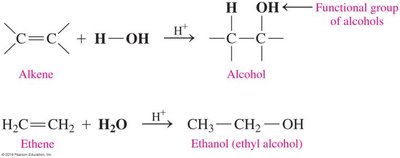
Hydration adds water across the double bond, producing an alcohol. The reaction is acid-catalyzed and follows Markovnikov's rule: the hydrogen atom adds to the less substituted carbon.
Addition of HX (Hydrohalogenation)
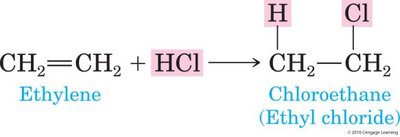
Alkenes react with hydrogen halides (HCl, HBr, HI) to form haloalkanes. The reaction follows Markovnikov's rule.
Polymerization
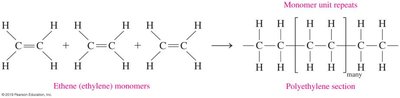
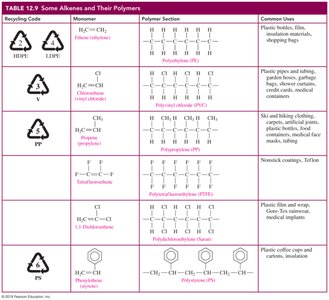
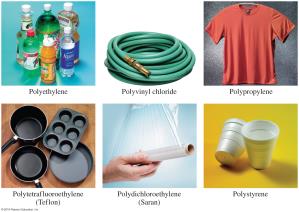
Polymerization is the process by which small alkene monomers join to form large polymers, such as polyethylene and polystyrene. This process is fundamental to the production of many plastics.
Aromatic Compounds (Arenes)
Benzene Structure and Resonance
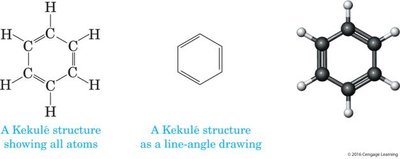
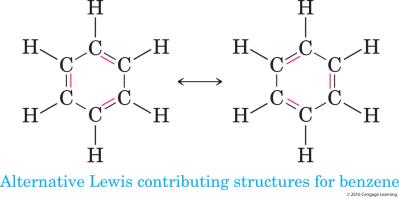
Benzene is the simplest aromatic hydrocarbon, with a six-membered ring and alternating double bonds. However, all carbon-carbon bonds in benzene are equivalent due to resonance, resulting in a planar, stable structure.
Nomenclature of Benzene Derivatives
Benzene derivatives are named based on the substituents attached to the ring. When two substituents are present, their relative positions are indicated by ortho (o-), meta (m-), and para (p-).
Polynuclear Aromatic Hydrocarbons (PAHs)
PAHs contain multiple fused benzene rings and are important in both environmental chemistry and biochemistry.
Key Terms and Concepts
Hydrocarbon: Compound containing only carbon and hydrogen.
Saturated hydrocarbon: Only single bonds (alkanes).
Unsaturated hydrocarbon: Contains double or triple bonds (alkenes, alkynes).
Aromatic hydrocarbon: Contains benzene-like rings with delocalized electrons.
Isomer: Compounds with the same molecular formula but different structures.
Conformation: Different spatial arrangements due to rotation around single bonds.
Resonance: Delocalization of electrons in molecules like benzene, leading to stability.
