 뒤로
Ionic and Covalent Bonding, Electronegativity, Molecular Polarity, and Intermolecular Forces
스터디 가이드 - 스마트 노트
 자료에 맞춘 맞춤형 노트, 핵심 정의, 예시, 맥락을 확장해 제공합니다.
Ionic and Covalent Bonding
Formation of Ions and Ionic Compounds
Atoms achieve stable electron configurations by gaining or losing electrons to form ions. Metals tend to lose electrons and form positively charged ions (cations), while nonmetals tend to gain electrons and form negatively charged ions (anions). Ionic compounds are formed when cations and anions attract each other through electrostatic forces, resulting in a neutral compound.
Cations: Formed by metals losing electrons (e.g., Na+, Ca2+).
Anions: Formed by nonmetals gaining electrons (e.g., Cl-, O2-).
Example: Sodium (Na) loses one electron to form Na+; chlorine (Cl) gains one electron to form Cl-. Together, they form NaCl.
Key Properties of Ionic Compounds:
High melting and boiling points
Conduct electricity when molten or dissolved in water
Form rigid, crystalline structures
Covalent Bonding and Molecular Compounds
Covalent compounds are formed when nonmetal atoms share pairs of electrons to achieve stable electron configurations. These shared electrons create covalent bonds, resulting in discrete molecules.
Single, double, or triple bonds may form depending on the number of shared electron pairs.
Example: In H2O, each hydrogen shares one electron with oxygen, forming two single bonds.
Properties: Lower melting/boiling points, poor electrical conductivity, often soft or brittle.
Compounds with Both Ionic and Covalent Bonds
Some compounds contain both ionic and covalent bonds, typically when a metal cation is bonded to a polyatomic ion (e.g., NaNO3, CaCO3), or when a polyatomic cation is present (e.g., NH4Cl). The ionic bond exists between the ions, while the atoms within the polyatomic ion are held together by covalent bonds.
Electronegativity and Bond Polarity
Electronegativity Trends
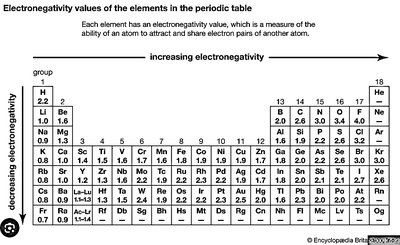
Electronegativity (EN) is the ability of an atom to attract shared electrons in a chemical bond. EN increases from left to right across a period and from bottom to top within a group. Fluorine is the most electronegative element.
Metals: Low EN (tend to lose electrons)
Nonmetals: High EN (tend to gain electrons)
Bond Polarity
The difference in electronegativity (ΔEN) between two bonded atoms determines the bond type:
ΔEN = 0–0.4: Nonpolar covalent (electrons shared equally)
ΔEN = 0.5–1.8: Polar covalent (electrons shared unequally; partial charges develop)
ΔEN > 1.8: Ionic (electrons transferred; ions form)
Example: In H2O, O–H bonds are polar covalent (ΔEN = 1.4), with oxygen carrying a partial negative charge (δ−) and hydrogen a partial positive charge (δ+).
Molecular Polarity and VSEPR Theory
Determining Molecular Polarity
A molecule is polar if it contains polar bonds and the molecular shape does not allow the bond dipoles to cancel. The VSEPR theory (Valence Shell Electron Pair Repulsion) is used to predict molecular shapes based on regions of high electron density (bonds and lone pairs) around the central atom.
Nonpolar molecules: All bond dipoles cancel due to symmetry (e.g., CO2, CCl4).
Polar molecules: Bond dipoles do not cancel (e.g., H2O, NH3).
Intermolecular Forces
Types of Intermolecular Forces
Intermolecular forces are attractions between molecules or ions that influence physical properties such as melting and boiling points.
Ionic bonds: Strongest; between ions in ionic solids (e.g., NaCl).
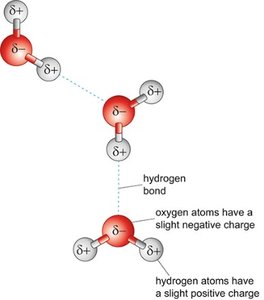
Hydrogen bonds: Strong dipole–dipole attractions between H bonded to N, O, or F and a lone pair on another N, O, or F atom (e.g., H2O, NH3).
Dipole–dipole attractions: Between polar molecules (e.g., HCl, SO2).
Dispersion forces: Weakest; present in all molecules, but only force in nonpolar molecules (e.g., CH4, I2).
Hydrogen Bonding in Water
Hydrogen bonds are responsible for many unique properties of water, such as its high boiling point and the fact that ice floats. In water, the δ+ hydrogen of one molecule is attracted to the δ− oxygen of another molecule.
Applications to Health Sciences
"Like dissolves like": Polar and ionic substances dissolve in water; nonpolar substances (fats, oils) do not. This principle explains why vitamins and drugs have different solubilities in body fluids.
Evaporation of sweat: When sweat evaporates, hydrogen bonds between water molecules must be broken, absorbing heat and cooling the body.
Transport of fats: Fats are nonpolar and do not dissolve in blood plasma (mostly water). The body uses lipoproteins (with polar surfaces and nonpolar cores) to transport fats.
Summary Table: Intermolecular Forces
Force | Particles | Strength | Examples |
|---|---|---|---|
Ionic bonds | Ions | Strongest | NaCl, KBr |
Hydrogen bonds | Polar molecules with N–H, O–H, F–H | Strong | H2O, NH3, ethanol |
Dipole–dipole | Polar molecules | Moderate | HCl, SO2 |
Dispersion | Nonpolar molecules | Weakest | CH4, CO2, Cl2 |
Key Equations and Concepts
Electronegativity difference:
Bond type classification:
: Nonpolar covalent
: Polar covalent
: Ionic
