 뒤로
Ionic and Molecular Compounds: Structure, Naming, and Formulas
스터디 가이드 - 스마트 노트
 자료에 맞춘 맞춤형 노트, 핵심 정의, 예시, 맥락을 확장해 제공합니다.
Ionic & Molecular Compounds
Types of Chemical Bonds
Chemical bonds are the forces that hold atoms together in compounds. The two primary types are ionic bonds and covalent bonds.
Ionic bonds: Formed when valence electrons are transferred from a metal to a nonmetal, resulting in the formation of ions.
Covalent bonds: Formed when nonmetal atoms share valence electrons, creating molecular compounds.
Octet Rule: Atoms tend to lose, gain, or share electrons to achieve eight electrons in their outer shell, leading to stable electron arrangements.
Ions: Formation and Properties
Ions are atoms or groups of atoms with an electrical charge, formed by the loss or gain of electrons.
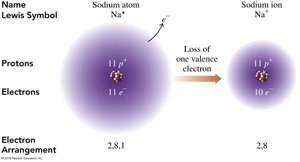
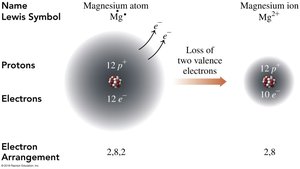
Cations: Positive ions formed when atoms lose electrons (typically metals in Groups 1, 2, and 13).
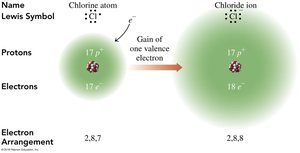
Anions: Negative ions formed when atoms gain electrons (typically nonmetals in Groups 15, 16, and 17). The name of the anion changes to end in "-ide" (e.g., chlorine becomes chloride).
Formation of Cations
Metals lose electrons to form cations, resulting in a positive charge.
Formation of Anions
Nonmetals gain electrons to form anions, resulting in a negative charge.
Ionic Charges from Group Numbers
The charge of ions can often be predicted based on their group number in the periodic table:
Group 1A: loses 1 electron (+1 charge)
Group 2A: loses 2 electrons (+2 charge)
Group 3A: loses 3 electrons (+3 charge)
Group 5A: gains 3 electrons (-3 charge)
Group 6A: gains 2 electrons (-2 charge)
Group 7A: gains 1 electron (-1 charge)
Ionic Compounds
Chemical Formulas of Ionic Compounds
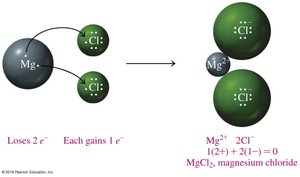
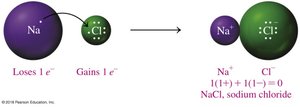
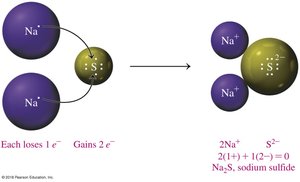
Ionic compounds are represented by formulas showing the lowest whole number ratio of ions that results in a neutral compound.
Subscripts indicate the number of each ion needed to balance the charges.
Always write the cation first, followed by the anion.
Use the lowest ratio of ions (formula unit).
Naming Ionic Compounds
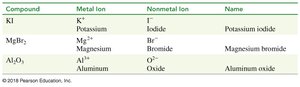
The name of an ionic compound consists of the name of the metal (cation) and the nonmetal (anion), with the anion ending changed to "-ide".
Subscripts are not used in the name, only in the formula.
Space separates the metal and nonmetal names.
Metals with Variable Charges
Transition metals (except Zn2+, Cd2+, and Ag+) can form ions with different charges. Their charge is indicated by a Roman numeral in parentheses after the metal name.
Example: FeO is named iron(II) oxide.
To determine the charge, use the charge of the anion and balance the total charge to zero.
Example: Determining Variable Charge
For MnF2:
Mn charge + 2(F charge) = 0
Mn charge + 2(-1) = 0
Mn charge = +2
Name: manganese(II) fluoride
Writing Formulas for Ionic Compounds from Names
To write a formula:
Identify the cation and its charge.
Identify the anion and its charge.
Balance the charges.
Write the formula with cation first, using subscripts as needed.
Example: Tin(II) chloride
Cation: Sn2+
Anion: Cl-
Balance: 1(2+) + 2(1-) = 0
Formula: SnCl2
Polyatomic Ions
Naming with Polyatomic Ions
Polyatomic ions are groups of atoms with a charge, often ending in "-ate" or "-ite" depending on the number of oxygen atoms.
"-ate" indicates more oxygen; "-ite" indicates one less oxygen.
"per-" prefix means one more oxygen than "-ate"; "hypo-" prefix means one less oxygen than "-ite".
Example: ClO4- is perchlorate, ClO3- is chlorate, ClO2- is chlorite, ClO- is hypochlorite.
Writing Formulas for Compounds with Polyatomic Ions
Polyatomic ions combine with ions of opposite charge. The total positive and negative charges must equal zero. Parentheses are used around polyatomic ions when more than one is needed.
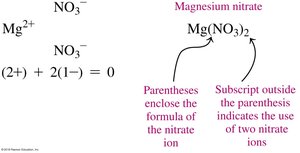
Subscripts for polyatomic ions are placed outside the parentheses.
Naming Compounds with Polyatomic Ions
Follow the same rules as for simple ionic compounds:
Cation name first.
Name of the polyatomic ion second.
Recognition of polyatomic ions is key for correct naming.
Summary Table: Common Ionic Compounds
Compound | Metal Ion | Nonmetal Ion | Name |
|---|---|---|---|
KI | K+ | I- | Potassium iodide |
MgBr2 | Mg2+ | Br- | Magnesium bromide |
Al2O3 | Al3+ | O2- | Aluminum oxide |
Key Equations
Charge balance for ionic compounds:
Example for MgCl2:
Example for Mg(NO3)2:
Additional info:
Transition metals with single charge: Zn2+, Cd2+, Ag+
Flashcards are recommended for memorizing polyatomic ions and their charges.
