 뒤로
뒤로Study Guidance for Carbohydrate Chemistry: Isomers, Fischer Projections, and Hemiacetal Formation
스터디 가이드 - 스마트 노트
 자료에 맞춘 맞춤형 노트, 핵심 정의, 예시, 맥락을 확장해 제공합니다.
Q1. Make an outline of chapter 10, sections 1 and 2 of your textbook.
Background
Topic: Carbohydrate Chemistry Overview
This question is testing your ability to organize and summarize key concepts related to carbohydrates, including their structures, terminology, and types of isomers.
Key Terms:
Monosaccharides
Isomers (constitutional, stereoisomers, enantiomers, diastereomers, epimers, anomers)
Fischer projection
Glycosidic bond
Polysaccharides
Step-by-Step Guidance
Begin by reading sections 1 and 2 of chapter 10, focusing on the definitions and examples of carbohydrates.
Identify the main categories discussed: monosaccharides, disaccharides, and polysaccharides.
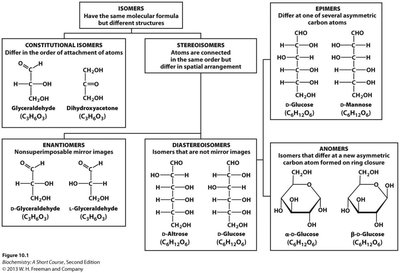
List the types of isomers relevant to carbohydrates, such as constitutional isomers, stereoisomers, enantiomers, diastereomers, epimers, and anomers. Use the provided figure to help clarify these terms.
Note the structural representations, such as Fischer projections, and how they are used to depict sugars.
Summarize the importance of glycosidic bonds in linking monosaccharides to form complex carbohydrates.
Try solving on your own before revealing the answer!
Final Answer:
Your outline should include:
Definitions and examples of monosaccharides, disaccharides, and polysaccharides
Explanation of isomer types (constitutional, stereoisomers, enantiomers, diastereomers, epimers, anomers)
Depiction of sugars in Fischer projections
Role of glycosidic bonds in forming complex carbohydrates
This structure will help you organize the key concepts for carbohydrate chemistry and prepare for further study.
Q2. Print out a copy of the CHO terminology sheet posted on our canvas page and fill it in as best you can while reading through section 1 and 2 of chapter 10. The figure below might be helpful to you, as it summarizes much of the stereochemical terminology associated with sugar chemistry.
Background
Topic: Stereochemistry and Terminology in Carbohydrate Chemistry
This question is testing your understanding of the terminology used to describe the stereochemistry of sugars, including isomer types and their structural differences.
Key Terms:
Isomers
Constitutional isomers
Stereoisomers
Enantiomers
Diastereomers
Epimers
Anomers
Step-by-Step Guidance
Review the terminology sheet and match each term to its definition and example from the figure.
For each isomer type, note the structural differences and similarities. For example, constitutional isomers differ in atom connectivity, while stereoisomers differ in spatial arrangement.
Use the figure to identify examples of each isomer type, such as D-glucose and D-mannose for epimers.
Fill in the terminology sheet with definitions and examples, referencing the figure for clarity.
Try solving on your own before revealing the answer!
Final Answer:
The terminology sheet should include:
Definitions and examples for each isomer type
Structural differences illustrated by the figure
Clear understanding of how each term applies to carbohydrate chemistry
Completing this sheet will reinforce your grasp of stereochemical terminology in sugars.
Q3. Memorize the structure of D-Glucose in the Fischer projection (pyranose) conformation (circled in the figure above).
Background
Topic: Structure of D-Glucose
This question is testing your ability to recognize and recall the Fischer projection of D-glucose, which is essential for understanding carbohydrate chemistry.
Key Terms:
Fischer projection
D-Glucose
Pyranose conformation
Step-by-Step Guidance
Locate the Fischer projection of D-glucose in the figure. Note the arrangement of hydroxyl groups and the aldehyde group at the top.
Observe the pyranose (six-membered ring) conformation, which is the cyclic form of glucose.
Memorize the positions of the hydroxyl groups on each carbon, as this will help you identify D-glucose in future problems.
Practice drawing the Fischer projection and the pyranose ring structure from memory.
Try solving on your own before revealing the answer!
Final Answer:
The Fischer projection of D-glucose shows the aldehyde group at the top, with hydroxyl groups arranged as follows (from top to bottom): right, left, right, right. The pyranose conformation is a six-membered ring with the same arrangement of groups.
Memorizing this structure will help you quickly identify D-glucose in both linear and cyclic forms.
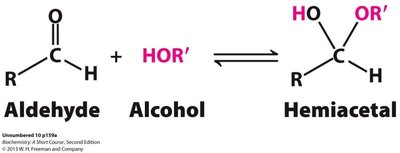
Q4. See if you can identify the ‘electrophile’ and the ‘nucleophile’ in the hemicetal reaction shown at the bottom of p. 159. Draw an arrow from the nucleophile’s lone pair of electrons to the atom of the electrophile that shows what bond is being formed in this reaction.
Background
Topic: Hemiacetal Formation in Carbohydrate Chemistry
This question is testing your understanding of the mechanism by which an aldehyde reacts with an alcohol to form a hemiacetal, a key step in the cyclization of sugars.
Key Terms and Formula:
Electrophile: The atom or molecule that accepts electrons (aldehyde carbon)
Nucleophile: The atom or molecule that donates electrons (alcohol oxygen)
Hemiacetal: The product formed when an aldehyde reacts with an alcohol
Step-by-Step Guidance
Identify the electrophile in the reaction: the carbonyl carbon of the aldehyde, which is electron-deficient.
Identify the nucleophile: the oxygen atom of the alcohol, which has lone pairs of electrons.
Understand that the nucleophile attacks the electrophile, forming a new bond between the alcohol oxygen and the carbonyl carbon.
Draw an arrow from the lone pair on the alcohol oxygen to the carbonyl carbon to represent the bond formation.
Try solving on your own before revealing the answer!
Final Answer:
In the hemiacetal reaction, the electrophile is the carbonyl carbon of the aldehyde, and the nucleophile is the oxygen atom of the alcohol. The arrow should be drawn from the lone pair on the alcohol oxygen to the carbonyl carbon, indicating the formation of a new C–O bond.
This mechanism is fundamental to the cyclization of sugars, forming the ring structure seen in many carbohydrates.
