 뒤로
뒤로Study Guide: Introduction to Organic Compounds (GOB Chemistry, Chapter 4)
스터디 가이드 - 스마트 노트
 자료에 맞춘 맞춤형 노트, 핵심 정의, 예시, 맥락을 확장해 제공합니다.
Q1. Name the straight-chain alkanes or cycloalkanes whose structure or formula is shown:
Background
Topic: Nomenclature of Alkanes and Cycloalkanes
This question tests your ability to identify and name straight-chain alkanes and cycloalkanes based on their molecular formula or structural representation.
Key Terms and Formulas
Alkane: A saturated hydrocarbon with only single bonds (general formula: for straight chains).
Cycloalkane: A saturated hydrocarbon with a ring structure (general formula: ).
Naming: Use the prefix for the number of carbons (meth-, eth-, prop-, but-, pent-, hex-, hept-, oct-, non-, dec-) and the suffix "-ane" for alkanes or "cyclo-...ane" for cycloalkanes.
Step-by-Step Guidance
For each part, count the number of carbon atoms in the formula or structure provided.
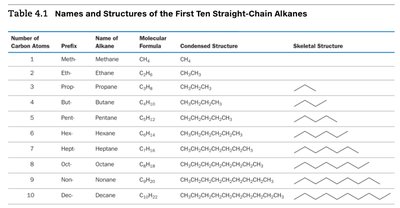
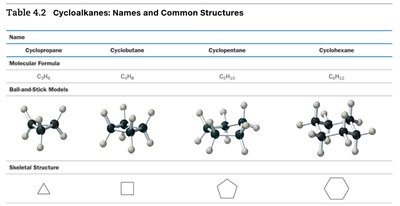
Match the number of carbons to the correct alkane or cycloalkane name using a reference table (like Table 4.1 or 4.2).
For condensed formulas (e.g., CH3CH2CH2CH3), identify the chain length and check for branching or rings.
For skeletal structures, count the vertices (each represents a carbon) and check if the structure is a straight chain or a ring.
Assign the correct name based on your analysis, but stop before writing the final answer for each part.
Try solving on your own before revealing the answer!
Final Answer:
a. CH3CH2CH2CH3 is butane.
b. C6H12 is cyclohexane.
c. The skeletal structure shown is pentane.
Each answer is based on the number of carbons and the structure (straight chain or ring).
Q2. Write the condensed structure for the straight-chain alkanes shown:
Background
Topic: Condensed Structural Formulas of Alkanes
This question tests your ability to write the condensed structural formula for a given straight-chain alkane name.
Key Terms and Formulas
Condensed Structure: A way to write organic molecules showing each carbon and its attached hydrogens in a compact form (e.g., CH3CH2CH3).
Use the general formula for alkanes: .
Step-by-Step Guidance
Identify the number of carbons in the alkane name (e.g., heptane = 7, methane = 1, decane = 10).
Write out the carbon chain, starting with CH3 at each end and CH2 groups in the middle as needed.
Ensure the total number of hydrogens matches the formula .
Double-check your structure for accuracy before moving to the next part.
Try solving on your own before revealing the answer!
Final Answer:
a. Heptane: CH3CH2CH2CH2CH2CH2CH3
b. Methane: CH4
c. Decane: CH3(CH2)8CH3
Each condensed structure matches the number of carbons and hydrogens for the given alkane.
Q3. Write the condensed structure for the straight-chain alkanes shown:
Background
Topic: Condensed Structural Formulas of Alkanes
This question is similar to the previous one, focusing on writing condensed formulas for different alkanes.
Key Terms and Formulas
Refer to the general formula and the naming conventions for alkanes.
Step-by-Step Guidance
Determine the number of carbons for each alkane (butane = 4, octane = 8, hexane = 6).
Write the condensed structure, starting and ending with CH3 and filling in CH2 groups as needed.
Check that the total number of hydrogens matches the formula for each alkane.
Try solving on your own before revealing the answer!
Final Answer:
a. Butane: CH3CH2CH2CH3
b. Octane: CH3(CH2)6CH3
c. Hexane: CH3(CH2)4CH3
Q4. Write the skeletal structure for the alkane or cycloalkane shown:
Background
Topic: Skeletal (Line-Angle) Structures
This question tests your ability to convert molecular formulas or condensed structures into skeletal (line-angle) structures, which are commonly used in organic chemistry.
Key Terms and Formulas
Skeletal Structure: Each vertex or end of a line represents a carbon atom; hydrogens are implied and not shown.
For cycloalkanes, draw polygons (e.g., hexagon for cyclohexane).
Step-by-Step Guidance
For each formula or condensed structure, count the number of carbons.
Draw a zig-zag line with the correct number of vertices for straight-chain alkanes.
For cycloalkanes, draw the appropriate polygon (triangle, square, pentagon, hexagon, etc.).
Do not add hydrogens explicitly; they are implied in skeletal structures.
Try solving on your own before revealing the answer!
Final Answer:
a. C6H12: Hexagon (cyclohexane)
b. CH3CH2CH2CH3: Four-vertex zig-zag (butane)
c. CH3CH2CH2CH2CH2CH3: Six-vertex zig-zag (hexane)
Q5. Write the skeletal structure for the alkane or cycloalkane shown:
Background
Topic: Skeletal (Line-Angle) Structures
This question is similar to the previous one, focusing on different formulas and names.
Key Terms and Formulas
Use the same conventions for skeletal structures as above.
Step-by-Step Guidance
Identify the number of carbons in each formula or name.
Draw the appropriate zig-zag or polygon for each compound.
Try solving on your own before revealing the answer!
Final Answer:
a. C4H8: Square (cyclobutane)
b. CH3CH2CH2CH2CH3: Five-vertex zig-zag (pentane)
c. C10H22: Ten-vertex zig-zag (decane)
Q6. Draw the condensed structural formula for each of the following alkyl groups:
Background
Topic: Alkyl Groups
This question tests your ability to write condensed formulas for common alkyl groups, which are fragments of alkanes missing one hydrogen (used as substituents).
Key Terms and Formulas
Propyl group: Derived from propane (C3H8), formula is C3H7-
Methyl group: Derived from methane (CH4), formula is CH3-
Step-by-Step Guidance
Recall the parent alkane and remove one hydrogen to form the alkyl group.
Write the condensed formula, showing the point of attachment as a dash (-).
Try solving on your own before revealing the answer!
Final Answer:
a. Propyl: CH3CH2CH2-
b. Methyl: CH3-
Q7. Give the correct name for each of the following substituents:
Background
Topic: Naming Alkyl and Halogen Substituents
This question tests your ability to name common substituent groups attached to organic molecules.
Key Terms and Formulas
Alkyl groups: Named by replacing the "-ane" ending of the parent alkane with "-yl" (e.g., ethane → ethyl).
Halogen substituents: Named by replacing the element name ending with "-o" (e.g., iodine → iodo).
Step-by-Step Guidance
Identify the number of carbons or the halogen in each substituent.
Apply the correct naming convention for alkyl or halogen groups.
Try solving on your own before revealing the answer!
Final Answer:
a. CH3CH2- : Ethyl
b. CH3CH2CH2- : Propyl
c. I- : Iodo
