 뒤로
TCA Cycle and Electron Transport Chain: Structure, Function, and Regulation
스터디 가이드 - 스마트 노트
 자료에 맞춘 맞춤형 노트, 핵심 정의, 예시, 맥락을 확장해 제공합니다.
TCA Cycle and Electron Transport Chain
Overview of Carbohydrate Catabolism
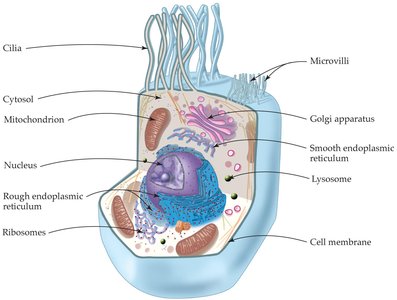
The catabolism of carbohydrates in eukaryotic cells involves a series of metabolic pathways that convert glucose into usable cellular energy (ATP). This process occurs in several stages, culminating in the tricarboxylic acid (TCA) cycle and the electron transport chain (ETC), both of which take place in the mitochondria.
Stage I: Digestion of macromolecules into subunits (e.g., glucose).
Stage II: Breakdown of subunits into acetyl-CoA.
Stage III: Oxidation of acetyl-CoA in the TCA cycle to produce CO2 and reduced coenzymes (NADH, FADH2).
Stage IV: Oxidative phosphorylation in the ETC to produce ATP and H2O.
Pyruvate Dehydrogenase Complex
Function and Regulation
The pyruvate dehydrogenase complex (PDC) links glycolysis to the TCA cycle by converting pyruvate into acetyl-CoA. This multi-enzyme complex is tightly regulated to control the flow of carbon into the TCA cycle.
Inhibition: PDC is inhibited by high-energy molecules such as ATP, NADH, and acetyl-CoA (allosteric regulation), and by phosphorylation (covalent modification).
Activation: PDC is activated by low-energy molecules such as AMP, NAD+, and CoA-SH, and by dephosphorylation.
Reaction:
Enzyme Components:
Pyruvate dehydrogenase (requires TPP, Vitamin B1)
Dihydrolipoyl transacetylase (requires CoA-SH & lipoic acid)
Dihydrolipoyl dehydrogenase (requires NAD+ & FAD)
The TCA Cycle (Citric Acid Cycle)
Purpose and Location
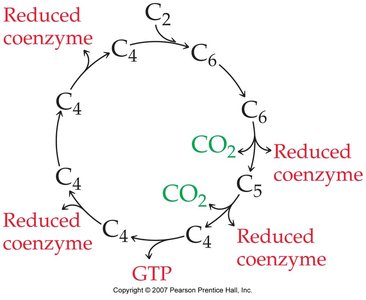
The TCA cycle is a central metabolic pathway that oxidizes acetyl-CoA to CO2, generating reduced coenzymes (NADH, FADH2) and GTP/ATP. It occurs in the mitochondrial matrix and is essential for aerobic energy production.
Main Purpose: Release energy from acetyl groups via oxidation, producing reduced coenzymes for the ETC.
Location: Mitochondrial matrix.
Cycle Structure: 8 steps, regenerating oxaloacetate.
Two turns per glucose molecule (since each glucose yields two acetyl-CoA).
Detailed Steps and Enzymes
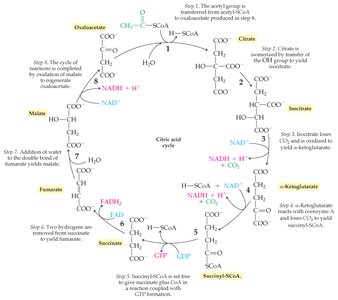
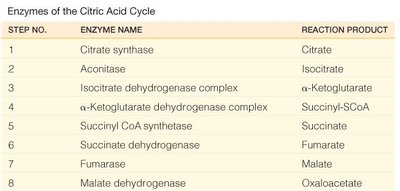
The TCA cycle consists of eight enzyme-catalyzed steps. Each step is associated with specific substrates, products, and enzyme classes.
Step No. | Enzyme Name | Reaction Product |
|---|---|---|
1 | Citrate synthase | Citrate |
2 | Aconitase | Isocitrate |
3 | Isocitrate dehydrogenase complex | α-Ketoglutarate |
4 | α-Ketoglutarate dehydrogenase complex | Succinyl-SCoA |
5 | Succinyl CoA synthetase | Succinate |
6 | Succinate dehydrogenase | Fumarate |
7 | Fumarase | Malate |
8 | Malate dehydrogenase | Oxaloacetate |
Products of the TCA Cycle
For each acetyl-CoA (one turn): 3 NADH, 1 FADH2, 1 GTP (or ATP), 2 CO2
For each glucose (two turns): 6 NADH, 2 FADH2, 2 GTP (or ATP), 4 CO2
Regulation of the TCA Cycle
The TCA cycle is regulated at several key steps to match energy production with cellular demand.
Citrate synthase: Inhibited by succinyl-CoA, NADH, and ATP.
Isocitrate dehydrogenase: Inhibited by ATP and NADH; activated by ADP and NAD+.
α-Ketoglutarate dehydrogenase: Inhibited by NADH and succinyl-CoA; activated by AMP.
Classification of TCA Cycle Enzymes
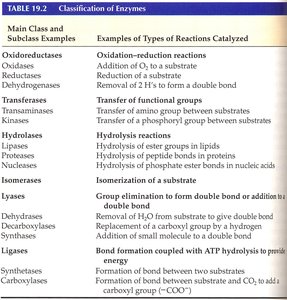
Enzymes in the TCA cycle belong to different major classes based on the reactions they catalyze:
Main Class | Examples of Types of Reactions Catalyzed |
|---|---|
Oxidoreductases | Oxidation-reduction reactions (e.g., dehydrogenases) |
Transferases | Transfer of functional groups (e.g., citrate synthase) |
Lyases | Group elimination to form double bonds (e.g., fumarase) |
Ligases | Bond formation coupled with ATP hydrolysis (e.g., synthetases) |
Isomerases | Isomerization of a substrate (e.g., aconitase) |
Hydrolases | Hydrolysis reactions (less common in TCA) |
Electron Transport Chain (ETC) and Oxidative Phosphorylation
Purpose and Location
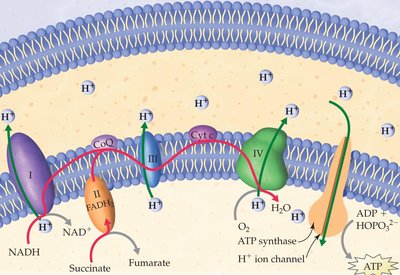
The ETC is a series of protein complexes located in the inner mitochondrial membrane. It couples the oxidation of NADH and FADH2 to the phosphorylation of ADP, producing ATP. This process is called oxidative phosphorylation.
Location: Inner mitochondrial membrane.
Main Purpose: Generate ATP using the energy stored in reduced coenzymes.
Complexes and Substrates/Products
Complex I (NADH Q Reductase): NADH is oxidized to NAD+; electrons transferred to ubiquinone (CoQ); pumps protons.
Complex II (Succinate Dehydrogenase): FADH2 is oxidized to FAD; electrons transferred to CoQ; does not pump protons.
Complex III (QH2 Reductase): Transfers electrons from CoQ to cytochrome c; pumps protons.
Complex IV (Cytochrome c Oxidase): Transfers electrons to O2 to form H2O; pumps protons.
ATP Synthase: Uses the proton gradient to synthesize ATP from ADP and inorganic phosphate (HPO42-).
Oxidative Phosphorylation
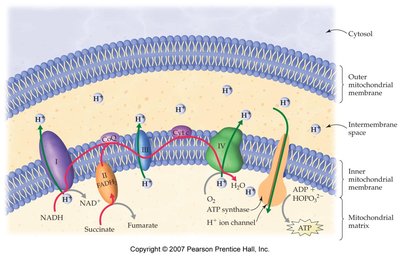
Oxidized: NADH and FADH2 are oxidized, donating electrons to the ETC.
Phosphorylated: ADP is phosphorylated to ATP.
Energy Production: The energy released from electron transfer is used to pump protons, creating a membrane potential. The return flow of protons through ATP synthase drives ATP synthesis.
ATP Synthase Mechanism
ATP synthase is a molecular machine that synthesizes ATP as protons flow down their electrochemical gradient from the intermembrane space into the mitochondrial matrix. This process is analogous to a water wheel being turned by flowing water.
Membrane Potential: Essential for ATP formation; without the proton gradient, ATP synthesis ceases.
Links Between TCA Cycle and Electron Transport Chain
The TCA cycle produces NADH and FADH2, which are high-energy molecules because they carry electrons with high transfer potential. These electrons are donated to the ETC, driving ATP production.
NADH and FADH2: Considered high-energy because their oxidation releases significant free energy, used to generate ATP.
Net Energy Yield from Glucose Oxidation
Complete oxidation of one glucose molecule yields up to 38 ATP molecules (theoretical maximum).
Actual yield may be slightly lower due to transport and leakages.
About 40% of the energy from glucose is captured as ATP; the rest is released as heat to maintain body temperature.
Summary Table: Enzyme Classes
Main Class and Subclass Examples | Examples of Types of Reactions Catalyzed |
|---|---|
Oxidoreductases | Oxidation-reduction reactions (e.g., dehydrogenases, oxidases) |
Transferases | Transfer of functional groups (e.g., kinases, transaminases) |
Hydrolases | Hydrolysis reactions (e.g., lipases, proteases) |
Isomerases | Isomerization of a substrate |
Lyases | Group elimination to form double bonds or addition to double bonds |
Ligases | Bond formation coupled with ATP hydrolysis |
Additional info: The TCA cycle and ETC are central to cellular respiration, integrating carbohydrate, fat, and protein metabolism. Disruptions in these pathways can lead to metabolic diseases and energy deficiencies.
