
Pentoses also exist in a ring form, but they most commonly occur as furanose rings. D-Ribose exists in its furanose ring form in the nucleic acid RNA. Using the structure of D-ribose from Table 6.1, draw the furanose form of β-D-ribose.
Ch.6 Carbohydrates Life's Sweet Molecules
3장, 문제 36a
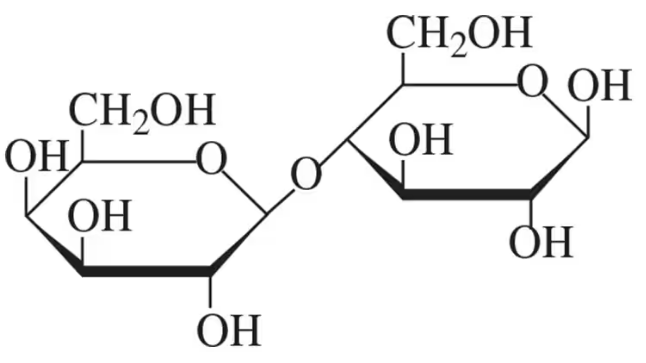
For each of the following disaccharides, name the glycosidic bond and draw the monosaccharide units produced by hydrolysis:
(a) 
검증된 단계별 안내1
Step 1: Understand the concept of glycosidic bonds. Glycosidic bonds are covalent bonds that connect monosaccharide units in disaccharides. They are formed through a dehydration reaction and can be broken by hydrolysis.
Step 2: Identify the type of glycosidic bond in the disaccharide. Look at the structure provided in the image to determine the position and type of linkage (e.g., α-1,4 or β-1,4). This involves analyzing the orientation of the oxygen atom in the bond and the carbon numbers involved.
Step 3: Hydrolysis of the disaccharide. Hydrolysis is a chemical reaction where water is used to break the glycosidic bond, resulting in the separation of the disaccharide into its monosaccharide components.
Step 4: Draw the monosaccharide units produced by hydrolysis. Based on the structure of the disaccharide, sketch the individual monosaccharides that result from breaking the glycosidic bond. Ensure you represent the correct stereochemistry (α or β forms) and functional groups.
Step 5: Name the monosaccharides and the glycosidic bond. Provide the names of the monosaccharides produced and specify the type of glycosidic bond that was present in the original disaccharide (e.g., α-1,4 glycosidic bond).

비슷한 문제에 대한 검증된 영상 답변:
이 영상 해법은 위 문제에 도움이 된다고 튜터들이 추천한 것입니다.
영상 길이:
6m주요 개념
질문에 올바르게 답하기 위해 반드시 이해해야 하는 핵심 개념들은 다음과 같습니다.
Disaccharides
Disaccharides are carbohydrates formed by the condensation of two monosaccharides, linked by a glycosidic bond. Common examples include sucrose, lactose, and maltose. Understanding the structure and composition of disaccharides is essential for identifying the specific glycosidic bonds that connect the monosaccharide units.
추천 영상:
가이드 코스
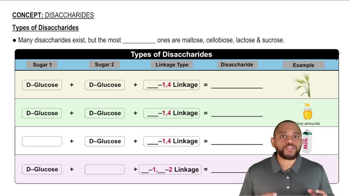
Types of Disaccharides Concept 1
Glycosidic Bond
A glycosidic bond is a type of covalent bond that links monosaccharides together in carbohydrates. It is formed through a dehydration reaction, where a water molecule is released. The specific type of glycosidic bond (e.g., α or β) influences the properties and digestibility of the disaccharide.
추천 영상:
가이드 코스
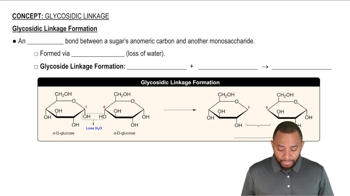
Glycosidic Linkage Formation Concept 1
Hydrolysis
Hydrolysis is a chemical reaction that involves the breaking of a bond in a molecule using water. In the context of disaccharides, hydrolysis results in the separation of the glycosidic bond, yielding the individual monosaccharides. This process is crucial for understanding how disaccharides are metabolized in biological systems.
추천 영상:
가이드 코스
Acidic Hydrolysis Concept 1
관련 실천
교과서 질문
425
views
교과서 질문
Based on the sweetness index in Table 6.2, if you tasted a drop of each of the syrups below, which would taste the sweetest?
(a) light corn syrup (100% glucose)
649
views
교과서 질문
Name the glycosidic bond present in mannobiose, shown in the following figure:
747
views
교과서 질문
Identify a disaccharide that fits each of the following descriptions:
(a) ordinary table sugar
620
views
교과서 질문
Identify the following reactions as condensation or hydrolysis:
(a) two monosaccharides reacting to form a disaccharide
711
views
교과서 질문
Lactulose is a disaccharide used in the treatment of chronic constipation. Its formal name is galactose β(1→4) fructose.
(a) Draw the structure of lactulose.
699
views
