Ch.21 The Generation of Biochemical Energy
McMurry - Fundamentals of General, Organic, and Biological Chemistry 8th Edition
McMurry8th EditionFundamentals of General, Organic, and Biological ChemistryISBN: 9780134015187당신이 사용하는 게 아니라요?교과서 변경
21장, 문제 24d

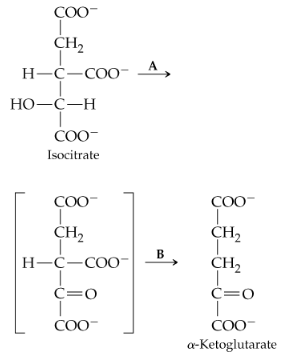
The reaction that follows is catalyzed by isocitrate dehydrogenase and occurs in two steps, the first of which (step A) is formation of an unstable intermediates (shown in brackets).

d. To what class of enzymes does isocitrate dehydrogenase, the enzyme that catalyzes this reaction, belong?

검증된 단계별 안내
1
Step 1: Understand the role of isocitrate dehydrogenase in the reaction. This enzyme catalyzes the oxidation of isocitrate to form an intermediate, which is then further processed in the reaction. Enzymes are classified based on the type of reaction they catalyze.
Step 2: Recall the six major classes of enzymes: oxidoreductases, transferases, hydrolases, lyases, isomerases, and ligases. Each class corresponds to a specific type of chemical reaction.
Step 3: Analyze the reaction catalyzed by isocitrate dehydrogenase. This reaction involves the removal of hydrogen atoms (oxidation) from isocitrate, which is coupled with the reduction of NAD+ (or NADP+) to NADH (or NADPH).
Step 4: Based on the reaction type, identify the enzyme class. Enzymes that catalyze oxidation-reduction reactions, where electrons are transferred, belong to the oxidoreductase class.
Step 5: Conclude that isocitrate dehydrogenase is classified as an oxidoreductase because it facilitates the oxidation of isocitrate and the reduction of NAD+ (or NADP+).

비슷한 문제에 대한 검증된 영상 답변:

이 영상 해법은 위 문제에 도움이 된다고 튜터들이 추천한 것입니다.
영상 길이:
1m

주요 개념

질문에 올바르게 답하기 위해 반드시 이해해야 하는 핵심 개념들은 다음과 같습니다.

Enzyme Classification

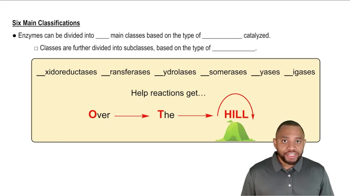
Enzymes are classified into six main categories based on the type of reaction they catalyze: oxidoreductases, transferases, hydrolases, lyases, isomerases, and ligases. Isocitrate dehydrogenase falls under the category of oxidoreductases, which facilitate oxidation-reduction reactions by transferring electrons between molecules.
추천 영상:
가이드 코스
1:26
Six Main Classifications Concept 3

Isocitrate Dehydrogenase Function

Isocitrate dehydrogenase is an important enzyme in the citric acid cycle (Krebs cycle), where it catalyzes the conversion of isocitrate to alpha-ketoglutarate. This reaction involves the decarboxylation of isocitrate and the reduction of NAD+ to NADH, playing a crucial role in cellular respiration and energy production.
추천 영상:
가이드 코스
02:16
Logarithmic Functions

Enzyme Catalysis Mechanism

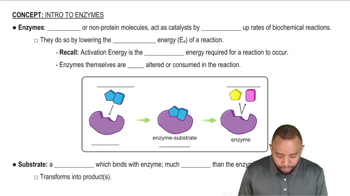
Enzyme catalysis involves the lowering of activation energy for a reaction, allowing it to proceed more quickly. In the case of isocitrate dehydrogenase, the enzyme stabilizes the transition state and facilitates the formation of unstable intermediates, which are critical for the reaction's progression and efficiency.
추천 영상:
가이드 코스
2:14
Intro to Enzymes Concept 1