
Ch.21 The Generation of Biochemical Energy
McMurry - Fundamentals of General, Organic, and Biological Chemistry 8th Edition
McMurry8th EditionFundamentals of General, Organic, and Biological ChemistryISBN: 9780134015187당신이 사용하는 게 아니라요?교과서 변경
21장, 문제 27

What energy requirements must be met in order for a reaction to be favorable?

검증된 단계별 안내
1
Understand that for a reaction to be favorable, it must be thermodynamically spontaneous. This is determined by the Gibbs free energy change (ΔG) of the reaction.
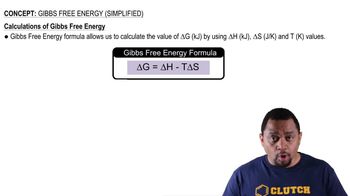
Recall the equation for Gibbs free energy: ΔG = ΔH - TΔS, where ΔH is the enthalpy change, T is the temperature in Kelvin, and ΔS is the entropy change.
For a reaction to be favorable, ΔG must be negative (ΔG < 0). This indicates that the reaction releases free energy and can proceed without external input.
Analyze the contributions of ΔH and ΔS to ΔG. A negative ΔH (exothermic reaction) and a positive ΔS (increase in disorder) both favor a negative ΔG. However, the temperature (T) can influence the impact of ΔS on ΔG.
Consider the specific conditions of the reaction, such as temperature and the signs of ΔH and ΔS, to determine whether the reaction is favorable. For example, if ΔH is positive and ΔS is positive, the reaction may only be favorable at high temperatures where the TΔS term dominates.

비슷한 문제에 대한 검증된 영상 답변:

이 영상 해법은 위 문제에 도움이 된다고 튜터들이 추천한 것입니다.
영상 길이:
2m

주요 개념

질문에 올바르게 답하기 위해 반드시 이해해야 하는 핵심 개념들은 다음과 같습니다.

Gibbs Free Energy

Gibbs Free Energy (G) is a thermodynamic potential that helps predict whether a reaction will occur spontaneously at constant temperature and pressure. A reaction is considered favorable if the change in Gibbs Free Energy (ΔG) is negative, indicating that the products have lower energy than the reactants, thus driving the reaction forward.
추천 영상:
가이드 코스
01:04
Gibbs Free Energy (Simplified) Concept 3

Activation Energy

Activation Energy (Ea) is the minimum energy required to initiate a chemical reaction. Even if a reaction is thermodynamically favorable (negative ΔG), it may still require a certain amount of energy to overcome the energy barrier, which is where catalysts can play a role in lowering the activation energy needed for the reaction to proceed.
추천 영상:
가이드 코스
1:06
Factors Affecting Enzyme Activity Concept 1

Entropy

Entropy (S) is a measure of the disorder or randomness in a system. For a reaction to be favorable, not only must the Gibbs Free Energy decrease, but the change in entropy (ΔS) must also be considered. A positive change in entropy contributes to a more favorable reaction, as it indicates an increase in disorder, which is thermodynamically favored.
추천 영상:
가이드 코스
00:54
Entropy (Simplified) Concept 1
관련 실천
교과서 질문

The reaction that follows is catalyzed by isocitrate dehydrogenase and occurs in two steps, the first of which (step A) is formation of an unstable intermediates (shown in brackets).

d. To what class of enzymes does isocitrate dehydrogenase, the enzyme that catalyzes this reaction, belong?

1217
views
교과서 질문

The following reactions occur during the catabolism of acetyl-CoA. Which are exergonic? Which is endergonic? Which reaction produces a phosphate that later yields energy by giving up a phosphate group?

c. L-Malate + NAD+ → Oxaloacetate + NADH + H+

∆G = +17 kcal/mol (+129.3 kJ/mol)

769
views
교과서 질문

Why is ∆G a useful quantity for predicting the favorability of biochemical reactions?

1406
views
교과서 질문

The electron-transport chain uses several different metal ions, especially iron, copper, zinc, and manganese. Why are metals used frequently in these two pathways? What can metals do better than organic biomolecules?

1265
views
교과서 질문

The reaction that follows is catalyzed by isocitrate dehydrogenase and occurs in two steps, the first of which (step A) is formation of an unstable intermediates (shown in brackets).

c. Which of the structures shown can be described as a β-keto acid?

586
views
교과서 질문

The following reactions occur during the catabolism of glucose. Which are exergonic? Which is endergonic? Which proceeds farthest toward products at equilibrium?

b. Phosphoenol pyruvate + H2O → Pyruvate + Phosphate(Pi)

∆G = –14.8 kcal/mol (–61.9 kJ/mol)

836
views