Ch.24 Lipid Metabolism
McMurry - Fundamentals of General, Organic, and Biological Chemistry 8th Edition
McMurry8th EditionFundamentals of General, Organic, and Biological ChemistryISBN: 9780134015187당신이 사용하는 게 아니라요?교과서 변경
24장, 문제 47a

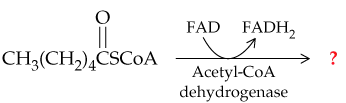
Show the products of each step in the fatty acid oxidation of hexanoic acid.
a. Chemical structure of hexanoic acid with reaction pathway showing Acetyl-CoA dehydrogenase and FAD/FADH2 involvement.

검증된 단계별 안내
1
Step 1: Understand the process of fatty acid oxidation (beta-oxidation). Beta-oxidation is a metabolic process where fatty acids are broken down in the mitochondria to generate acetyl-CoA, NADH, and FADH2. Each cycle of beta-oxidation removes a two-carbon unit from the fatty acid chain in the form of acetyl-CoA.
Step 2: Activate hexanoic acid (C6H12O2) by converting it into its CoA derivative. This involves the reaction of hexanoic acid with coenzyme A (CoA) in the presence of ATP, forming hexanoyl-CoA. The reaction can be represented as: Hexanoic-acid+CoA+ATP→Hexanoyl-CoA+AMP+PPi.
Step 3: Perform the first step of beta-oxidation, which is the oxidation of hexanoyl-CoA. This step involves the removal of two hydrogen atoms from the beta and alpha carbons of the fatty acid chain, forming a double bond. The enzyme acyl-CoA dehydrogenase catalyzes this reaction, and FAD is reduced to FADH2.
Step 4: Hydrate the double bond formed in the previous step. The enzyme enoyl-CoA hydratase adds a molecule of water across the double bond, converting it into a hydroxyl group on the beta carbon and a single bond between the alpha and beta carbons.
Step 5: Continue the beta-oxidation cycle by oxidizing the hydroxyl group on the beta carbon to a keto group using the enzyme beta-hydroxyacyl-CoA dehydrogenase. NAD+ is reduced to NADH in this step. Finally, the beta-ketoacyl-CoA is cleaved by thiolase, releasing acetyl-CoA and a shortened fatty acyl-CoA (now with four carbons, butyryl-CoA). Repeat the cycle until the fatty acid is completely broken down into acetyl-CoA units.

비슷한 문제에 대한 검증된 영상 답변:

이 영상 해법은 위 문제에 도움이 된다고 튜터들이 추천한 것입니다.
영상 길이:
1m

주요 개념

질문에 올바르게 답하기 위해 반드시 이해해야 하는 핵심 개념들은 다음과 같습니다.

Fatty Acid Oxidation

Fatty acid oxidation is a metabolic process where fatty acids are broken down to generate energy. This process occurs primarily in the mitochondria and involves several steps, including activation, transport into the mitochondria, and beta-oxidation, where fatty acids are converted into acetyl-CoA units. Each cycle of beta-oxidation shortens the fatty acid chain by two carbon atoms, producing NADH and FADH2, which are crucial for ATP production.
추천 영상:
가이드 코스
1:29
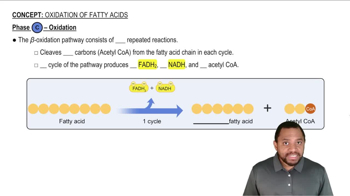
Oxidation of Fatty Acids Concept 3

Hexanoic Acid

Hexanoic acid, also known as caprylic acid, is a medium-chain fatty acid with six carbon atoms. It is significant in metabolism because it can be rapidly oxidized for energy compared to long-chain fatty acids. Understanding its structure and properties is essential for analyzing its oxidation pathway, as the length of the carbon chain influences the enzymes and processes involved in its breakdown.
추천 영상:
가이드 코스
2:26
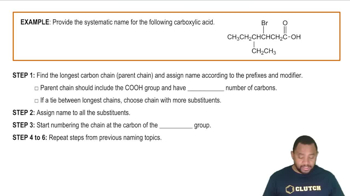
IUPAC Rules for Naming Carboxylic Acids Example 1

Beta-Oxidation Pathway

The beta-oxidation pathway is a series of enzymatic reactions that degrade fatty acids into acetyl-CoA units. Each cycle of beta-oxidation involves four main steps: oxidation, hydration, another oxidation, and thiolysis. For hexanoic acid, this pathway will yield three cycles of beta-oxidation, producing two molecules of acetyl-CoA and generating reducing equivalents in the form of NADH and FADH2, which are vital for ATP synthesis in the electron transport chain.
추천 영상:
가이드 코스
02:32
Characteristics of Beta Particles