Ch.3 Matter and Energy
Timberlake - Chemistry: An Introduction to General, Organic, and Biological Chemistry 14th Edition
Timberlake14th EditionChemistry: An Introduction to General, Organic, and Biological ChemistryISBN: 9781292472249당신이 사용하는 게 아니라요?교과서 변경
3장, 문제 29

If the same amount of heat is supplied to samples of 10.0 g each of aluminum, iron, and copper all at 15.0 °C, which sample would reach the highest temperature (see TABLE 3.11)?

검증된 단계별 안내
1
Step 1: Understand the relationship between specific heat capacity and temperature change. The specific heat capacity (c) of a substance determines how much heat (q) is required to change the temperature of a given mass (m) of the substance by a certain amount (ΔT). The formula is q = m * c * ΔT.
Step 2: Recognize that the same amount of heat (q) is supplied to each sample. Since the mass (m) of each sample is the same (10.0 g), the temperature change (ΔT) will depend on the specific heat capacity (c) of each metal. Metals with lower specific heat capacities will experience a greater temperature change for the same amount of heat.
Step 3: Refer to the specific heat capacities of aluminum, iron, and copper from Table 3.11 (not provided in the image). Compare the values of specific heat capacity for these metals. Identify which metal has the lowest specific heat capacity.
Step 4: Use the relationship ΔT = q / (m * c) to confirm that the metal with the lowest specific heat capacity will reach the highest temperature when the same amount of heat is supplied.
Step 5: Conclude that the metal with the lowest specific heat capacity from Table 3.11 will reach the highest temperature. Ensure you understand the concept that lower specific heat capacity means less heat is required to increase the temperature of the substance.

비슷한 문제에 대한 검증된 영상 답변:

이 영상 해법은 위 문제에 도움이 된다고 튜터들이 추천한 것입니다.
영상 길이:
1m

주요 개념

질문에 올바르게 답하기 위해 반드시 이해해야 하는 핵심 개념들은 다음과 같습니다.

Specific Heat Capacity

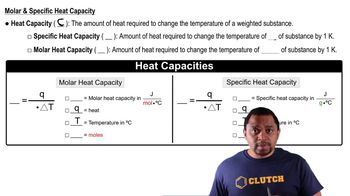
Specific heat capacity is the amount of heat required to raise the temperature of one gram of a substance by one degree Celsius. It is a crucial property that varies among different materials, influencing how quickly they heat up or cool down when subjected to the same amount of heat. Metals with lower specific heat capacities will experience a greater temperature increase when the same amount of heat is applied.
추천 영상:

Heat Transfer

Heat transfer refers to the movement of thermal energy from one object or substance to another due to a temperature difference. In this context, when equal heat is supplied to different metals, the rate at which each metal's temperature increases depends on its specific heat capacity. Understanding heat transfer is essential for predicting how different materials respond to thermal energy.
추천 영상:

Thermal Equilibrium

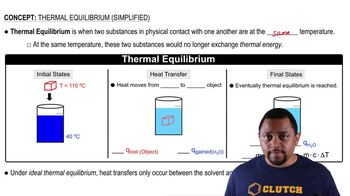
Thermal equilibrium is the state reached when two objects at different temperatures come into contact and exchange heat until they reach the same temperature. In the scenario presented, once heat is supplied to the aluminum, iron, and copper samples, they will eventually reach thermal equilibrium, but the rate at which they do so will depend on their specific heat capacities, affecting which sample reaches the highest temperature first.
추천 영상:
가이드 코스
02:13
Thermal Equilibrium (Simplified) Concept 1