Ch.3 Matter and Energy
Timberlake - Chemistry: An Introduction to General, Organic, and Biological Chemistry 14th Edition
Timberlake14th EditionChemistry: An Introduction to General, Organic, and Biological ChemistryISBN: 9781292472249당신이 사용하는 게 아니라요?교과서 변경
3장, 문제 33c

Use the heat equation to calculate the energy, in joules and calories, for each of the following (see TABLE 3.11):
c. lost when 15.0 g of ethanol, C2H6O, cools from 60.5 °C to −42.0 °C

검증된 단계별 안내
1
Step 1: Identify the heat equation to use: \( q = m \cdot c \cdot \Delta T \), where \( q \) is the heat energy, \( m \) is the mass, \( c \) is the specific heat capacity, and \( \Delta T \) is the change in temperature.
Step 2: Determine the values given in the problem: \( m = 15.0 \; \text{g} \), \( \Delta T = T_{\text{final}} - T_{\text{initial}} = -42.0 \; ^\circ\text{C} - 60.5 \; ^\circ\text{C} \), and the specific heat capacity of ethanol (not methanol) must be obtained from a reliable source, as the table provided does not include ethanol.
Step 3: Calculate \( \Delta T \): Subtract the final temperature from the initial temperature to find the temperature change. Ensure the sign is correct, as cooling results in a negative \( \Delta T \).
Step 4: Substitute the values into the heat equation for both joules and calories. Use the specific heat capacity in \( \text{J/g} \cdot ^\circ\text{C} \) for joules and \( \text{cal/g} \cdot ^\circ\text{C} \) for calories.
Step 5: Perform the calculations separately for joules and calories to find the energy lost. Ensure unit consistency throughout the calculation.

비슷한 문제에 대한 검증된 영상 답변:

이 영상 해법은 위 문제에 도움이 된다고 튜터들이 추천한 것입니다.
영상 길이:
6m

주요 개념

질문에 올바르게 답하기 위해 반드시 이해해야 하는 핵심 개념들은 다음과 같습니다.

Heat Equation

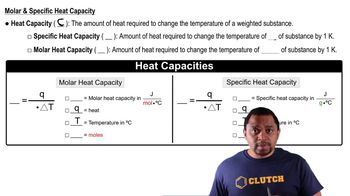
The heat equation is a formula used to calculate the amount of heat energy absorbed or released by a substance when its temperature changes. It is expressed as Q = mcΔT, where Q is the heat energy, m is the mass of the substance, c is the specific heat capacity, and ΔT is the change in temperature. This equation is fundamental in thermodynamics and helps in understanding energy transfer in physical processes.
추천 영상:

Specific Heat Capacity

Specific heat capacity is a property of a substance that indicates the amount of heat required to change the temperature of one gram of the substance by one degree Celsius. It varies between different materials and is crucial for calculating heat transfer. In this case, the specific heat capacity of ethanol will be needed to determine the energy lost as it cools from 60.5 °C to −42.0 °C.
추천 영상:

Energy Conversion (Joules to Calories)

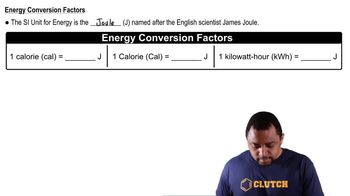
Energy conversion between joules and calories is important in thermodynamics, as these units measure energy in different contexts. One calorie is equivalent to approximately 4.184 joules. When calculating energy changes, it may be necessary to convert between these units to provide results in the desired format, such as joules for scientific contexts or calories for nutritional contexts.
추천 영상:
가이드 코스
01:14
Nature of Energy