 뒤로
Bone Development, Growth, and Remodeling
스터디 가이드 - 스마트 노트
 자료에 맞춘 맞춤형 노트, 핵심 정의, 예시, 맥락을 확장해 제공합니다.
Bone Development
Embryonic and Fetal Bone Formation
Bone development begins in the embryo and continues through adulthood. The process involves the transformation of cartilage into bone, a process known as ossification.
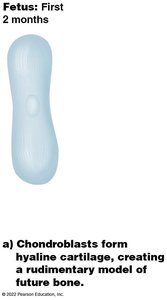
Embryo (First 2 months): Chondroblasts produce hyaline cartilage, forming a rudimentary model for future bones.
Fetus (2–3 months): The periosteum and blood vessels begin to develop. Cartilage starts to dissolve, and blood vessels transport osteoblasts into the area.
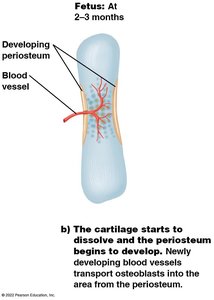
Ossification: Chondroblasts die, and the matrix breaks down. Blood brings osteoblasts to the site, which secrete proteins (osteoid) and enzymes to facilitate the production of hydroxyapatite, the mineral component of bone. Osteoblasts eventually become embedded in the matrix as osteocytes.
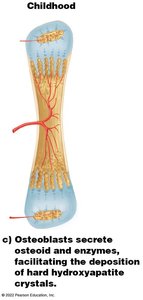
Childhood and Adolescence: Bone Growth
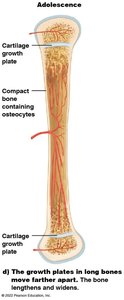
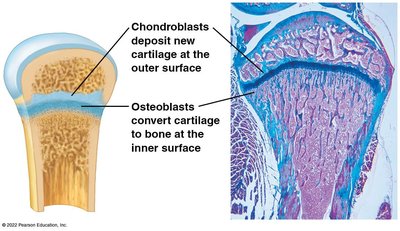
Bone growth is regulated by hormones and occurs at the epiphyseal plate (growth plate) located at each end of long bones.
Epiphyseal Plate: Chondroblasts produce new cartilage at the outer surface, while osteoblasts convert cartilage to bone at the inner surface. This process lengthens the bone as the two epiphyseal plates move apart.
Bone Remodeling
Bone Remodeling Process
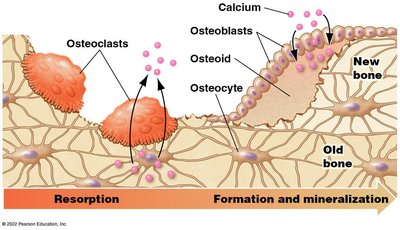
Bone remodeling is the continuous process of removing mature bone (resorption) and creating new bone. It is regulated by calcium levels and mechanical stress.
Osteoclasts: Specialized cells that break down bone by secreting enzymes to dissolve hydroxyapatite and digest the osteoid matrix. Calcium and phosphate ions are released into the blood.
Osteoblasts: Attracted to areas of resorption, they deposit new hydroxyapatite crystals and osteoid matrix, forming new bone.
Osteocytes: Mature bone cells embedded in the matrix, maintaining bone structure.
Bone Remodeling & Mechanical Stress
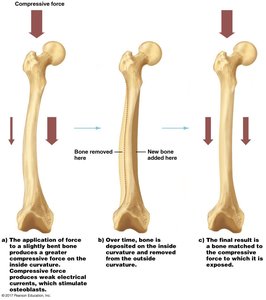
Bone adapts to mechanical stress by remodeling its shape and size. Areas exposed to high compressive stress develop more bone, while areas with low stress lose bone.
Compressive Force: Weight-bearing exercises increase bone mass and strength. Bone is deposited where compressive force is greatest and removed from areas with less force.
Bone Cells and Their Functions
Classification of Bone Cells
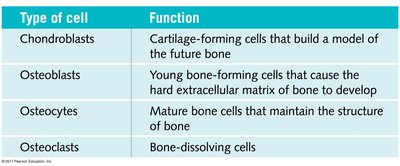
Bone tissue contains several specialized cell types, each with distinct functions.
Type of cell | Function |
|---|---|
Chondroblasts | Cartilage-forming cells that build a model of the future bone |
Osteoblasts | Young bone-forming cells that cause the hard extracellular matrix of bone to develop |
Osteocytes | Mature bone cells that maintain the structure of bone |
Osteoclasts | Bone-dissolving cells |
Hormonal Regulation of Bone Growth
Calcitonin and Parathyroid Hormone
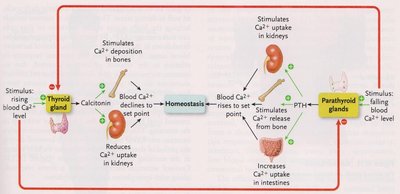
Bone growth and remodeling are regulated by hormones that maintain calcium homeostasis.
Calcitonin: Secreted by the thyroid gland when blood calcium levels rise. Stimulates osteoblast activity and inhibits osteoclasts, promoting calcium deposition in bones and reducing calcium absorption in intestines and kidneys.
Parathyroid Hormone (PTH): Secreted by the parathyroid gland when blood calcium levels fall. Stimulates osteoclasts to release calcium from bones, increases calcium absorption in kidneys and intestines, and promotes vitamin D production. Excessive PTH can lead to bone demineralization and osteoporosis.
Key Equations
Hydroxyapatite Formation:
Calcium Homeostasis:
Summary
Bone development is a complex process involving the transformation of cartilage into bone, regulated by specialized cells and hormones. Bone remodeling ensures adaptation to mechanical stress and maintenance of calcium homeostasis, which is essential for overall skeletal health.
