 뒤로
Dividing Polynomials: Long Division, Synthetic Division, and Remainder Theorem
스터디 가이드 - 스마트 노트
 자료에 맞춘 맞춤형 노트, 핵심 정의, 예시, 맥락을 확장해 제공합니다.
Q1. Divide: (12x^5 + 4x^4 - 12x^2 - 4x) ÷ (3x + 1)
Background
Topic: Polynomial Long Division
This question tests your ability to divide a polynomial by a binomial using long division. This is a fundamental skill in Intermediate Algebra, especially when simplifying expressions or solving equations.
Key Terms and Formulas
Dividend: The polynomial being divided,
Divisor: The binomial
Quotient: The result of the division
Remainder: Any leftover part after division
Step-by-Step Guidance
Arrange the dividend and divisor in standard form, making sure all powers of are present (add zero coefficients if needed).
Divide the leading term of the dividend () by the leading term of the divisor () to get the first term of the quotient.
Multiply the entire divisor by this first term and subtract the result from the dividend.
Bring down the next term from the dividend and repeat the process: divide, multiply, subtract.
Continue this process until all terms have been brought down and divided. Stop before calculating the final remainder.
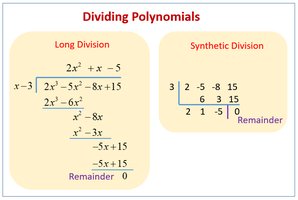
Try solving on your own before revealing the answer!
Final Answer:
The quotient is and the remainder is $0$.
This means the division is exact, and the polynomial divides evenly by the binomial.
Q2. If a polynomial is divided by x - 6, the quotient is 2x^2 + 4x - 3 and the remainder is 7. Find the original polynomial.
Background
Topic: Polynomial Division and Remainder Theorem
This question tests your understanding of how to reconstruct the original polynomial from its quotient and remainder after division by a linear binomial.
Key Terms and Formulas
Quotient:
Divisor:
Remainder: $7$
Original Polynomial:
Step-by-Step Guidance
Recall the division algorithm for polynomials: .
Substitute the given quotient and remainder into the formula.
Expand using the distributive property.
Add the remainder $7$ to the expanded expression to get the original polynomial.
Stop before combining like terms for the final polynomial expression.
Try solving on your own before revealing the answer!
Final Answer:
The original polynomial is .
This is found by expanding and combining like terms after applying the division algorithm.
